

AMD Ryzen AI Halo review: AMD builds a DGX Spark of its own
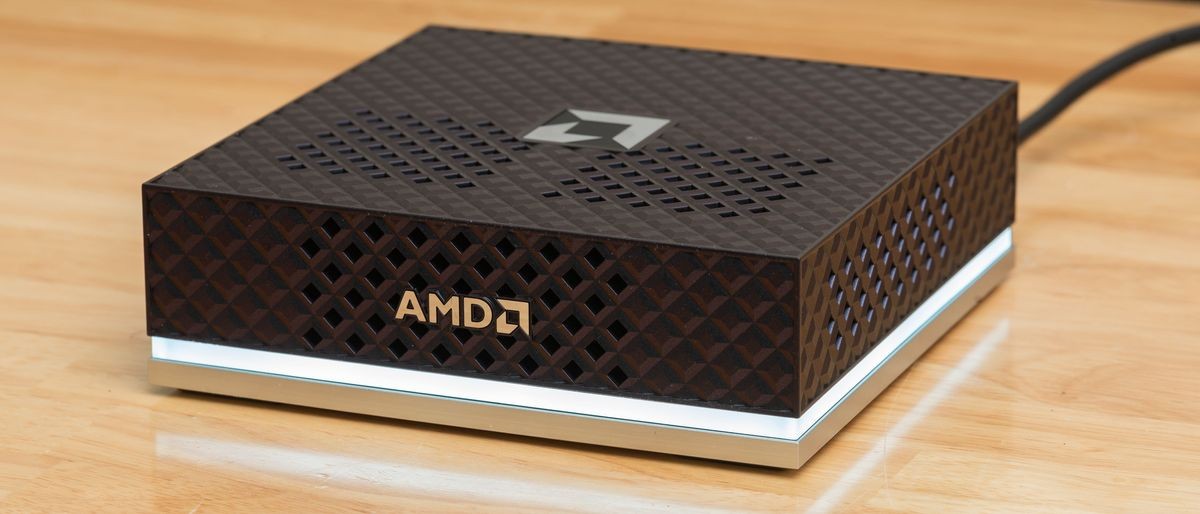
The Ryzen AI Halo lives up to its promise as a turn-key local AI platform within AMD’s AI ecosystem, and it comes with helpful docs and useful software to get you rolling quickly. But its performance trails DGX Spark and GB10 boxes, and it’s not much cheaper than those systems.
Pros
- +
Takes all the guesswork out of setting up a Strix Halo box for local AI
- +
Included software and playbooks get you moving quickly
- +
Provides a direct line to AMD software updates
- +
x86 platform lets you run Windows and Windows apps easily if needed
Cons
- -
AI performance and software compatibility still trails Nvidia GB10 platform
- -
Playbooks and documentation could use more refinement
- -
Pre-installed software could sometimes be more logically configured
- -
At $3,999, you’re not that far off from a faster, more refined GB10 box
Why you can trust Tom's Hardware Our expert reviewers spend hours testing and comparing products and services so you can choose the best for you. Find out more about how we test.
Nvidia's DGX Spark and its GB10 SoC have set the template for what a purpose-built local AI developer sandbox should be. The combination of a standardized hardware platform with robust first-party software support and thorough documentation lets those curious about local AI get up and running faster than buying a bare-metal box and building everything up from scratch, especially in the rapidly evolving AI space.
AMD's Ryzen AI Max+ 395, aka Strix Halo, SoC, is the best x86 spoiler for GB10 so far. It has the same 128GB of unified memory, a powerful 16C/32T Zen 5 CPU, and a Radeon 8060S integrated GPU with 2560 RDNA 3.5 stream processors. It also has an AMD XDNA 2 NPU for those who want to experiment with that accelerator in addition to the general-purpose Radeon GPU. And it can run Windows and Windows apps natively, whereas GB10 boxes are Linux-only for now.
AMD's partners have been building around this hardware for about a year and a half, and it's a well-known quantity at this point. But once you have that hardware in hand, setting it up for AI workloads involves digging through scattered GitHub pages, Reddit threads, and AMD official documentation to get all the software pieces lined up right for the best performance and compatibility.
AMD is trying to change all that today with the launch of the Ryzen AI Halo, a first-party, turn-key Strix Halo mini-PC that puts local AI first. This system can be had with Windows or Linux, and at least in the Linux form we're testing today, it comes preloaded with the full AMD ROCm software stack and an assortment of applications you need to immediately start generating tokens with your preferred model.
And on the support side, AMD has taken a page directly out of Nvidia’s book and cooked up an entire set of its own playbooks that cover various local AI applications and usage scenarios with the AI Halo (and Strix Halo systems more generally) to serve as a springboard for local AI explorers.
The grand tour
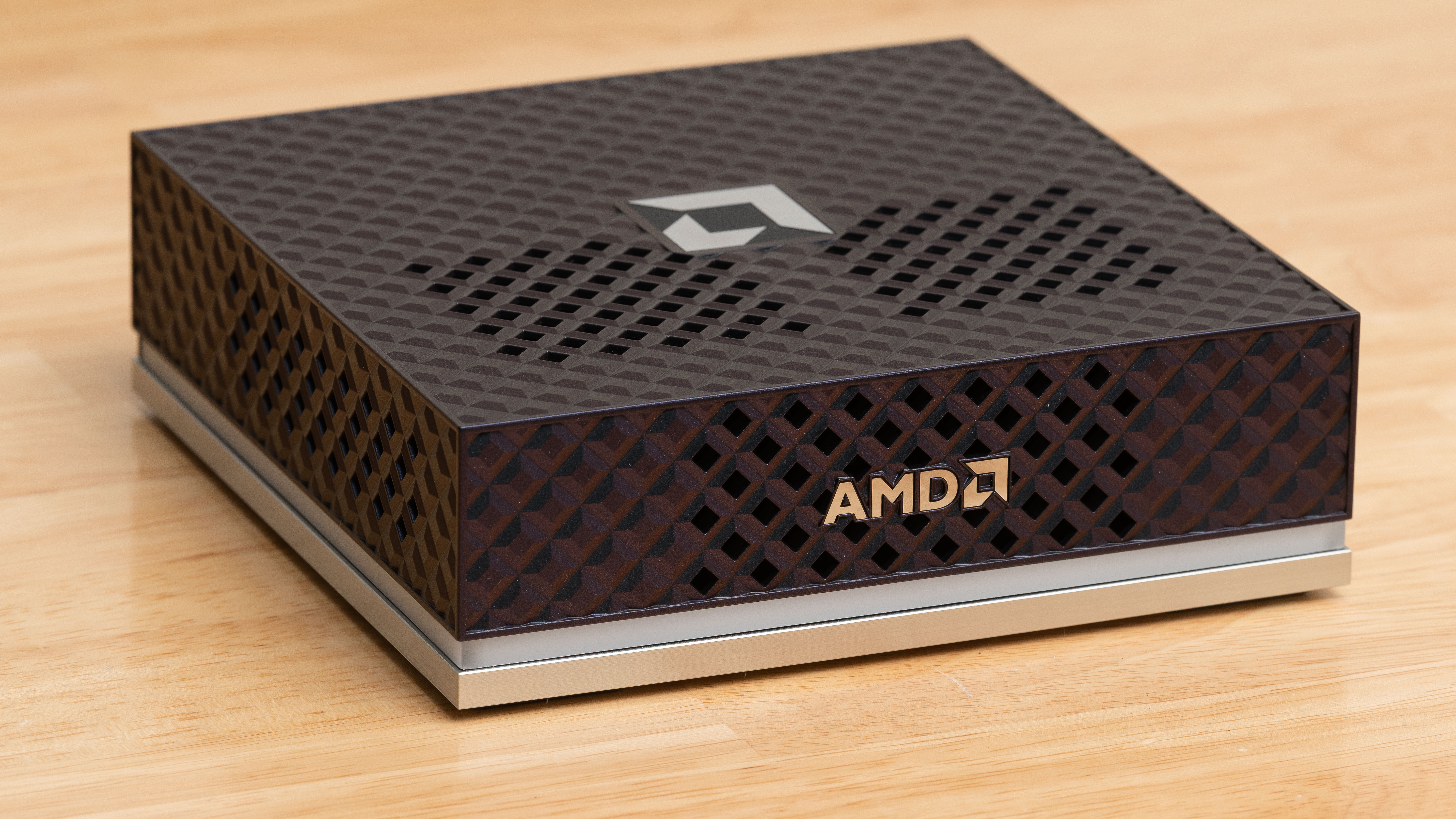
The AI Halo comes wrapped in a plastic shell with a subtly color-shifting finish. It's got a large light bar ringing its front and sides that indicates system status. White means it's awake, while a pulsing blue indicates that it's asleep, assuming you allow it to suspend at all. Red indicates a fault. If you find the LED strip distracting, you can just turn it off using the preinstalled AI Developer Center app.
The AI Halo has air intakes on its top and sides, and AMD cautions that you shouldn't block any of these intakes. If you're running by the book, that means this system is less flexible than it could be for space-constrained or multi-node home lab setups, where turning the unit on its side would allow for valuable space savings.
Stay On the Cutting Edge: Get the Tom's Hardware Newsletter
Get Tom's Hardware's best news and in-depth reviews, straight to your inbox.
Enterprising community members will likely design and share 3D-printed spacers and risers to get around these limitations, but for a device that is presumably meant to be used in home labs and production environments, the lack of flexibility in orientation is a small but annoying oversight.
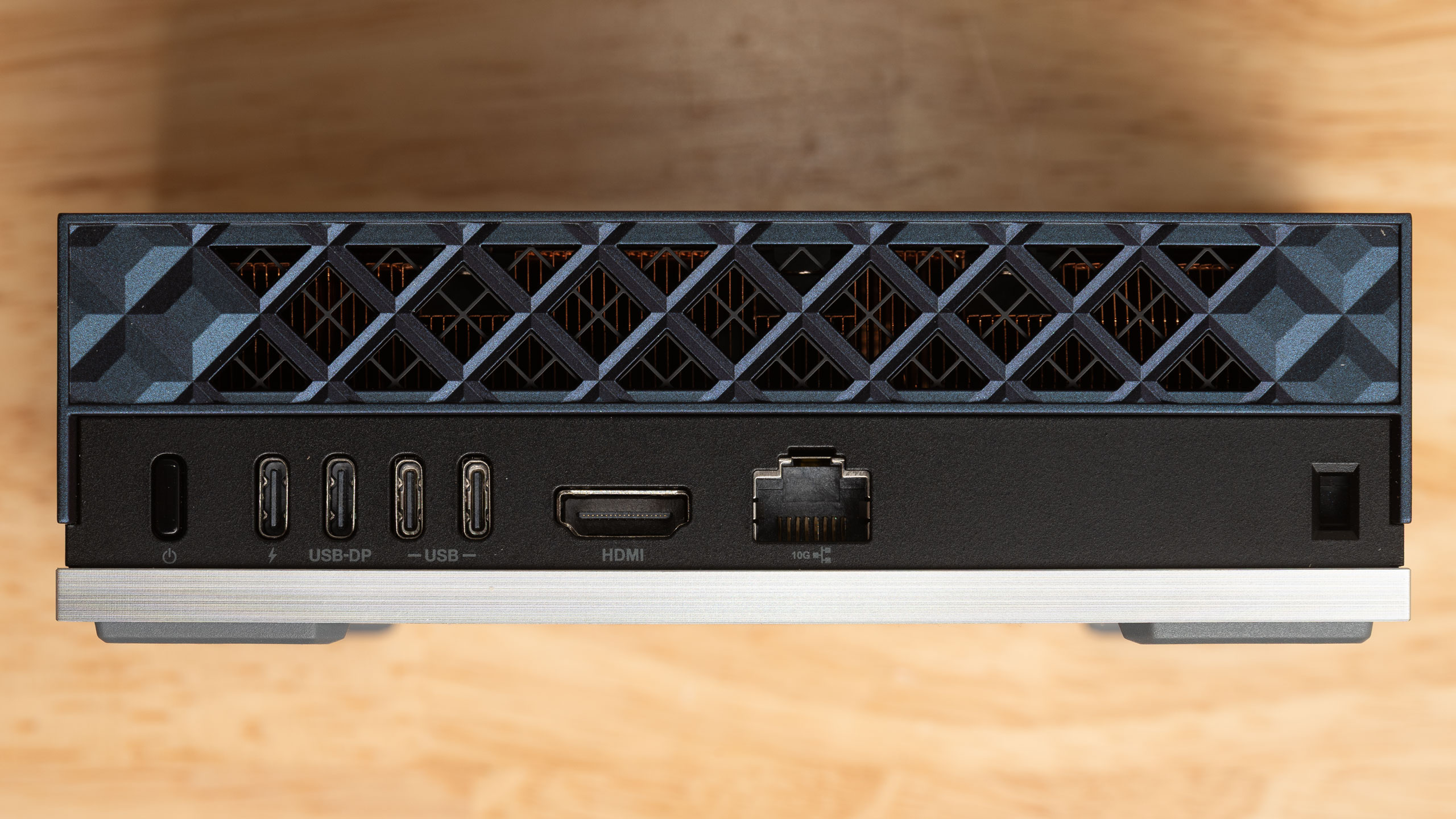
Around back, the AI Halo has the same trio of USB Type-C ports you'll find on Nvidia GB10 boxes, plus one more for power input with the included 240W brick. The port closest to the power plug runs at “USB 3.2” speeds, while ports 3 and 4 are higher-speed USB 4. These ports are all DisplayPort Alt Mode compatible, or you can use the HDMI 2.1 port for display output if you prefer.
For wired networking, the AI Halo offers a 10 Gigabit Ethernet port. That’s certainly fast, and AMD has written a clustering playbook for multiple AI Halos using that interface, but it’s in a whole other league compared to the 200Gbps ConnectX-7 NIC on the DGX Spark and its ilk.
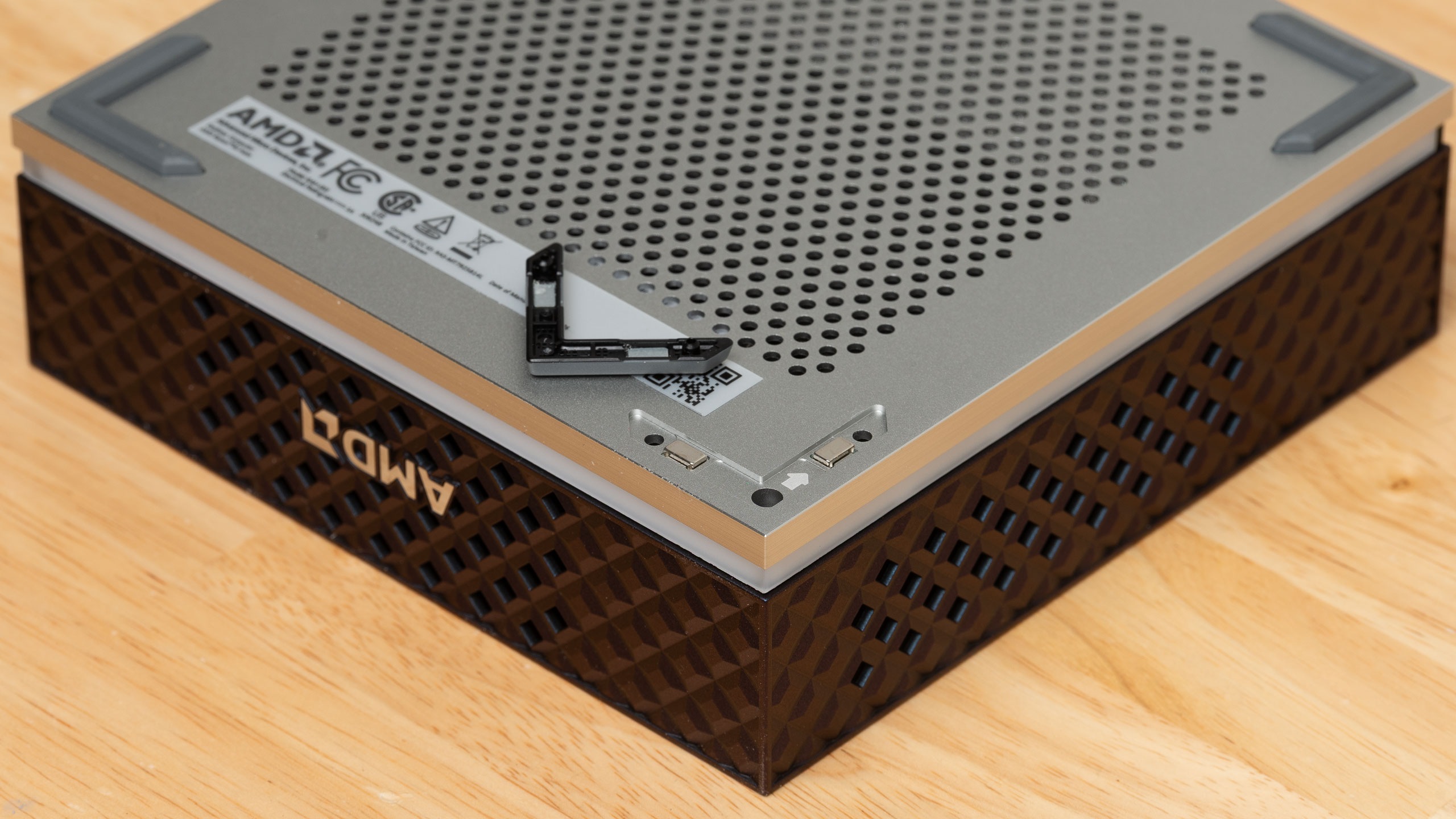
We didn't want to strip our AI Halo all the way down to its guts, but each of the four rubber feet on the bottom of the system is secured with a pair of tiny magnets, and they conceal the four screws you presumably need to remove to get further inside.
Here’s a quick look at this system’s specs:
Swipe to scroll horizontally
CPU | AMD Ryzen™ AI Max+ 395 Processor — 16 cores, 32 threads, “Zen 5” architecture |
GPU | AMD Radeon™ 8060S Integrated Graphics |
NPU | AMD XDNA™ 2 NPU |
SoC TDP | 120W |
Memory | 128GB LPDDR5X, 8000 MT/s, 256GB memory bandwidth |
Storage | 2TB NVMe SSD |
USB | 3x USB-C ports (one USB 3.2 Gen 2, two USB 4), 1x USB-C for power input |
Networking | 1x 10 Gigabit Ethernet Wi-Fi 7 Bluetooth 5.4 |
Display outputs | USB-C DisplayPort Alt Mode HDMI 2.1 |
Operating system | Linux (customized Debian) or Windows 11 |
Dimensions | 150 x 150 x 45.4 mm (5.9 x 5.9 x 1.79 in) |
Amid the ongoing RAMpocalypse and NANDpocalyse, no Ryzen AI Max+ 395 system with 128GB of RAM and a large SSD is cheap, assuming you can find a 128GB config in stock anywhere.
Even against that backdrop, the $3999 price tag for the AI Halo that we’re testing today is a pricey proposition. That sticker puts it at the low end of Nvidia GB10 systems like the Asus Ascent GX10 (albeit in its 1TB config).
Our past testing of Strix Halo versus GB10 for local AI workloads has decisively put Nvidia’s platform on top, so this is a potentially awkward place for the AI Halo to land. Let’s dig in and find out if anything has changed.
- MORE: Best Graphics Cards
- MORE: GPU Benchmarks and Hierarchy
- MORE: All Graphics Content

As the Senior Analyst, Graphics at Tom's Hardware, Jeff Kampman covers everything that has to do with graphics cards, gaming performance, and more. From integrated graphics processors to discrete graphics cards to the hyperscale installations powering our AI future, if it's got a GPU in it, Jeff is on it.
What's Your Reaction?
 Like
0
Like
0
 Dislike
0
Dislike
0
 Love
0
Love
0
 Funny
0
Funny
0
 Wow
0
Wow
0
 Sad
0
Sad
0
 Angry
0
Angry
0










Comments (0)