

Why the Podracing Sequence in ‘The Phantom Menace’ Epitomizes the Very Best of What Prequels Can Be
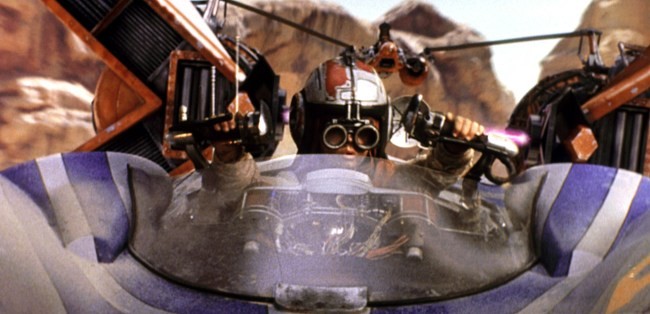

IndieWire’s desks are arranged as part of an open-plan office, and sometimes our fine colleagues at [redacted non-entertainment PMC brand] like to talk to each other about movies. I don’t think they realize that Ben Travers, Ryan Lattanzio, IndieWire video producer Trevor Wallace, and I are in earshot. We’re exactly as quiet and nerdy and awkward as you’d expect IndieWire writers to be, and we have yet to intervene as they debate the merits of 70mm IMAX (“So what, do you just see more trees?”) or the forces of industry consolidation and changing models of distribution that funnel so many script ideas into limited series as opposed to features (“I feel like there’s only three good movies a year and I’ve already seen them”).


The other day, though, they were talking about the “Star Wars” prequels and one of these non-entertainment sorts said something very perceptive: that “The Phantom Menace” was worth it because the Nintendo 64 podracing game, 1999’s “Star Wars Episode I: Racer,” rules. Which is true. That game rules.
Bear with me here.
Sequels, in so many respects, have the luxury of getting to be open worlds. They are set in familiar landscapes with characters that we love, yes, but their forward trajectory is unwritten. Characters can wind up anywhere, from a different town to a different universe to prison. They have saved the world, perhaps, but it always needs saving again — if not always from the same person, as “Star Wars” itself would do well to remember. Maybe they have worked out some emotional Gordian Knot through the extraordinary circumstances of the first film, but that’s not how life works. Someone from their past can always step back in, upend that settled life, and make them late for the airport.
There’s something that comes with open worlds that bad sequels always fumble, and that can take the gas right out of ailing franchises. Because the narrative can be anything, and go anywhere, there is a tendency for character arcs to echo the previous films, if they’re present at all. For Tony Stark or John McClane to learn the same lesson about needing to let the people they love more fully into their lives. For Chris Pratt to… tame more dinosaurs, I guess? The exception that proves the rule is, perhaps, how Dom Torretto never re-learns the lesson that La Familia is what livin’ life one quarter mile at a time is all about, but he demonstrates it again and again by crashing cars at increasingly high speeds from increasingly improbable heights.
Which is all to say that too much emotional repetition, too many beats of trying to mine the same old character dynamics and too many instances of stuffing in references for the Rick Dalton Pointing Meme, and it doesn’t matter how open a world is at all. It feels stale.
Prequels have the opposite problem. Dramatic irony hangs low and menacing as a storm cloud over stories when we know where the characters are going to end up, and whether what they’re struggling with will ultimately matter. The existing plot is an enemy that must be combated head-on, and it doesn’t matter how much of a Chosen One story it is. The original will always have the high ground, Anakin. Bad prequels do the same thing as bad sequels: they try and emotionally echo what’s come before. They lean so far into the Lore™ they end up in the lava.
Put another way, if you have, say, a couple of detectives bustling around the “Titanic,” it’s kinda neat that we’re ambiently aware of the fact that there’s a finite clock for them to being able to solve a murder mystery. But if they’re being like, “I do believe we are sailing too fast!” or “Hmm, I’m not sure the steel plates of the hull wouldn’t buckle under pressure!” that also wrecks our suspension of disbelief. The more a story engages with its original, the less allows us to relate to the story and the characters on their own terms. But also it has to engage with its original, and if it’s using original characters, their emotional trajectory has also been set.
Good prequels, and they are out there, get around this in ways that sequels can learn from, too. There is a Tony Gilroy quote about how entering an established fictional universe is like jumping into a sandbox. As a fan, you are excited to play with the toys that are already in there. But as a storyteller, your job is to leave more new toys in the sandbox when you’re done than were there when you started. To appropriate a phrase, this is podracing.
More importantly, this is “Duel of the Fates.” This is the Aldhani heist in “Andor” and the Fury Road in “Furiosa.” It’s Kim Wexler and her indomitable ponytail in “Better Call Saul.” It’s Adonis Creed having 21st century traumas he needs to punch his way through, as opposed to Rocky Balboa’s very ‘70s-coded angst. It’s Joe Manganiello dancing to “I Want It That Way.” New characters, new tones, new kinds of conflicts: they can all exist within the same (fictional) historical timeline. These are how you bring new toys to the sandbox.
And the thing about cool new toys, as the little prequel montage inside of “Up” teaches us, is that if they matter to us, then the things the characters care about are going to matter, and the adventures they go on will matter, and it will make the original story matter more, too. Introducing a terrifying KGB agent or constructing the lushest cinematography around Robert De Niro is how prequels get around the problem of a closed world. But it’s also how the best sequels keep theirs open.
What's Your Reaction?
 Like
0
Like
0
 Dislike
0
Dislike
0
 Love
0
Love
0
 Funny
0
Funny
0
 Wow
0
Wow
0
 Sad
0
Sad
0
 Angry
0
Angry
0



Comments (0)