

Andrew Scott Knew How to Play Hamlet, but ‘Elsinore’ Required Him to Channel Another Actor
You’ve heard the drumbeats about Andrew Scott’s performance in “Elsinore.” The true story about British actor Ian Charleson’s last performance as Hamlet world-premiered in Telluride over Labor Day weekend to mostly raves, and it screens in Toronto on September 14. While there’s always a lot of noise this time of year, Scott may finally land that Oscar that has been eluding him. Maybe not enough people saw Andrew Haigh’s heartbreaking “All of Us Strangers” (2023) or his supporting stint as Richard Rodgers in last year’s “Blue Moon.” Fact is, Scott’s most lauded work has been in television and theater, from “Fleabag” and “Ripley” to “Vanya.”


And over the years, he told me in Telluride that he has played Hamlet more than any other character. He once played a three-hour-and-50-minute version of “Hamlet” eight times a week. “Once you play that part, everything else is a walk in the park,” he said. “That’s the great training of it.”
So he understood what an athletic and intellectual feat it was for “Chariots of Fire” star Ian Charleson, back in 1989, to play the role at the National Theatre while fighting complications from HIV. “You’ve got 1,500 lines,” he said. “He’s got the most actual lines to learn in any Shakespeare character, I think, apart from Iago, and then you’re the Prince, and you’re the grieving son, and you’re the lover. And then in the third act, you have to do a sword fight. I mean, that’s fucking mental. It’s crazy.”
In some ways, “Elsinore” functions like a sports movie. “Is he going to be able to do it?” said Scott. “And we see rehearsal. It doesn’t seem like a polite enterprise. It’s tough. It takes it out of you. I was like Bambi afterwards. It messes with you. Even the sound of your own voice, and he was playing it in the Olivier, which is an enormous theater. So the fact that he did it is absolutely extraordinary, and that people warned him against it is also very understandable. When you get offered to play Hamlet in one of the most famous theaters in the world, that’s life. That’s not death. That’s life.”
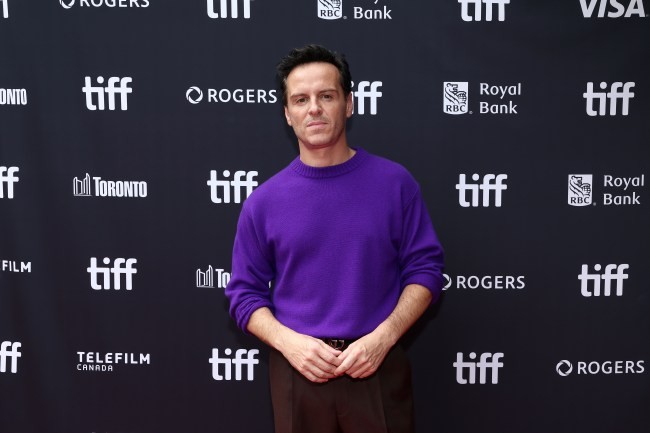
 ‘Elsinore’ star Andrew Scott at the Telluride Opening Day BrunchAnne Thompson
Olivia Coleman plays Dr. Margaret Johnson, the groundbreaking AIDS doctor who reluctantly helps Charleson get through the grueling rehearsals and performances while struggling with the ups and downs of chronic illness. And Johnny Flynn plays the theater director who sticks by his man even while he’s worried about his ability to go on. “It’s about life or death,” said Scott, who had to be ready with the odd soliloquy at a moment’s notice. “And so we went through it: what are the parts in it that directly correlate with Ian’s life? There’s a line: ‘I see the imminent death of 20,000 men who for a fantasy and trick of fame go to their beds like graves.’ It moves me every time. That’s written 400 years ago.”
Playing Shakespeare was a lifeline for Charleson, even as he was dying. “The governments refused to do anything to help these people,” said Scott. “It was for Ian such an escape from the tedium of being sick, as well. Some of his friends spoke about the waiting rooms and the endless blood tests. He used to get his tests in the morning, and then he would go to rehearsal afterwards, and so you’d have something creative. It’s alive, it’s literally living. I know that feeling myself in a rehearsal room. It’s like a world away from the world.”
 ‘Elsinore’Anthony Dickenson/ © 2026 FOCUS FEATURES LLC
The tricky thing for Scott was to unshackle his old interpretation of the role. “That was difficult to unlearn,” he said, “what my version of it would be. And to try and imagine when you’re talking about ‘to be or not to be, to live or to die,’ when you feel like it could be a matter of weeks or months before that really is the undiscovered country from which no traveler returns.”
In the movie, Charleson states: “I’d rather die of Hamlet than AIDS.”
Over the course of the film, we see Charleson go through stages. He wants to extend his life as he watches his friends fall by the wayside. “There’s some beautiful photography from the time of family members or lovers or friends just being in the bed,” said Scott, “with these usually boys in their 20s or 30s or 40s, young people, I always find them very, very moving. There’s a correlation between the support that he received as a patient, and the support of actors, and the notion of a company of people who aren’t mawkish. Ian was a funny fucker. He wanted to live, and that was important, to have those moments where you’re not wallowing in it.”
Good old-fashioned human denial is part of the journey. “You have to understand that when we get to die,” said Scott, “my experience of human beings, for the most part, is that if you get a diagnosis or something bad happens, you go, ‘Well, at least we caught it early.’ Human beings, it’s true, you break your leg, and we go, ‘Well, it could have been worse. You could have broken your back.’ That’s what we actually do. That spirit I always find moving. That’s why it’s moving, because he was always reaching. So when he’s vomiting on the side of the stage, he’s like, ‘OK, let’s move on.'”
It wasn’t easy to finance this movie, which Focus Features picked up. “‘All of Us Strangers’ is also about grief in a way,” said Scott. “And was the last film that my mom saw; my mom died two years ago. When you’re going through grief, it gives you energy in some ways. So in getting the funding for the film and talking about it and pitching it to people, you do have a nothing-to-lose vibe.”
Scott, 49, grew up in a Catholic family in Dublin and missed the height of the ’80s AIDS crisis. “I lived in the shadow of it,” he said, “and the insidious nature of the prejudice against people, and the opportunity, perhaps, that something that I’ve related to, of being in the movies if you were a gay person, there was shame. I couldn’t say that was particularly spoken about, but there was something underneath. There weren’t many examples of people in the industry that were allowed to be there.”
In the film, Charleson and his friend Derek Jarman argue over whether to open up about his situation and go public for the cause. “I find that upsetting that gay people are turning on each other,” Scott said, “when actually they’re not the enemy, but they’re trying to work out how to politicize themselves: ‘what is the way out of this?’ Do you try and dampen down yourself in order to fit into the mainstream, or do you radicalize yourself?”
Next up: Scott just finished working with Oscar-winner Justine Triet (“Anatomy of a Fall”) on the psychological thriller “Fonda,” co-starring Allison Janney, Mia Goth, and Cherry Jones. He also co-starred with Emily Blunt on location in Ireland on John Curley’s adaptation of Claire Keegan’s “Walk the Bluefields.” He wants to “chill,” he says. If I’m not mistaken, he may find himself on the award circuit.
Focus Features releases “Elsinore” in theaters starting November 20.
What's Your Reaction?
 Like
0
Like
0
 Dislike
0
Dislike
0
 Love
0
Love
0
 Funny
0
Funny
0
 Wow
0
Wow
0
 Sad
0
Sad
0
 Angry
0
Angry
0







Comments (0)