

Why a Silver Card Fixed a Reflection That White Paper Couldn't
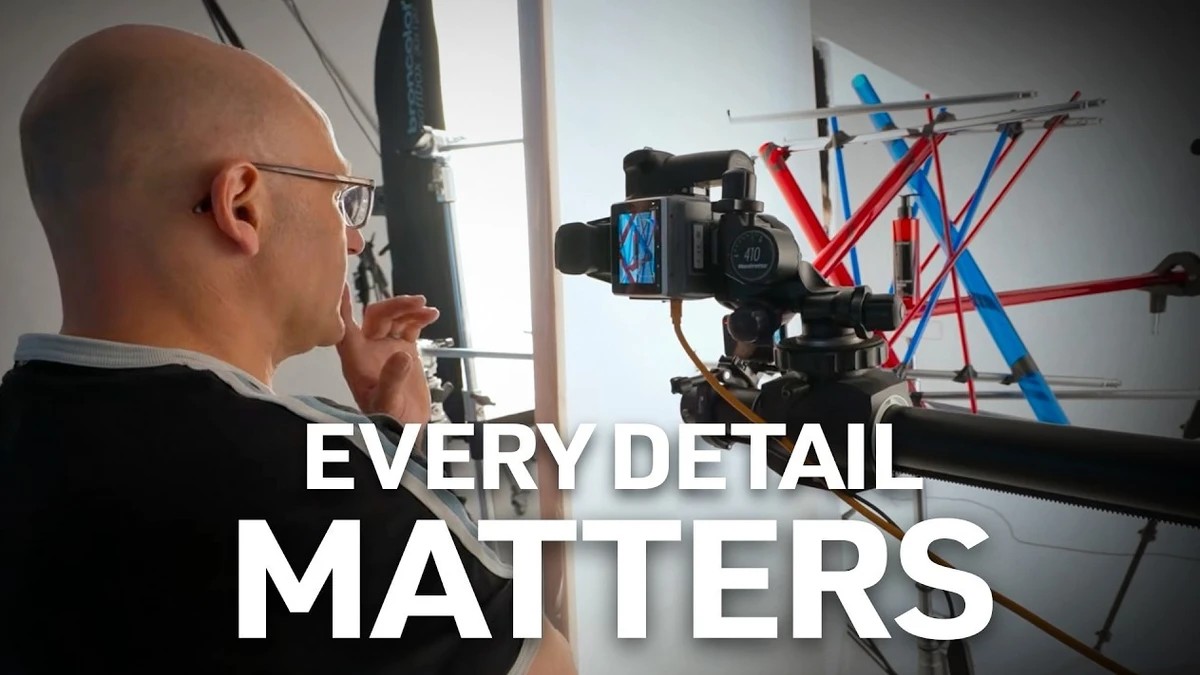
Acrylic rods under studio light look a lot like smooth, healthy hair, which makes them a smart prop for photographing a Total Results haircare bottle. The problem is that a glossy bottle behaves like a mirror, and every rod you bring into the set wants to show up across the label.
Karl Taylor of Visual Education sets the bottle on red and black acrylic rods against pure white, with a plan to wrap more rods around it like strands of repaired hair. His first light goes through a scrim, and it comes mostly from behind the product, so the label stays readable. Then he has the light pulled toward the end of the scrim, and the look changes. Because the light now runs right to the scrim's edge and stops, you get a hard cutoff on one side instead of a soft falloff on both, and that crisp edge reads as gloss. It also drops a bright line straight across the product name. You can watch a lighting choice look great and fail the client in the same frame, and Taylor talks through where a wider scrim, or one on the other side of the bottle, might keep the gloss without burying the text.
Before a single extra rod goes in, he commits to getting the bottle right on its own. The shot gets checked from the top down. The cap has dust and marks, the label sits well, a couple of colored streaks turn out to be his own arms, and the base is reflecting the rods it rests on. A sheet of white paper tucked in at the base doesn't fix that last one. It only changes the reflection. A silver card with a cutout around the base does the job, bouncing the gradient back into itself, and that frame gets saved as clean material to comp in later. It's a good reminder to think about what a reflective surface is actually seeing before you reach for the nearest white card.
Glossy products follow a simple rule: the angle light hits the surface equals the angle it leaves, so the camera sees a mirror image of whatever sits in a specific zone around the subject. The book "Light: Science & Magic" calls that zone the "family of angles," and once you start thinking in those terms, reflections stop being random. White paper changed the reflection at the base because it put a new object in that zone. The silver card worked because it returned the bottle's own lit gradient to the camera. Shooting the hero product first, with the camera locked down, follows the same logic. Most commercial still-life work now gets built this way, with a perfect plate of the product and separate frames for props, supports, and cleanup, all assembled in Photoshop. Tethering software has made that easier on set too. Capture One, for example, has an overlay tool that lets you lay a reference image over the live view, so you can line up a new frame against an earlier one. If you shoot anything shiny, the habit to build is deciding which frame carries the product and which frames carry everything else, then lighting each one for its own job.
Once the rods start crossing in front of the bottle, the reason for that plan is obvious. Streaky reflections run down the glossy surface no matter where the rods go. Taylor weighs shooting each rod separately and compositing them, but overlapping rods wouldn't read clearly that way, so some have to be physically held in place. The scrims come out, three C-stands with grip arms go in, and an assistant tapes rods into a crisscrossing lattice while trying not to bump the product, the base rods, or the stand already in the set. One rod at the lower left gets re-angled to make a stronger lead-in for a tighter crop. Then comes the hard part. The stand holding the base acrylic has to come out for retouching, and when it's lowered, the rods drop noticeably, which throws off the alignment with every frame already shot.
The overlay trick Taylor uses to get the rods back into position comes near the end of the video.
What's Your Reaction?
 Like
0
 Dislike
0
 Love
0
 Funny
0
 Wow
0
 Sad
0
 Angry
0











Comments (0)