Apple Mac mini (Late 2026) Review: Strong performance, but losing its grip on value
Sep 21, 2026 - 19:07
01
Apple’s latest mini machine delivers the generational performance improvements we expect, dampened by the realities of AI price hikes.
Pros
+
Strong single- and multi-threaded performance
+
Storage performance improvements over previous M4 model
+
Small footprint
Cons
-
Recent price hikes erode the Mac mini’s value proposition
-
Memory and storage upgrades are now even pricier
Why you can trust Tom's Hardware
Our expert reviewers spend hours testing and comparing products and services so you can choose the best for you. Find out more about how we test.
It’s been nearly two years since Apple updated the Mac mini. And for better or worse, things have changed a lot during that time. The last Mac mini with an M4 processor went on sale in early November 2024, with a starting price of $599. The latest Mac mini that we’re testing today starts at $899, which we can directly blame on the rising costs of components due to the voracious demand for everything related to artificial intelligence (AI).
A $300 price hike in less than two years is unprecedented, but it’s a sign of the times, and we have to factor those realities when evaluating any product today. So with that context in mind, we’ll take a look at Apple’s newest Mac mini, which looks very familiar on the outside, but has undergone some internal hardware upgrades, to deliver some significant performance improvements over its predecessor.
Design of the Apple Mac mini (M6)
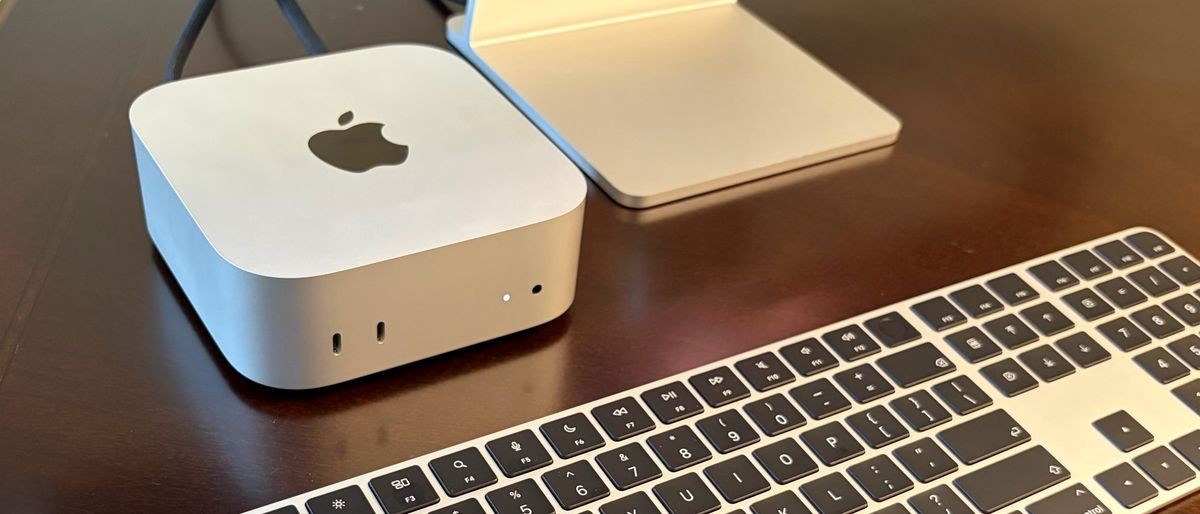
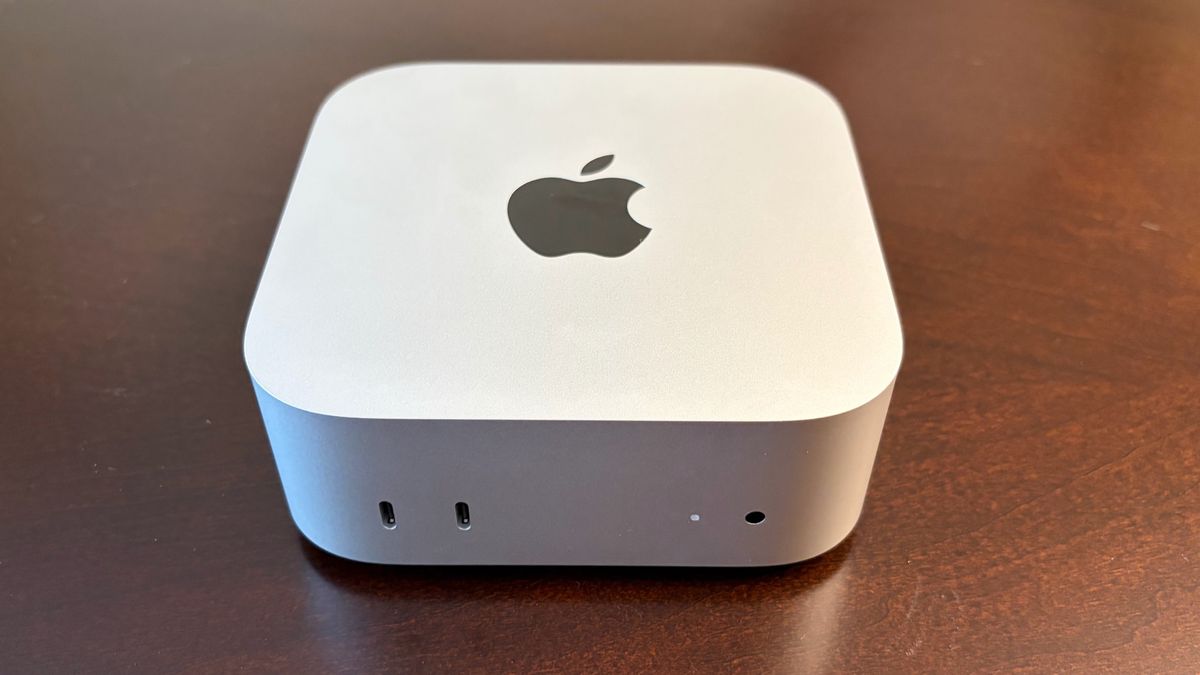
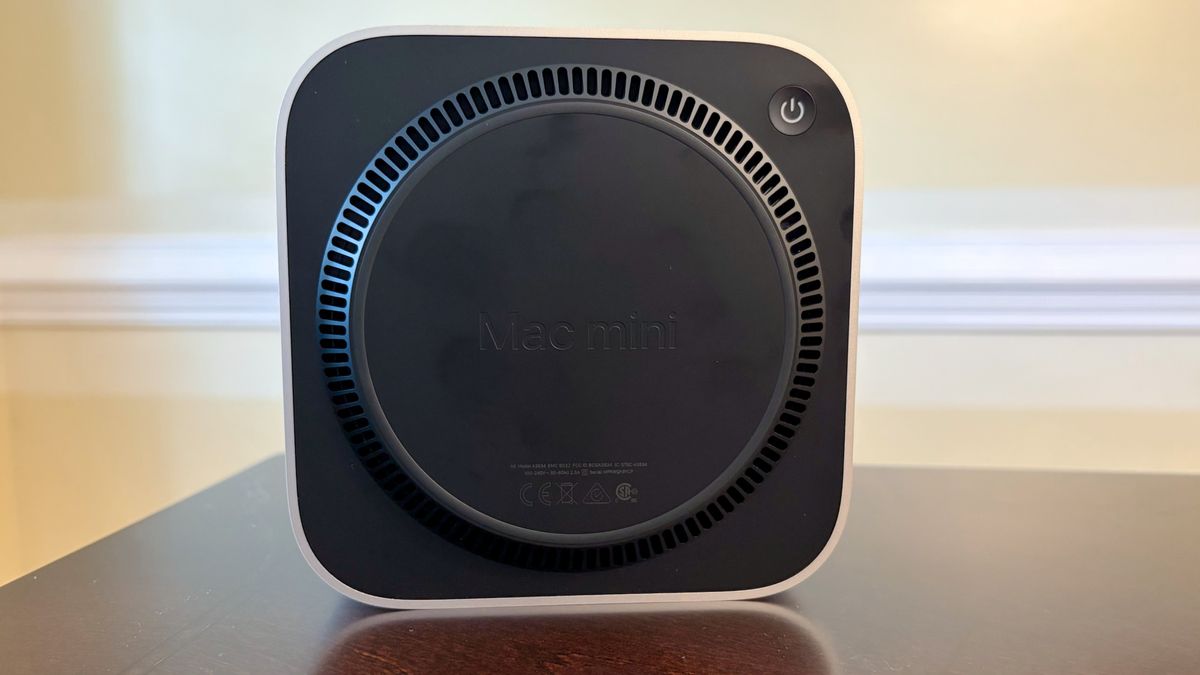
The Mac mini hasn’t changed on the design front, and that’s mostly a good thing. I’m always impressed with not only the minimalist style of this small form-factor computer, but also its tiny size. It has a 5-inch x 5-inch footprint, while standing just 2 inches tall. My only gripe is the power button, which remains stubbornly on the bottom of the system (back left corner). You’ll need to lift the system any time you want to turn it on (or force it to shut down in the event of a crash), and you’ll need to double-tap the power button when setting up Touch ID with an Apple Magic Keyboard for the first time. However, this is just a minor annoyance, as interacting with the power button on a modern Mac is a rarity.
Latest Videos FromTom's Hardware
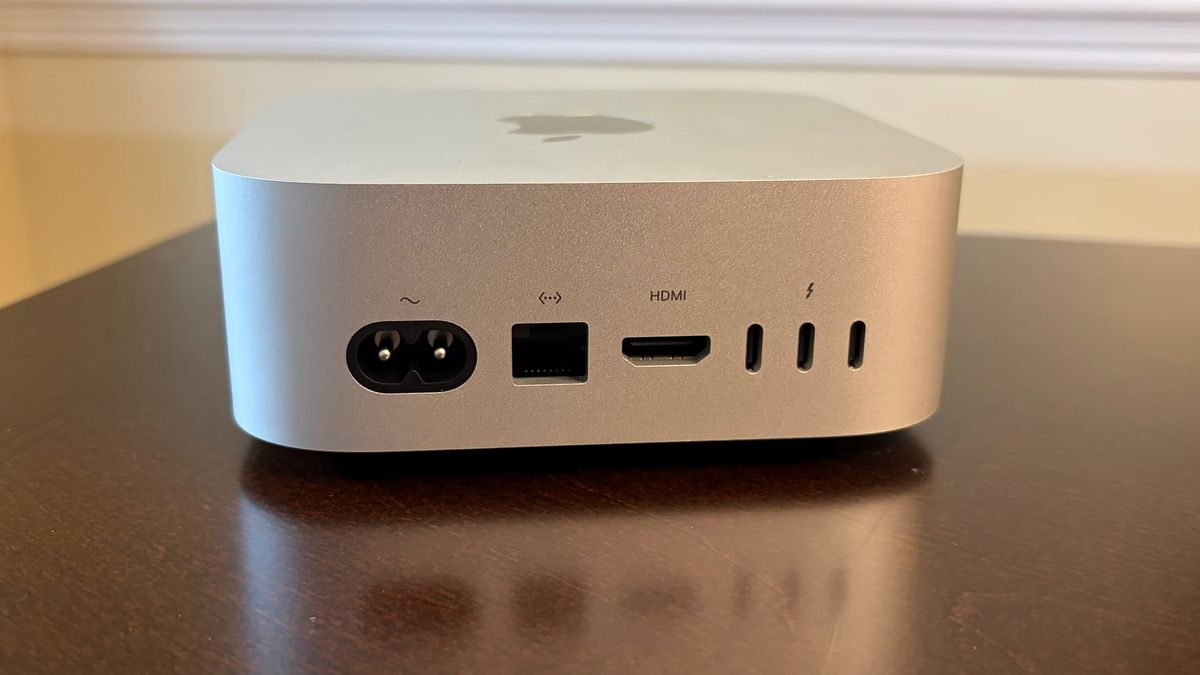
Despite its trim dimensions, you do get a fairly decent number of ports on the exterior of the Mac mini. However, let’s get this out of the way first: Apple doesn’t give you any USB-A ports on the Mac mini, so keep that in mind before purchasing. So, if you have USB-A devices around, you’ll either need to keep some cheap USB-A to USB-C adapters on hand, or invest in a USB-C or Thunderbolt dock for connecting legacy devices.
Image 1 of 4
(Image credit: Tom's Hardware)
(Image credit: Tom's Hardware)
(Image credit: Tom's Hardware)
(Image credit: Tom's Hardware)
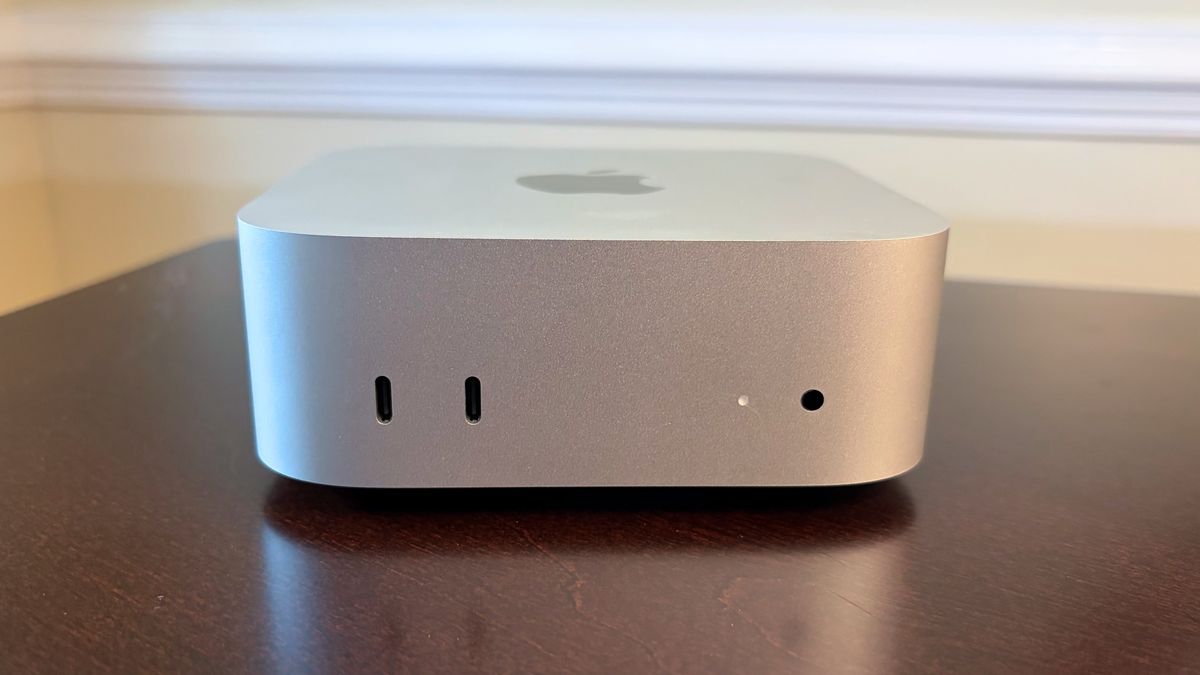
Instead, our Mac mini review unit features two USB-C ports (10 Gbps) and a 3.5 mm headphone jack up front, along with three Thunderbolt 4 ports on the rear (M5 Pro systems swap the Thunderbolt 4 ports for Thunderbolt 5). You’ll also find a 2.5 GbE port (up from 1 GbE), an HDMI port, and the power port on the back. We should note that while our review unit was specced with the 2.5 GbE LAN, you can individually option a 10 GbE port for $100 extra. A 10 GbE USB-C adapter would set you back around $100, so Apple’s upgrade is surprisingly reasonably priced, and you don’t lose a port in the process.
When it comes to wireless connectivity, the Mac mini uses Apple’s new in-house N1 wireless chip instead of relying on a third-party design. It provides tri-band Wi-Fi 7 and Bluetooth 6 support, which is an upgrade from the Wi-Fi 6E and Bluetooth 5.3 on the previous generation.
One thing to keep in mind with the Mac mini is that what you see is what you get when you purchase one. There are no internal upgrades available for the system once you’ve purchased it, so choose wisely before you click the buy button. Base systems come with an M6 chip (12-core CPU, 12-core GPU), 16GB of RAM, and a 256GB SSD. Our review unit features the M6 chip, 24GB of RAM, and a 512GB SSD. If you want to add storage post-purchase, we’d suggest taking a look at one of the best external SSDs.
Stay On the Cutting Edge: Get the Tom's Hardware Newsletter
Get Tom's Hardware's best news and in-depth reviews, straight to your inbox.
Apple Mac mini (M6) Specifications
Swipe to scroll horizontally
Processor
Apple M6 (2 super cores, 4 performance cores, 6 efficiency cores)
Graphics
12-core GPU
Memory
24GB LPDDR5X unified memory
Storage
512GB SSD
Networking
2.5 Gigabit Ethernet, Wi-Fi 7, Bluetooth 6
Front Ports
2x USB Type-C (10GB/s), 3.5 mm headphone jack
Rear Ports
3x Thunderbolt 4 ports (USB-C), HDMI, Ethernet
Power Supply
Internal, 155W
Operating System
macOS 27 Golden Gate
Dimensions
5 x 5 x 2 inches
Price as Configured
$1,399
Productivity Performance on the Apple Mac mini (M6)
Although the Mac mini is available with a more potent M5 Pro processor, our review unit came with the base M6 processor (12 CPU cores, 12 GPU cores). It also incorporates 24GB of LPDDR5X memory and a 512GB SSD.
This is the first system we’ve tested with the new 2-nanometer M6 processor. So, we were eager to see how it would perform against not only the M4 Pro in the previous Mac mini, but also the M5, which can be found in the current-generation MacBook Air and base MacBook Pro.
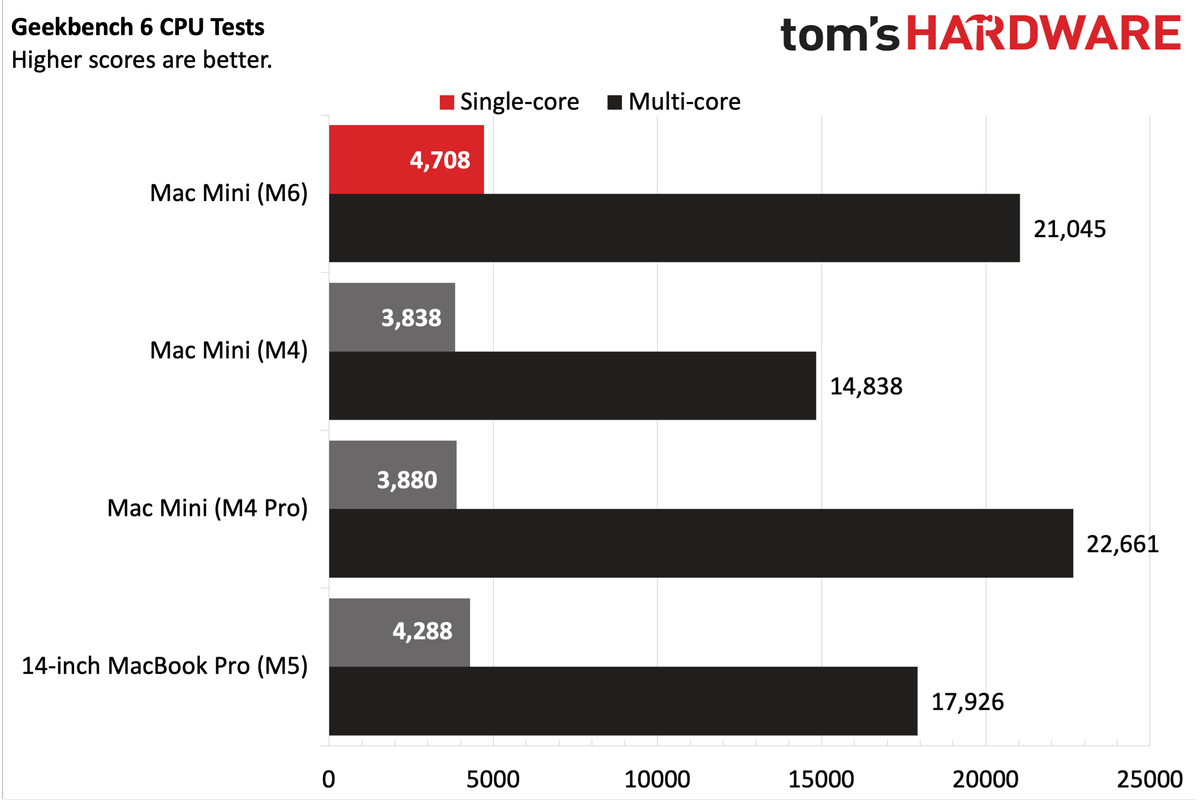
The M6 chip in the Mac mini had no trouble dispatching the M4, M4 Pro, and M5-equipped systems in the Geekbench synthetic CPU benchmark. In fact, it was 21 percent faster than the last M4 Pro Mac Mini in the single-core test. It also completely obliterated the M4 (10-core CPU, 10-core GPU) version of the Mac mini. The advantage versus the M5 system was lessened, but it was still a clear victory for the M6. The M6 actually slightly trailed the M4 Pro Mac mini (21,045 versus 22,661) in the multi-core test, which wasn’t too surprising given that the 12-core M6 was going up against a 16-core M4 Pro. But it was still a strong showing for the M6, given the architectural improvements that allowed it to get that close.
Image 1 of 4
(Image credit: Tom's Hardware)
(Image credit: Tom's Hardware)
(Image credit: Tom's Hardware)
(Image credit: Tom's Hardware)
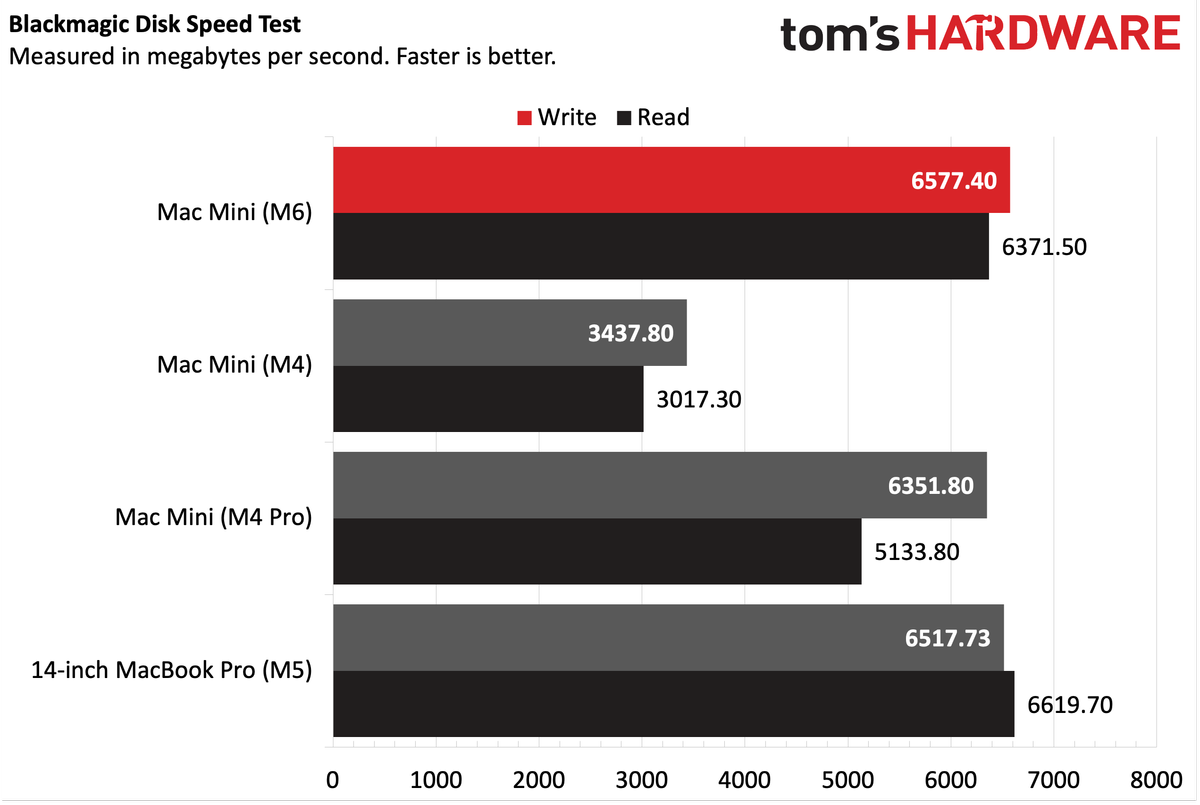
We had some trouble obtaining consistent performance from our usual 25GB file transfer test, so we fell back to the Blackmagic Disk Speed Test for benchmarking the 512GB SSD. Needless to say, it presented a marked improvement over the preceding M4 Mac mini.
Storage performance was comparable to the M5 MacBook Pro on sequential writes, but slightly behind for sequential reads. It also slightly outperformed the M4 Pro Mac mini in writes, but was over 1,000 MBps ahead in reads. However, the M6 Mac Mini nearly doubled the write performance and more than doubled the read performance of the M4 Mac mini.
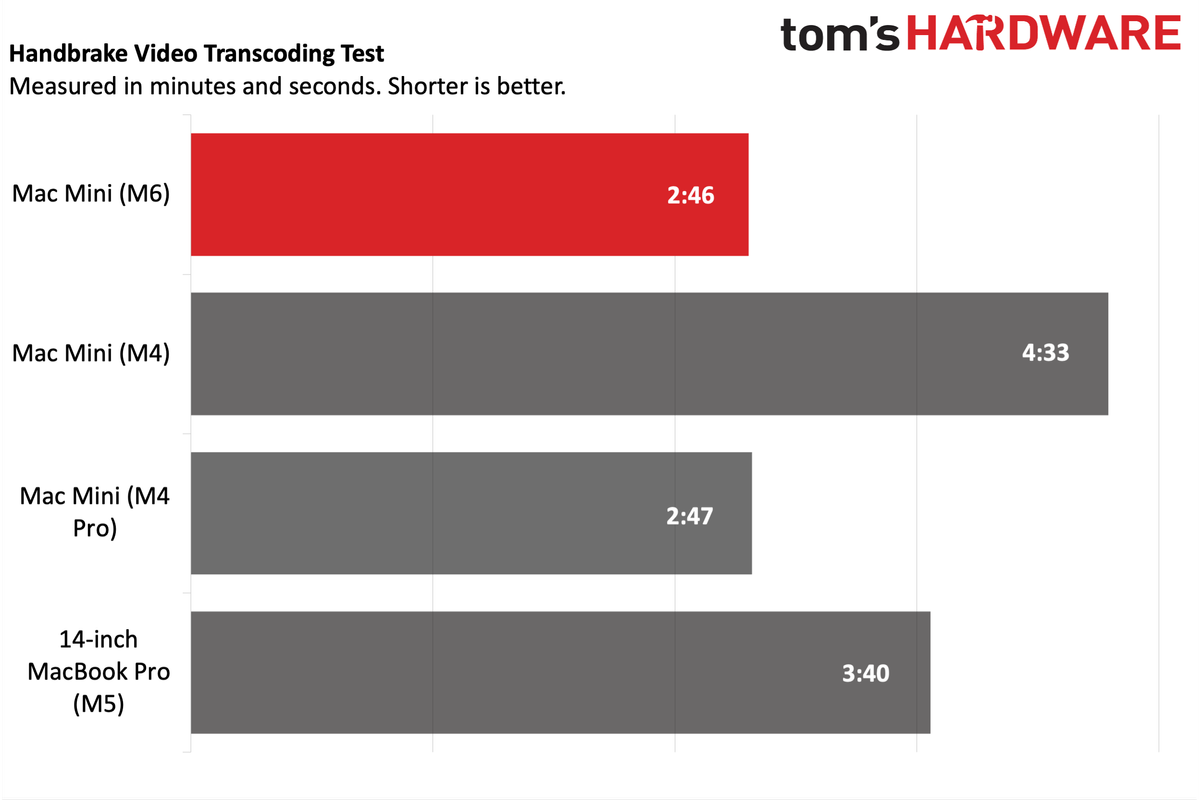
The similar multi-core performance in Geekbench was mirrored in our HandBrake test, during which we transcoded a 4K video file to 1080p. The M6 Mac mini completed the task in 2 minutes and 46 seconds, while the M4 Pro version was just one second behind. The M6 Mac mini was nearly 2 minutes faster than its M4 counterpart.
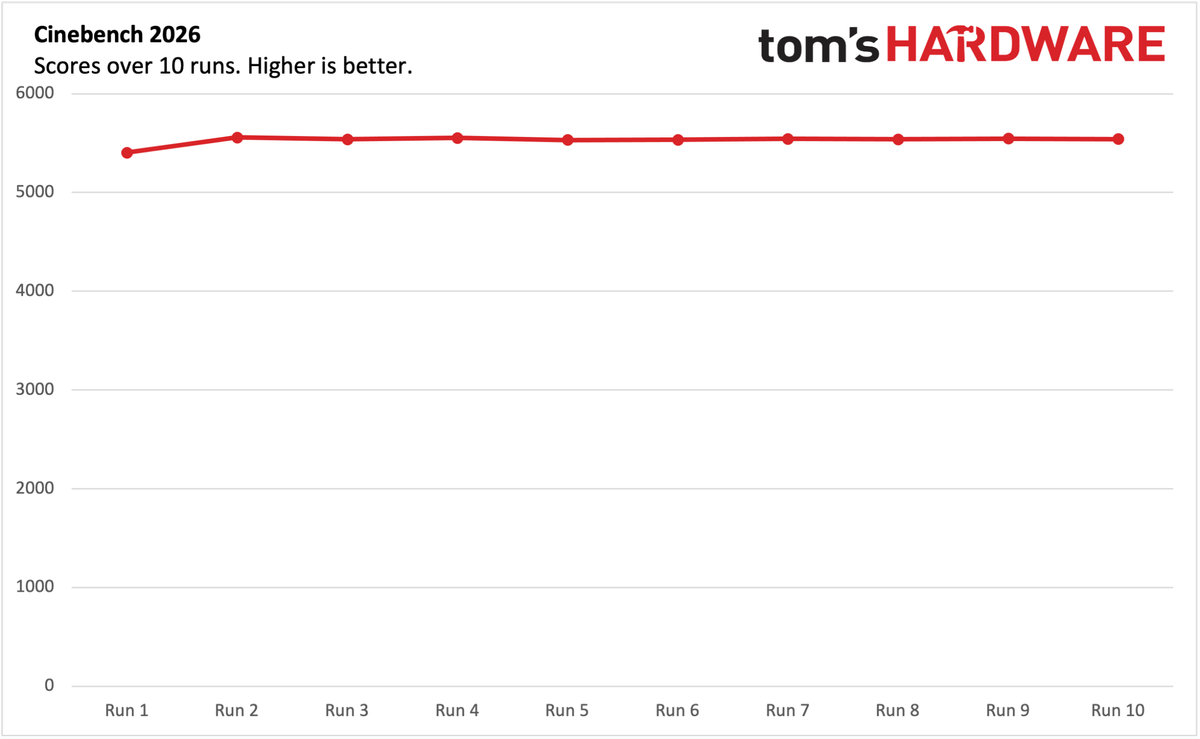
We ran Cinebench 2026 through 10 runs with the Mac mini, keeping track of its scores along the way. The Mac mini started off with a score of 5403, which rose to 5557 for the second run. For the remaining eight runs, the Mac mini was highly consistent, hovering between 5530 and 5554.
The M6 used in the Mac mini isn't yet fully supported by TG Pro, so we could only use the average of the available temperature sensors (power management sensors, power supply, and SSD). At idle, the fan spun at just around 1,000 revolutions per minute (RPM), with an average system temperature of 44 degrees Celsius. However, when running Cinebench 2026, the average system temperature rose to 64 degrees C, while the fan settled at around 2615 RPM.
Gaming and Graphics on the Apple Mac mini (M6)
Gaming shouldn’t be the primary goal with the Mac mini, but it can do some light lifting. I played Cyberpunk 2077 for a bit and benchmarked it. Although I was provided an Apple Studio Display (5K resolution) to test with the Mac mini, I ran benchmarks at 2560 x 1440 and 1920 x 1080, because the native 5K is a bridge too far for this game, given the hardware.
Using the "For this Mac" global setting, the Mac mini achieved 37.33 frames per second (fps) at 1440p and 58.11 fps at 1080p. With frame generation turned on, those numbers jumped to 62.61 fps and 96.24 fps, respectively.
If you don't mind turning the detail settings down a bit, you can achieve playable frame rates with the Mac mini. However, moving the detail slider to Ray Tracing (Medium) dropped frame rates into the 20 fps range even with frame generation turned on at 1440p.
macOS Golden Gate and Apple Intelligence
The Mac mini ships with macOS 27 Golden Gate, which was first made available to the public last week. macOS 27 is not a complete rethink of the desktop operating system formula for Apple, but it does provide a number of quality-of-life improvements for users.
One of the headlining features is new and improved Siri AI. While Siri was one of the first digital assistants to debut on a smartphone, it hasn't exactly been "smart," at least compared to its contemporaries. Siri AI now digs its fingers deeper into the operating system, allowing it to glean contextual data from your photos, mail, messages, and documents. You can access Siri AI from Spotlight (search) or using the dedicated Siri AI app. Siri AI is also vastly more useful, as it will more consistently answer general questions asked, rather than throw up its digital hands and say "Here's what I found on the web."
Apple's Shortcuts app is an incredibly powerful tool that has been available for years across the Mac, iPhone, and iPad product families. However, the granular control and seemingly limitless options can make creating a new shortcut daunting for newbies. So with macOS 27, you can now create a new Shortcut using natural language. For example, you could input, "Create a shortcut that sets the AC to 74 degrees when I leave work, and let my wife know what time I'll arrive at home," and it will take care of the rest.
Liquid Glass was one of the more controversial additions to macOS 26, with some people not liking the translucent makeover. MacOS 27 gives users more control over Liquid Glass, with sliders to adjust the intensity of the transparency effect.
Apple has also introduced plenty of system-level optimizations to improve performance across the board. For example, Apple says that AirDrop is up to 80 percent faster in macOS 27 than macOS 26, and a lot more reliable. Apps also open faster – any lagginess or stuttering that was perceptible in macOS 26 has been eliminated with this newest release. The best comparison I can make for the macOS 26 to macOS 27 upgrade is the fine-tuning that Apple did going from Mac OS X 10.5 Leopard to Mac OS X 10.6 Snow Leopard. There weren’t any major feature additions with that latter release, but there were a plethora of under-the-hood optimizations that made it much faster and more stable.
In addition, macOS 27 doesn’t install the Rosetta x86 translation software by default; you’ll need to download it when you first run a legacy x86 app. However, starting next year with macOS 28, you won’t be able to run apps that aren’t Apple Silicon-native, so Rosetta will be completely off the table.
Apple Mac mini (M6) Configurations and Warranty
The base Mac Mini comes with an M6 processor, 16GB of RAM, and a 256GB SSD for $899. Before Apple's June 2026 price increases, the base Mac mini with M4, 16GB of RAM, and a 256GB SSD cost $599. After the price increases, that $599 jumped to $799. Now, we're looking at another $100 increase for the base Mac Mini. There’s one standalone upgrade option: $100 extra gets you a 10 GbE port instead of the standard 2.5 GbE.
Apple also allows you to upgrade to 24GB or 32GB of RAM, along with 512GB, 1TB, and 2TB SSD options. A fully-loaded M6 Mac mini with 32GB of RAM, a 2TB SSD, and 10 GbE costs $2,399.
For people who require a bit more processing power, perhaps for AI tasks (as Apple seems so inclined to believe), the base M5 Pro Mac Mini (15-core CPU, 16-core GPU), with 24GB of RAM and a 512GB SSD, costs $1,699. However, you can go bonkers with the options, topping out with an M5 Pro (18-core CPU, 20-core GPU), 64GB of RAM, an 8TB SSD, and a 10 GbE adapter for a whopping $6,599. At that price, it’s probably worth looking at the Mac Studio.
All Mac minis come with a 1-year manufacturer warranty.
Bottom Line
The base M6 chip provides better single-core performance and nearly matches the multi-core performance of the optional M4 Pro in the previous-generation Mac mini. Compared ot the standard M4 Mac mini, the new M6 version blows it away in CPU and SSD performance.
These are the kinds of generational improvements we’ve come to expect with Apple Silicon, which seems to be firing on all cylinders these days. The new Mac mini also gets other, less-highlighted improvements, like faster standard wired networking (2.5 GbE versus 1 GbE) and Wi-Fi 7/Bluetooth 6.0 instead of Wi-Fi 6E/Bluetooth 5.4.
However, the elephant in the room is pricing for the Mac mini. Earlier this year, you could grab a base Mac mini for $599 – although availability was spotty after Q1, thanks to OpenClaw and anticipated price hikes. More importantly, over the years, going from one Mac mini generation to the next typically yielded performance benefits with no (or minimal) price increase. The AI revolution has rewritten the hardware rulebook, so we’re now faced with a new generation that is $300 more expensive than the previous model ($200 June price increase + another $100 increase for this new generation).
So in a matter of months, what was for years a screaming bargain for anyone looking for a cheap entry point into the Mac desktop ecosystem has gotten a lot more expensive. 16GB of memory and a 256GB hard drive are easier to justify at $599, but it’s a tougher pill to swallow at $899, and especially so with our review unit’s as-tested price of $1,399.
Brandon Hill is a senior editor at Tom's Hardware. He has written about PC and Mac tech since the late 1990s with bylines at AnandTech, DailyTech, and Hot Hardware. When he is not consuming copious amounts of tech news, he can be found enjoying the NC mountains or the beach with his wife and two sons.



 Like
0
Like
0
 Dislike
0
Dislike
0
 Love
0
Love
0
 Funny
0
Funny
0
 Wow
0
Wow
0
 Sad
0
Sad
0
 Angry
0
Angry
0







Comments (0)