

Astronaut Jessica Meir Photographed a Purple Aurora From 255 Miles Up With a Nikon Z9
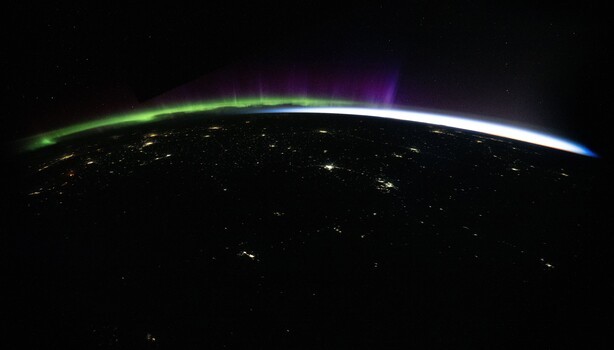
NASA astronaut Jessica Meir photographed an aurora glowing green and purple over Kyrgyzstan on September 7, shooting from the International Space Station at an altitude of 255 miles with a Nikon Z9 at a 15mm focal length. The frame catches the green band riding the curve of the atmosphere, purple rays climbing above it, and the lights of Central Asian cities scattered across the dark below.
NASA's Earth Observatory published the photograph as its Image of the Day, cataloged as astronaut photograph ISS075-E-88592 and one of a series the Expedition 75 crew shot as the station crossed the display. NASA's record puts the exposure at 21:46 GMT, with the station's nadir point over northern Kyrgyzstan at 41.9 degrees north and 72.2 degrees east. Meir posted the image the following day. "I've never before seen such a brilliant purple wavelength in the aurora," she wrote, adding that it "certainly makes me want to kiss the sky."
The purple comes from nitrogen, and the view from orbit shows how the colors stack. Oxygen excited by incoming solar particles glows green between roughly 60 and 120 miles up and red above 120 miles. Nitrogen adds blue and violet at those heights, and a pink fringe along the lower edge of a curtain. Where the emissions overlap along your line of sight, they can blend into purple, pink, or even white, and a single photograph cannot say how much of this display's purple was pure nitrogen and how much was blending. What the photograph does show is the layering. From the station, Meir was looking across the emitting layer in profile rather than up through it, so the altitude structure that merges from the ground separates into a tight green band along the limb with the purple standing above it as distinct rays.
The display came from a modest storm. According to NOAA's Space Weather Prediction Center, fast solar wind pouring out of a coronal hole, on top of the fading influence of several coronal mass ejections, disturbed Earth's magnetosphere enough to produce minor G1 geomagnetic storms in the first week of September. That is the lowest rung on NOAA's five-step scale. Timing helped. Around the spring and fall equinoxes, the seasonal tilt of Earth's magnetic field makes the magnetic field carried by the solar wind more likely to point the way that lets it link up with Earth's own, so geomagnetic storms are statistically more common in those months, a pattern known as the Russell-McPherron effect and the reason astronauts tend to see the best auroras in March and September.
Meir did not stop at a single frame. On September 12, she posted a stacked series of 30-second exposures shot through the window of the docked Dragon capsule with the same Nikon Z9 and 15mm setup, in which the aurora's green glow mixes with star trails, city trails, a string of satellites crossing above the horizon, and the Moon rising into the frame. NASA notes that the published still was cropped, contrast-enhanced, and cleaned of lens artifacts. The original is 8,256 by 5,504 pixels.
For you on the ground, the useful part is the timing. A G1 storm is enough to push visible aurora down to the northern tier of the United States, roughly northern Michigan and Maine, and the weeks on either side of the September 22 equinox give you the best odds of the year. Watch the Space Weather Prediction Center's three-day forecast for a Kp index of 5 or higher, get away from city light, and expect the purple to show up as a fringe above or below the green rather than as a separate curtain, because you will be looking up through the same layers Meir saw from the side. The full-resolution file is free to download from NASA's Gateway to Astronaut Photography, and the camera that made it is a physically unmodified Nikon Z9 running firmware Nikon wrote for NASA, with changes to noise reduction, file naming, and power management rather than to anything in the body itself.
Lead image: NASA astronaut photograph ISS075-E-88592, courtesy of the ISS Crew Earth Observations Facility and the Earth Science and Remote Sensing Unit, NASA Johnson Space Center. Public domain.
What's Your Reaction?
 Like
0
Like
0
 Dislike
0
Dislike
0
 Love
0
Love
0
 Funny
0
Funny
0
 Wow
0
Wow
0
 Sad
0
Sad
0
 Angry
0
Angry
0









Comments (0)