Asus ROG Strix XG27AQGNV 27-inch G-Sync Pulsar gaming monitor review: Super smooth with unprecedented control
Oct 18, 2026 - 19:13
01
G-Sync Pulsar delivers OLED-level smoothness, responsiveness, and gaming feel to LCD monitors, and the Asus ROG Strix XG27AQNGV is a great example. With unmatched tweakability, it will satisfy gamers from casual to professional.
Reasons to buy
+
G-Sync Pulsar delivers OLED-level smoothness and responsiveness
+
Fine and precise control of gamma and luminance
+
400-step variable overdrive
+
Accurate color
+
Premium build quality
Reasons to avoid
-
Smaller color gamut than other speedy monitors
-
No dynamic dimming means HDR contrast is the same as SDR
Why you can trust Tom's Hardware
Our expert reviewers spend hours testing and comparing products and services so you can choose the best for you. Find out more about how we test.
In the evolution of gaming monitors, there is nothing more significant than the advent of G-Sync and FreeSync (AKA, Adaptive-Sync or VRR). By syncing the video card output and monitor refresh rate in real time, all frame tearing and stuttering are eliminated. But there is one thing this tech cannot fix – motion blur.
LCD panels continuously display each frame until the next one arrives. This inevitably results in blur unless frame rates are very high. At least 500Hz is needed to truly call LCD motion resolution perfect. How to combat this? Well, you can buy one of the best OLED gaming monitors, which has a much faster panel response. You could employ overdrive, where the LCD panel anticipates the next frame. It’s also known as overshoot. If done precisely, that eliminates nearly all blur. Or you can insert a black frame by strobing the backlight. But this reduces light output.
Earlier this year, I reviewed my first G-Sync Pulsar display, the Acer XB273U F5. G-Sync Pulsar syncs the backlight’s LED array with the frame rate in real time. It’s a form of strobing but without the brightness penalty. And it’s the only way an LCD can achieve perfect motion resolution, i.e., when moving objects are as clear as stationary ones.
Latest Videos FromTom's Hardware
Thought of another way: an OLED pixel, or an LED, can flash 20,000 times per second. The TFT layer of an LCD panel is fast if it can flash 500 times per second.
Today, I’m reviewing another G-Sync Pulsar monitor, Asus’ ROG Strix XB27AQNGV. It’s a 27-inch QHD IPS panel with 360 Hz, HDR, and wide gamut color. Let’s take a look.
Asus ROG Strix XG27AQGNV Specs
Swipe to scroll horizontally
Panel Type / Backlight
IPS / W-LED, edge array
Screen Size / Aspect Ratio
27 inches / 16:9
Max Resolution and Refresh Rate
2560x1440 @ 360 Hz
Row 3 - Cell 0
G-Sync Pulsar
Row 4 - Cell 0
FreeSync Compatible
Native Color Depth and Gamut
10-bit / sRGB+
Response Time (GTG)
1ms
Brightness (mfr)
500 nits
Contrast (mfr)
1,000:1
Speakers
None
Video Inputs
1x DisplayPort 1.4
Row 11 - Cell 0
2x HDMI 2.1
Audio
3.5mm headphone output
USB 3.2
1x Type-B upstream
Row 14 - Cell 0
3x Type-A downstream
Power Consumption
46.5w, brightness @ 200 nits
Panel Dimensions
WxHxD w/base
24.17 x 15.5-19.75 x 7.4 inches
(614 x 394-502 x 188mm)
Panel Thickness
3.4 inches (86mm)
Bezel Width
Top/sides: 0.31 inch (8mm)
Row 19 - Cell 0
Bottom: 0.83 inches (21mm)
Weight
14.33 pounds (6.5kg)
Warranty
3 years
As a ROG Strix display, the XB27AQNGV is a little less expensive than the ROG Swift line and gives up only a few minor features. Anything pertaining to game performance is included. The max refresh rate is 360 Hz at QHD 2560x1440 resolution. The panel is IPS, or as Asus calls it “Ultra-Fast IPS”. And it is, as you’ll see in my Nvidia LDAT tests on the next page. G-Sync Pulsar is there with low frame rate compensation that eliminates flicker when speeds drop. You also get a traditional overdrive with three presets and a user control with 400-step precision.
Color-wise, the XB27AQNGV can be considered wide gamut, but it doesn’t quite achieve full coverage of DCI-P3. I’ve termed it an sRGB+ display because it covers around 120% of sRGB with bonus color across the board. For tweakers who like to calibrate, there is a super cool gamma control that lets you move the luminance curve in 0.01 increments rather than the usual five or six presets that differ by 0.2. You can also dial in the color temperature with precise RGB sliders. And the brightness adjuster is graduated in nits for fine control.
Stay On the Cutting Edge: Get the Tom's Hardware Newsletter
Get Tom's Hardware's best news and in-depth reviews, straight to your inbox.
For extras, the XB27AQNGV has a full suite of GamePlus options with aiming points, frame counters, timer, stopwatch, and alignment marks. And there are six picture modes including sRGB and G-Sync Esports. LED lighting comes with a backlit ROG logo and the full set of Aura RGB and Sync options. A handy joystick and four control keys provide access to everything, or you can use the top-mounted ambient light sensor for automatic control of color and brightness.
The XB27AQNGV is selling for $500 at this writing, which is closer to premium than most 27-inch QHD screens. But it’s one of only four monitors that offer G-Sync Pulsar, and if you don’t want to buy an OLED, it’s the only LCD variant that is as smooth and responsive.
Assembly and Accessories
The XB27AQNGV ships in a plain brown carton with the words “For Those Who Dare” stenciled on the side. Dare to what? I cannot say. But I dared to open it and found the monitor packed in crumbly foam (hate that stuff). The upright is already attached, so all that needs doing is to attach the base with a captive bolt. To expose the inputs, remove the snap-on plastic cover. The cables and external power supply come in a zippered pouch and include DisplayPort and USB.
Product 360
Image 1 of 4
(Image credit: Asus)
(Image credit: Asus)
(Image credit: Asus)
(Image credit: Asus)
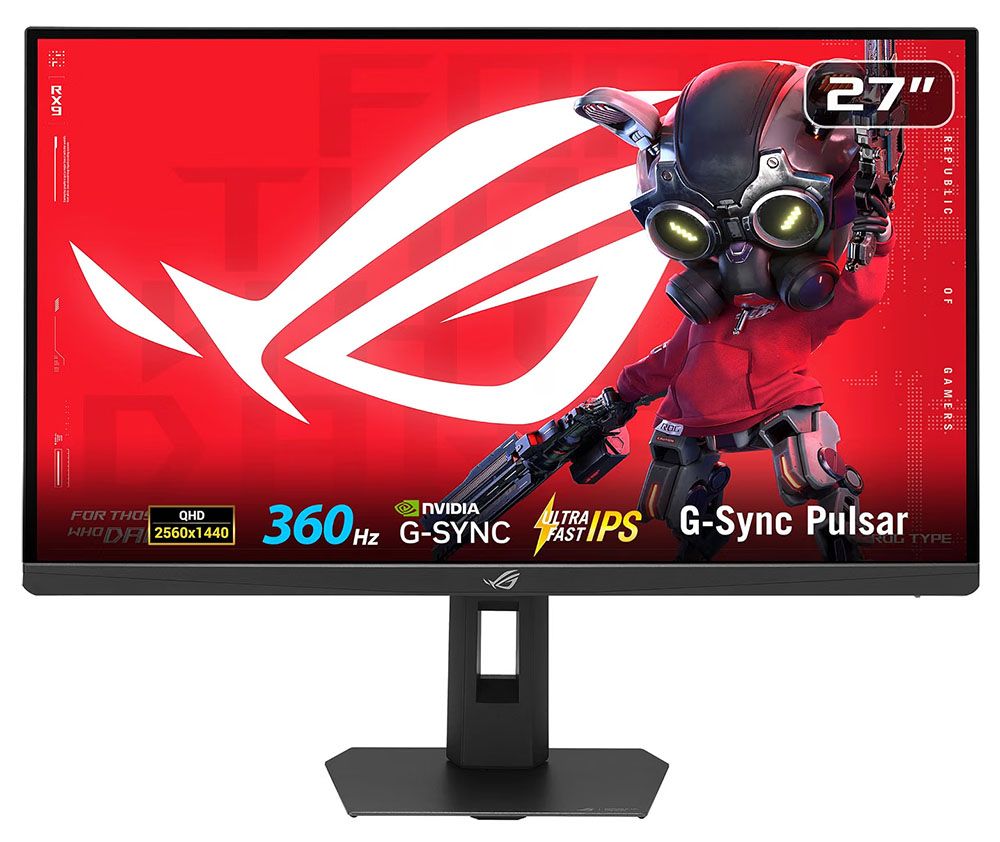
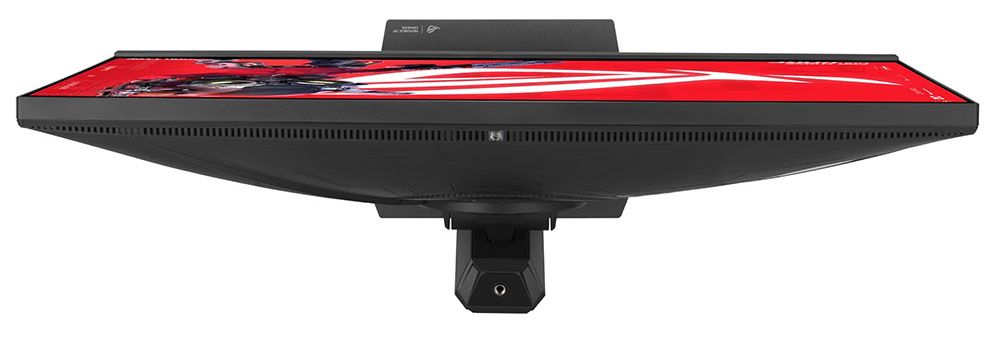
The XB27AQNGV doesn’t show much from the front besides the screen. The bezel is 8mm thin with a flush mount and a wider trim strip across the bottom adorned with a small ROG logo. The base is a solid metal plate with a small and stable footprint. The upright includes a cable hole to keep wires tidy. Ergonomics include 5/20 degrees tilt, 45 degrees swivel, a 90-degree portrait mode, and 4.25 inches of height range. Movements are very stiff with no hint of play. The XB27AQNGV will stay put even when you’re shaking things up on the virtual battlefield. On top of the stand is a quarter-inch threaded socket for things like webcams and other peripherals. Also on top is the ambient light sensor, which can automatically adjust brightness and color temperature.
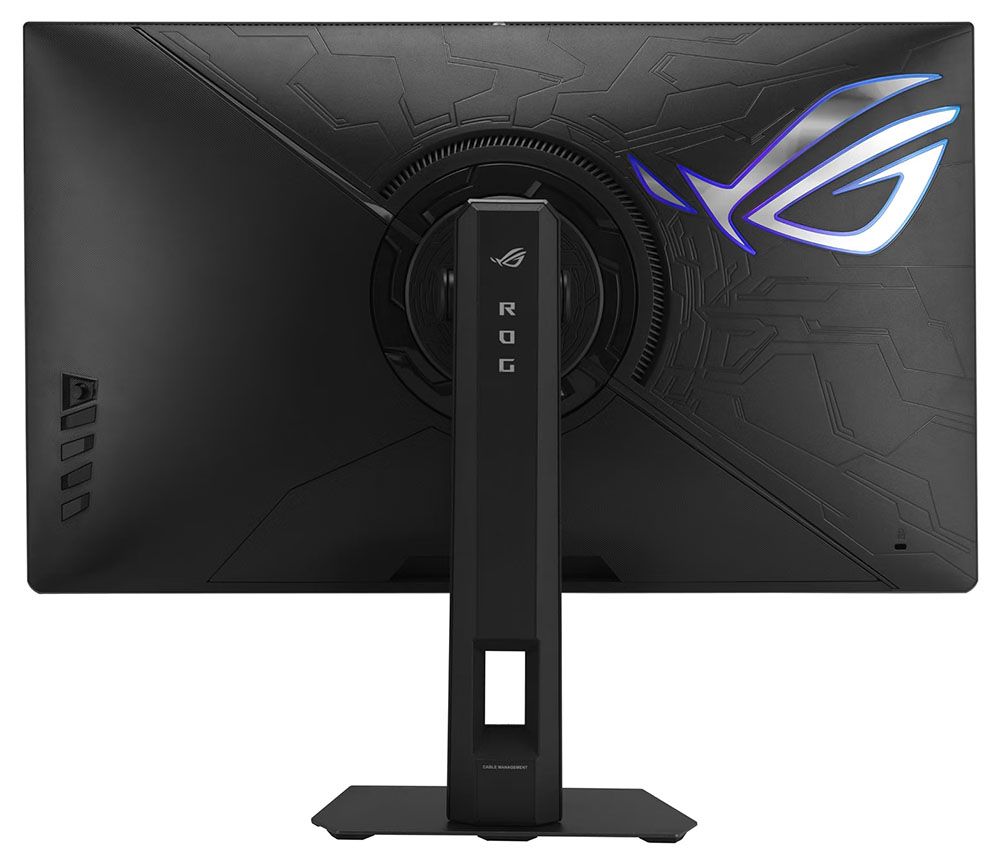
Around the back right is the OSD joystick and three control keys plus a power toggle. Two of the keys can be programmed by the user. The large ROG logo is backlit with a glowing border around a reflective material. You can see in the photo that the panel’s back is smoothly tapered left to right and top to bottom.
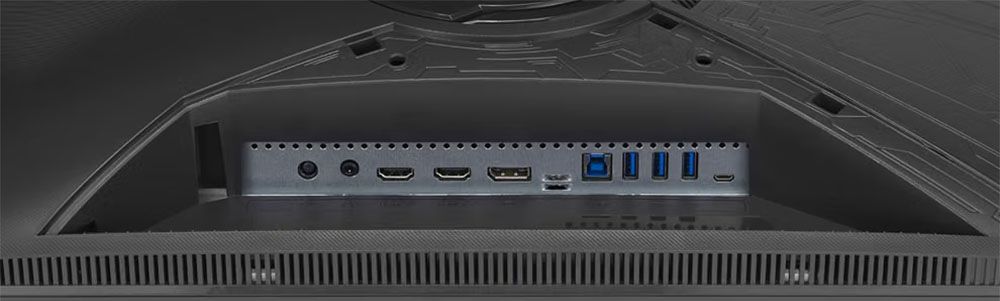
The input panel is hidden under a cover with a small hole to let the cables out. It’s a little tricky to plug in large connectors because the ports are very recessed. I/O options include a DisplayPort 1.4 with Display Stream Compression (DSC), two HDMI 2.1 ports, a 3.5mm headphone jack, and a large array of USB ports. There’s a USB-B upstream and three USB-A downstream.
OSD Features
Press the XB27AQNGV’s joystick and a large OSD appears. You can move it to a corner if you like. It’s divided into eight sections.
Image 1 of 8
(Image credit: Tom's Hardware)
(Image credit: Tom's Hardware)
(Image credit: Tom's Hardware)
(Image credit: Tom's Hardware)
(Image credit: Tom's Hardware)
(Image credit: Tom's Hardware)
(Image credit: Tom's Hardware)
(Image credit: Tom's Hardware)
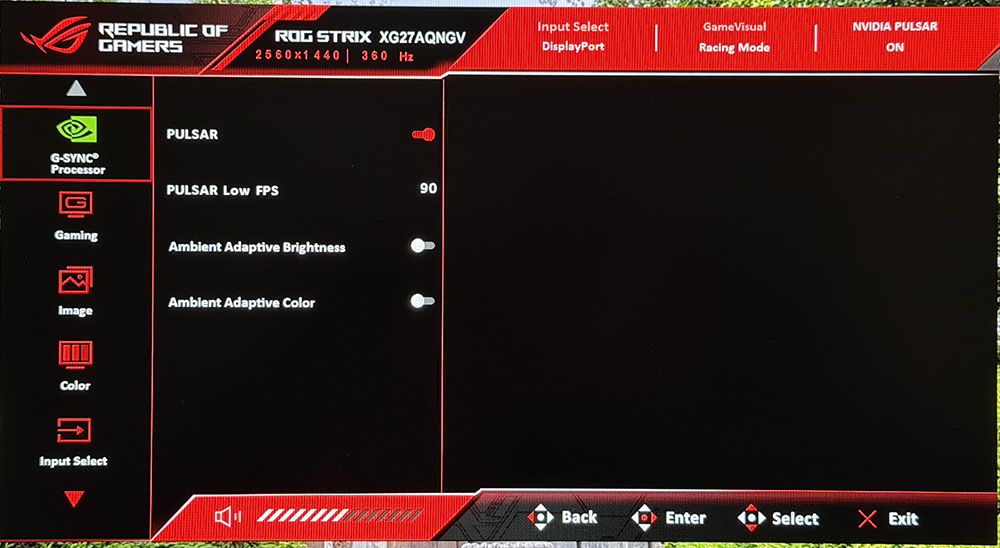
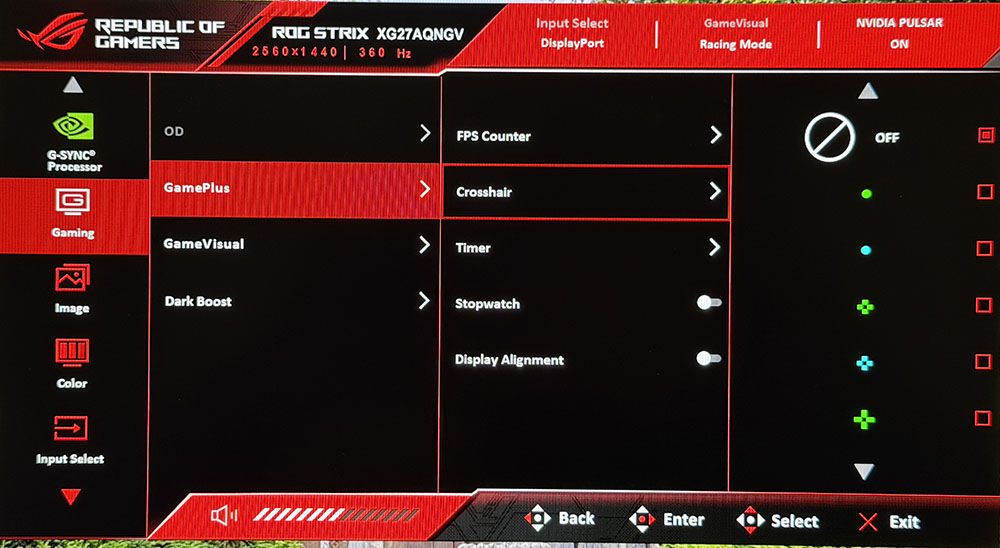
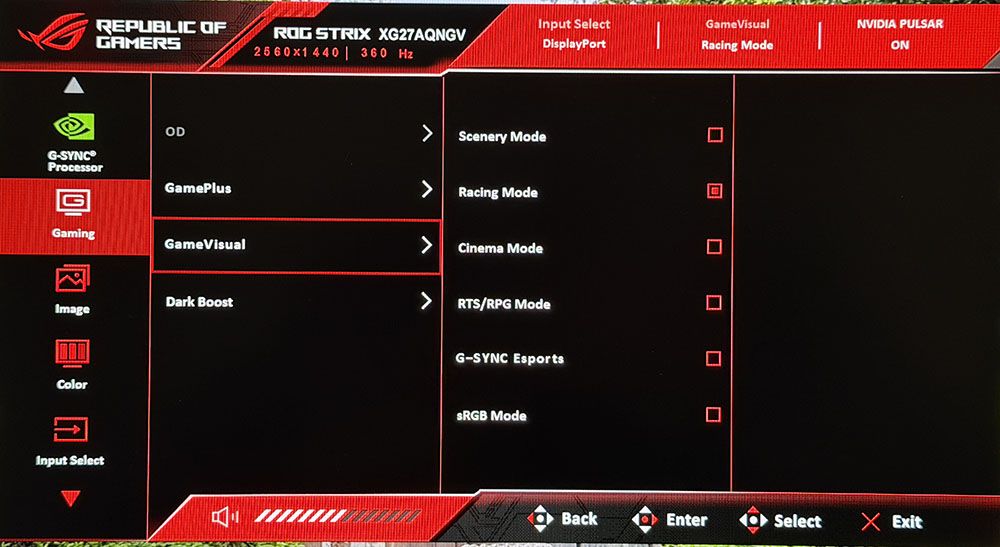
First up is the G-Sync Processor and Pulsar options. You can toggle the feature off if you prefer overdrive. Remember that there is no ELMB here because it’s part of the Pulsar technology. This menu also has toggles for adaptive brightness and color, which are controlled by the top-mounted sensor. The Gaming menu continues with a three-level overdrive which becomes active when you turn off Pulsar. You can also adjust the amount of overshoot with a 400-step slider. The suite of GamePlus options includes a frame counter, aiming points, timer, stopwatch, and display alignment marks. GameVisual is the six picture modes. The default and best option there is Racing. You can engage an sRGB mode as well.
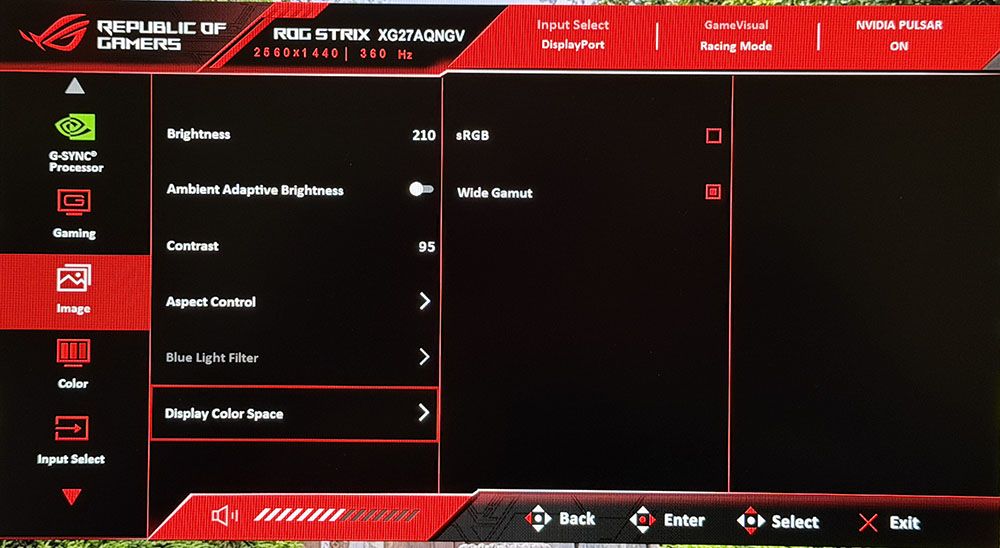
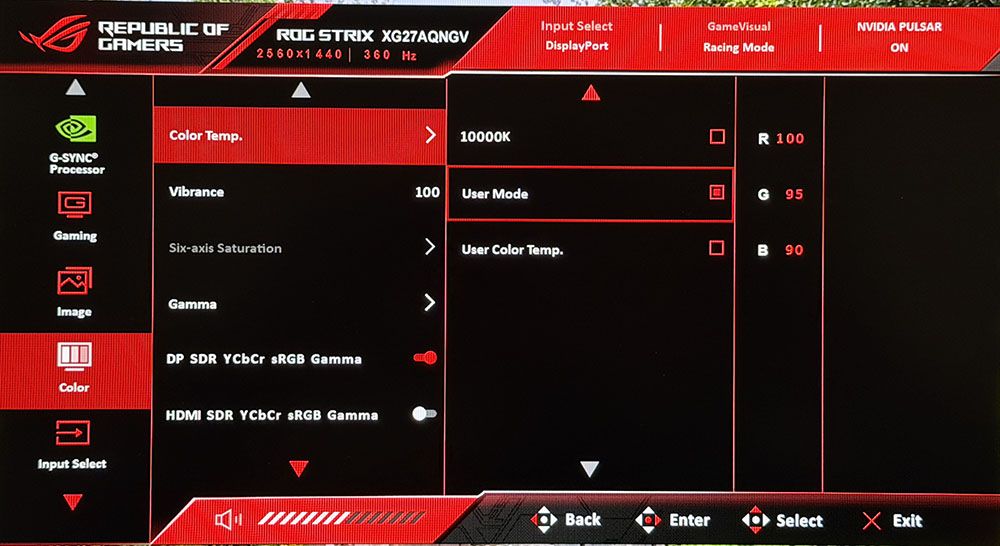
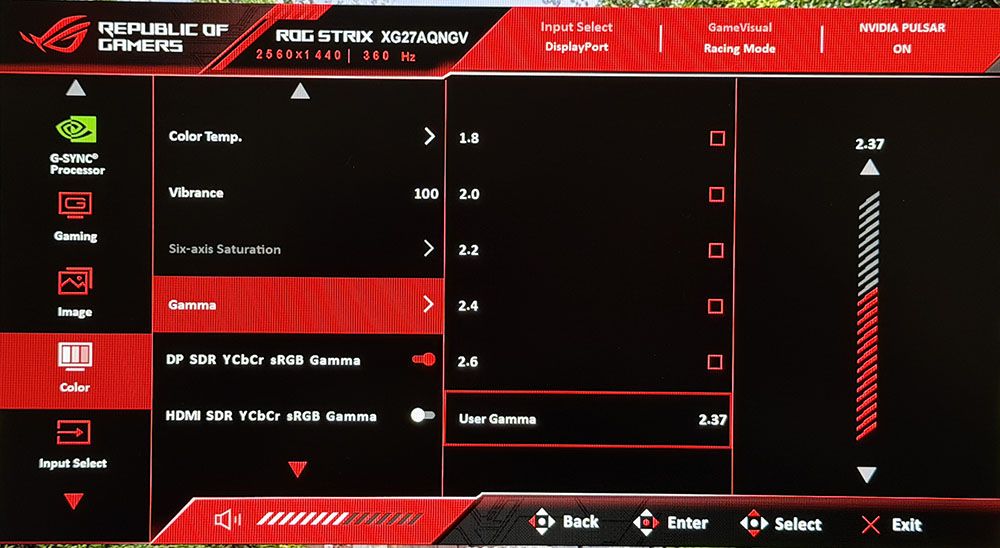
The Image menu has the luminance controls along with a redundant toggle for adaptive brightness. The color space options are sRGB and wide gamut, which is around 120% of sRGB. In the Color menu are preset color temps plus a very precise set of RGB sliders. The gamma control is something that I hope to see imitated by others because it is the most useful way to achieve precise gamma. Typically, there are five or six presets that are 0.2 apart, making gamma adjustments very coarse. You can almost never land right on 2.2 that way. The XG27AQNGV has a user gamma slider that moves in 0.01 increments. And that’s a good thing because the 2.2 preset is lighter than 2.2. You can read more about this on page four.
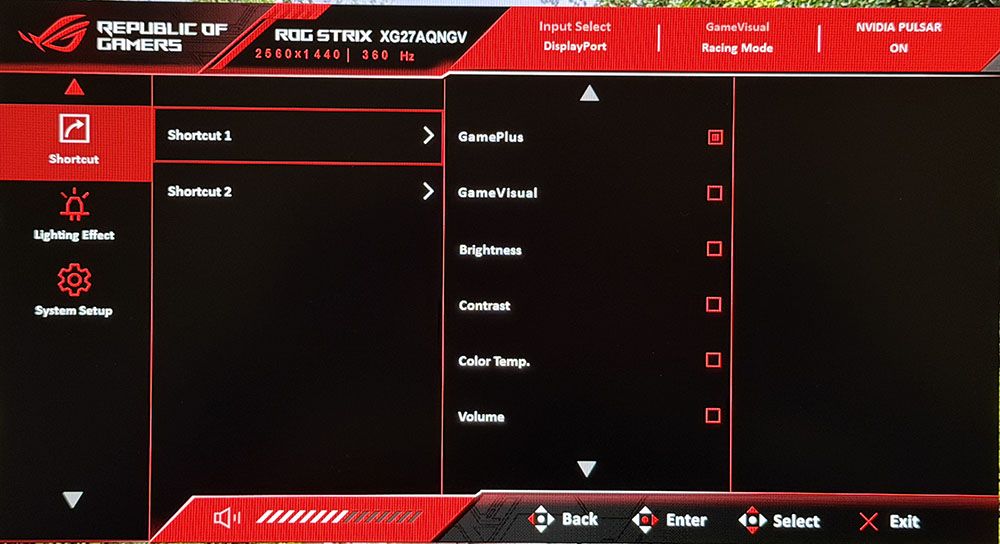
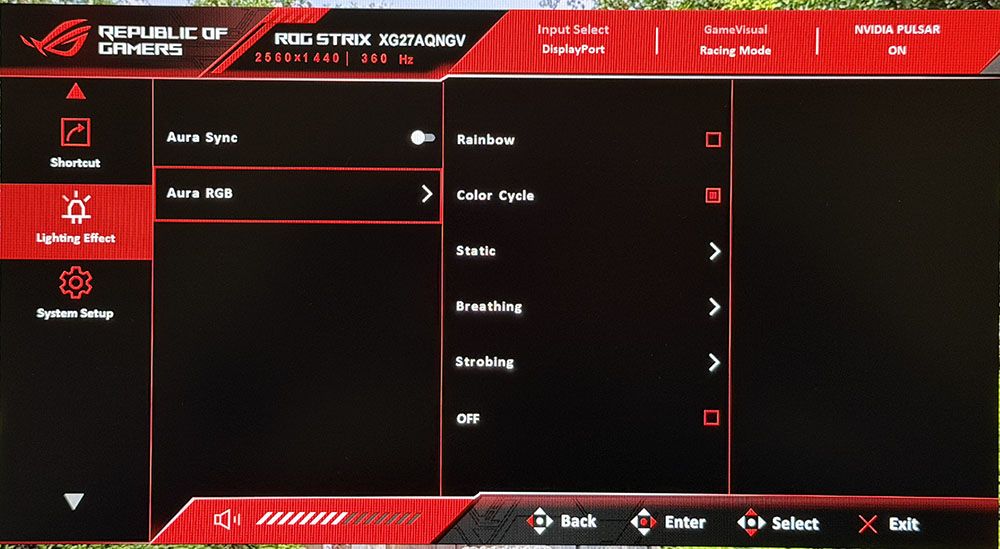
Two of the control keys can be set to one of seven different functions for easy access to picture modes, GamePlus, and others. The Lighting Effect menu has options for Aura Sync, where the LEDs change along with screen content. Or you can choose an effect and color using Aura RGB. This pertains to the backlit ROG logo in the back.
Asus ROG Strix XG27AQNGV Calibration Settings
The XG27AQNGV comes out of the box with decent grayscale tracking, but its default gamma is too light. With a few tweaks to the RGB sliders and changes to the user gamma (coolest thing ever!), I achieved near-perfection. The color gamut is a bit larger than sRGB but smaller than DCI-P3. You can choose between gamuts in the Display Color Space sub-menu. I recommend choosing this rather than the preset sRGB mode because that way, you can still calibrate. I also reduced contrast to solve a clipping issue that affected HDR luminance tracking. You can see the two recommended settings in the table below.
Swipe to scroll horizontally
Picture Mode
Racing
Brightness 200 nits
210
Brightness 120 nits
128
Brightness 100 nits
107
Brightness 80 nits
86
Brightness 50 nits
55 (min. 45 nits)
Contrast
95 (HDR Contrast 110)
Gamma
2.37
Color Temp User
Red 100, Green 95, Blue 90
Gaming and Hands-on
Gameplay on the XG27AQNGV is instantly addictive. Though it doesn’t have the deep contrast and vivid color of an OLED, its motion quality and responsiveness are indistinguishable from that premium technology. G-Sync Pulsar is truly a game changer for LCDs.
Playing Doom Eternal in HDR mode, I noted that my contrast settings did not carry over from SDR, so I had to change the slider whenever I switched. And since there’s no dynamic dimming, there was no more contrast or depth to the image. But it was a little more colorful thanks to the intentional oversaturation Asus included. You can read more about that on page five.
The image was plenty sharp enough, but what struck me the most was how much the XG27AQNGV felt like an OLED. Its smoothness and responsiveness are the same as any premium display. Though I would buy an OLED for myself, I realize that some users prefer LCD. If you want OLED performance in an LCD, a G-Sync Pulsar monitor is the best way to achieve that. It’s better than a 500 Hz LCD, or a 540 Hz LCD for that matter. There is no motion blur whatsoever, and input lag is super low.
Since I had no problem running over 300fps, there was no need for the low-speed compensation option. But it’s nice to know it’s there for systems that don’t have a GeForce RTX 4090 video card. I never needed the overdrive, and with Pulsar engaged, it was grayed out. When I tried it out, it worked well and reduced blur but didn’t eliminate it. The 400-step control was super cool though.
The XG27AQNGV is a solid choice for productivity with 109ppi pixel density and a sharp, colorful image. If you’re used to a Quantum Dot screen with its jumbo gamut, you’ll notice a little less color here, but the difference isn’t huge. It’s a worthwhile sacrifice to make for the incredible gaming performance on offer.
I spent time browsing the web and using Photoshop, and for that, the XG27AQNGV functioned as well as any bread-and-butter display. 27 inches is a good compromise between footprint and screen real estate, and the image is clean and detailed. I noted the extra USB ports, which many monitors don’t have. And though there were no internal speakers, I could plug into the 3.5mm jack when I wanted game sound. The stand is a quality piece, and it keeps everything solid and secure despite its small base. The inputs were a bit fiddly because they’re very recessed and hard to manage with cables that have large connectors.
Takeaway: The XG27AQNGV is an excellent all-around display and a superlative gaming monitor. G-Sync Pulsar delivers the same smooth and responsive performance as a premium OLED. It was very bright for both SDR and HDR, but I missed a dynamic dimming option for greater contrast. I noted slightly less color saturation than other speedy screens, but the XG27AQNGV is still more colorful than a typical sRGB monitor.
Christian Eberle is a Contributing Editor for Tom's Hardware US. He's a veteran reviewer of A/V equipment, specializing in monitors. Christian began his obsession with tech when he built his first PC in 1991, a 286 running DOS 3.0 at a blazing 12MHz. In 2006, he undertook training from the Imaging Science Foundation in video calibration and testing and thus started a passion for precise imaging that persists to this day. He is also a professional musician with a degree from the New England Conservatory as a classical bassoonist which he used to good effect as a performer with the West Point Army Band from 1987 to 2013. He enjoys watching movies and listening to high-end audio in his custom-built home theater and can be seen riding trails near his home on a race-ready ICE VTX recumbent trike. Christian enjoys the endless summer in Florida where he lives with his wife and Chihuahua and plays with orchestras around the state.



 Like
0
Like
0
 Dislike
0
Dislike
0
 Love
0
Love
0
 Funny
0
Funny
0
 Wow
0
Wow
0
 Sad
0
Sad
0
 Angry
0
Angry
0









Comments (0)