

Canon Just Patented an Insane f/2 Telephoto Zoom
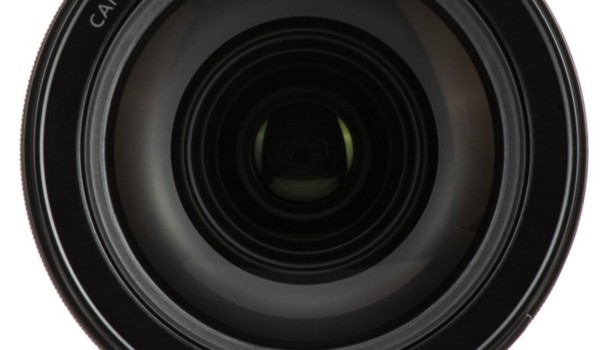
Canon has filed a patent for a 70-135mm f/2 zoom lens for full frame cameras, an internal-zoom design with a fixed front group that reads like a direct answer to the Sony FE 50-150mm f/2 GM that went on sale last year. The numerical example in the filing runs from 72.10mm to 136.89mm at f/2.05, with an optical length of 211mm from the front surface to the sensor, which puts it in the same physical class as Sony's lens.
The application, JP 2026-144169, was reported by Canon Rumors. It contains several optical examples, including a 200-400mm f/4 and a 180-600mm f/6.3, but the f/2 zoom is the one that's particularly interesting. A lens that starts at short telephoto and runs to 135mm at f/2 covers the classic portrait focal lengths of 85mm, 105mm, and 135mm a full stop wider than any 70-200mm f/2.8, in one lens, and Sony has been selling exactly that idea since June 2025.
Canon started this race. The RF 28-70mm f/2L USM arrived in 2018 with the first EOS R, at 1,430 g with 95mm filters, when the conventional wisdom said a full frame f/2 zoom was not worth building. Sony took six years to respond with the FE 28-70mm f/2 GM in November 2024, at 918 g and $2,899.99, then pushed past Canon in April 2025 with the FE 50-150mm f/2 GM: an internal zoom, 1,340 g, 95mm filters, 200mm long, $3,899. Since then, Canon has had an f/2 standard zoom and no f/2 telephoto zoom to put beside it. This filing is the first public sign that it intends to change that.
The physics is less absurd than an f/2 telephoto zoom sounds. The entrance pupil, the apparent size of the aperture as seen through the front of the lens, is the focal length divided by the f-number. At 135mm and f/2, that is 67.5mm; a 70-200mm f/2.8 needs 71.4mm at its long end. That figure is a floor for the front optic rather than a measurement of the barrel, but it tells you the front of this lens does not have to be a monster. The difficulty is behind it. Holding f/2 at the wide end means large rear groups and a great deal of glass in the middle, which is why the 28-70mm f/2 weighs what it does despite stopping at 70mm, and why Sony's 50-150mm weighs almost as much as a 70-200mm f/2.8 while covering less range.
Fast telephoto zooms have a longer history on smaller sensors. Olympus built the Zuiko Digital ED 35-100mm f/2 for Four Thirds in 2005, a 1,650 g lens with the field of view of a 70-200mm but the depth of field of f/4 on full frame. Sigma went a third of a stop faster in 2016 with a 50-100mm f/1.8 Art zoom, but only for APS-C sensors.
What you would get for the weight is one stop, and one stop at 135mm is not trivial. Focused on a subject 3 m away, a 135mm lens at f/2 gives you about 6 cm of depth of field; at f/2.8 it is about 8 cm. The background separation is visibly greater, and the same stop lets you halve your ISO under the same light. For wedding and portrait shooters who currently carry an 85mm f/1.4 and a 135mm f/1.8 to get that look, one zoom that does both at f/2 is the whole appeal, and Sony's sales of the 50-150mm have already made the case that the market exists.
Patents are not products, and Canon files far more optical designs than it builds. The 24mm f/0.7 that appeared in a filing last year has not become a lens, and this one may not either. Canon Rumors notes that Canon has one more announcement day scheduled before the end of 2026, with lenses expected to close out the year, and that two f/2 zoom designs have now surfaced in recent filings. If a 70-135mm f/2 is among them, expect it to be priced against Sony's $3,899 and weighed against Sony's 1,340 g, because those are now the numbers a Canon f/2 telephoto zoom has to beat. You can read more about the patents, including the 200-400mm f/4 and 180-600mm f/6.3 designs in the same filing, from our friends at Canon Rumors.
What's Your Reaction?
 Like
0
Like
0
 Dislike
0
Dislike
0
 Love
0
Love
0
 Funny
0
Funny
0
 Wow
0
Wow
0
 Sad
0
Sad
0
 Angry
0
Angry
0










Comments (0)