

Crude Oil Tumbles to Three-Month Bottom on Iran Nuclear Agreement Supply Expectations

Key Highlights
- Brent crude declined to approximately $78 per barrel, marking the weakest level since March
- Washington and Tehran scheduled to formalize peace agreement on Friday, reopening critical shipping channel
- Iranian crude exports permitted to resume immediately following agreement execution
- American petroleum stockpiles decreased by 8.33 million barrels in latest week, significantly exceeding forecasts
- Domestic gasoline costs retreated near $4.00 per gallon following May highs exceeding $4.56
Crude oil markets continued their downward trajectory for the fifth consecutive trading session Wednesday, reaching their weakest position since March as market participants anticipated the return of substantial Iranian petroleum volumes to international supply chains following a diplomatic breakthrough between Washington and Tehran.
Brent crude futures declined to approximately $78.23 per barrel, while West Texas Intermediate dropped to $75.16. The two primary global oil benchmarks have shed approximately 10% of their value across the previous two trading days alone.
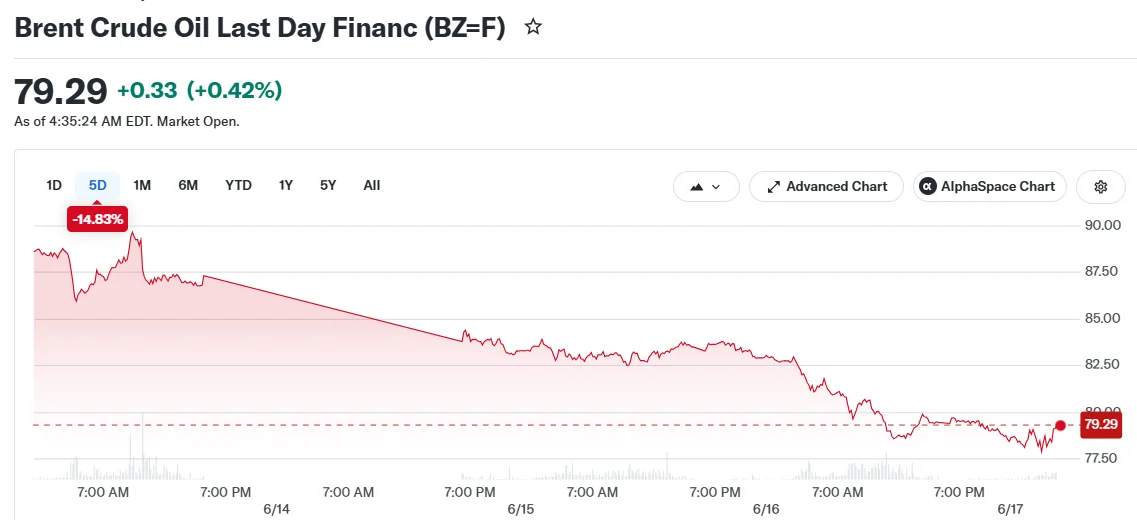 Brent Crude Oil Last Day Financ (BZ=F)
Diplomatic Breakthrough Weighing on Markets
Washington and Tehran have finalized an interim diplomatic framework scheduled for official signing Friday. According to the agreement’s provisions, Iran will permit commercial shipping to resume passage through the Strait of Hormuz, while American forces will terminate their blockade of Iranian maritime facilities.
BLOOMBERG PUBLISHES REPORTED 14-POINT DRAFT US-IRAN MOU
1. The US, Iran, and their allies would declare an immediate and permanent end to the war on all fronts, including Lebanon, and agree not to launch hostile action or threaten force against each other.
2. Both sides would…
— Wall St Engine (@wallstengine) June 17, 2026
Under the arrangement, Tehran gains authorization to commence petroleum exports immediately upon ratification. The comprehensive package includes American exemptions applicable to Iranian oil, petrochemical products, and essential ancillary services including financial transactions and insurance coverage.
The preliminary 14-point framework document establishes foundational parameters while initiating a 60-day negotiation period focused on comprehensive conflict resolution and nuclear program restrictions.
The Strait of Hormuz represents a critical maritime chokepoint linking Persian Gulf waters to the Indian Ocean. During normal operations, approximately 20% of global oil supplies transit this strategic waterway.
Logistical Considerations and Transportation Recovery
Market observers are closely monitoring the timeline for actual supply restoration. Maritime transportation firms are awaiting definitive security protocols before deploying vessels through the strategic channel.
Dennis Kissler, senior vice president for trading operations at BOK Financial Securities, indicated that American naval assets would probably provide escort protection during initial weeks, while mine clearance activities would further constrain shipping throughput.
Parash Jain, who serves as global head of transport and logistics research at HSBC, emphasized that any recovery would occur incrementally. He noted that shipping operators invested substantial time redirecting their fleets and would exercise caution before reversing these arrangements pending clear operational conditions.
Vessel tracking information reveals that two petroleum tankers previously destined for African ports have already reversed course in the Indian Ocean, redirecting toward Middle Eastern terminals.
Stockpile Figures Provide Price Support
Notwithstanding the pessimistic supply outlook, substantial declines in American petroleum reserves provided modest market stabilization.
The American Petroleum Institute disclosed that domestic crude inventories contracted by 8.33 million barrels during the week concluding June 12. This withdrawal exceeded consensus projections of a 4.5 million barrel reduction by more than 85%.
The figures suggest robust consumption patterns within the United States, the planet’s largest petroleum consumer. Official governmental inventory statistics were scheduled for release later Wednesday.
Retail fuel costs have also moderated. The nationwide average across the United States has retreated toward $4.00 per gallon after reaching peaks above $4.56 during May, based on American Automobile Association tracking data.
The Federal Reserve was simultaneously convening Wednesday to deliberate monetary policy direction. While rate adjustments were not anticipated, declining energy expenses represented a consideration within policymaker deliberations.
✨ Limited Time Offer
Get 3 Free Stock Ebooks
Discover top-performing stocks in AI, Crypto, and Technology with expert analysis.
- Top 10 AI Stocks - Leading AI companies
- Top 10 Crypto Stocks - Blockchain leaders
- Top 10 Tech Stocks - Tech giants


What's Your Reaction?
 Like
0
Like
0
 Dislike
0
Dislike
0
 Love
0
Love
0
 Funny
0
Funny
0
 Wow
0
Wow
0
 Sad
0
Sad
0
 Angry
0
Angry
0











Comments (0)