

Editorial: It's time to step up and have your say for science
Your comments on a dangerous rule putting politicals in charge of science can matter.
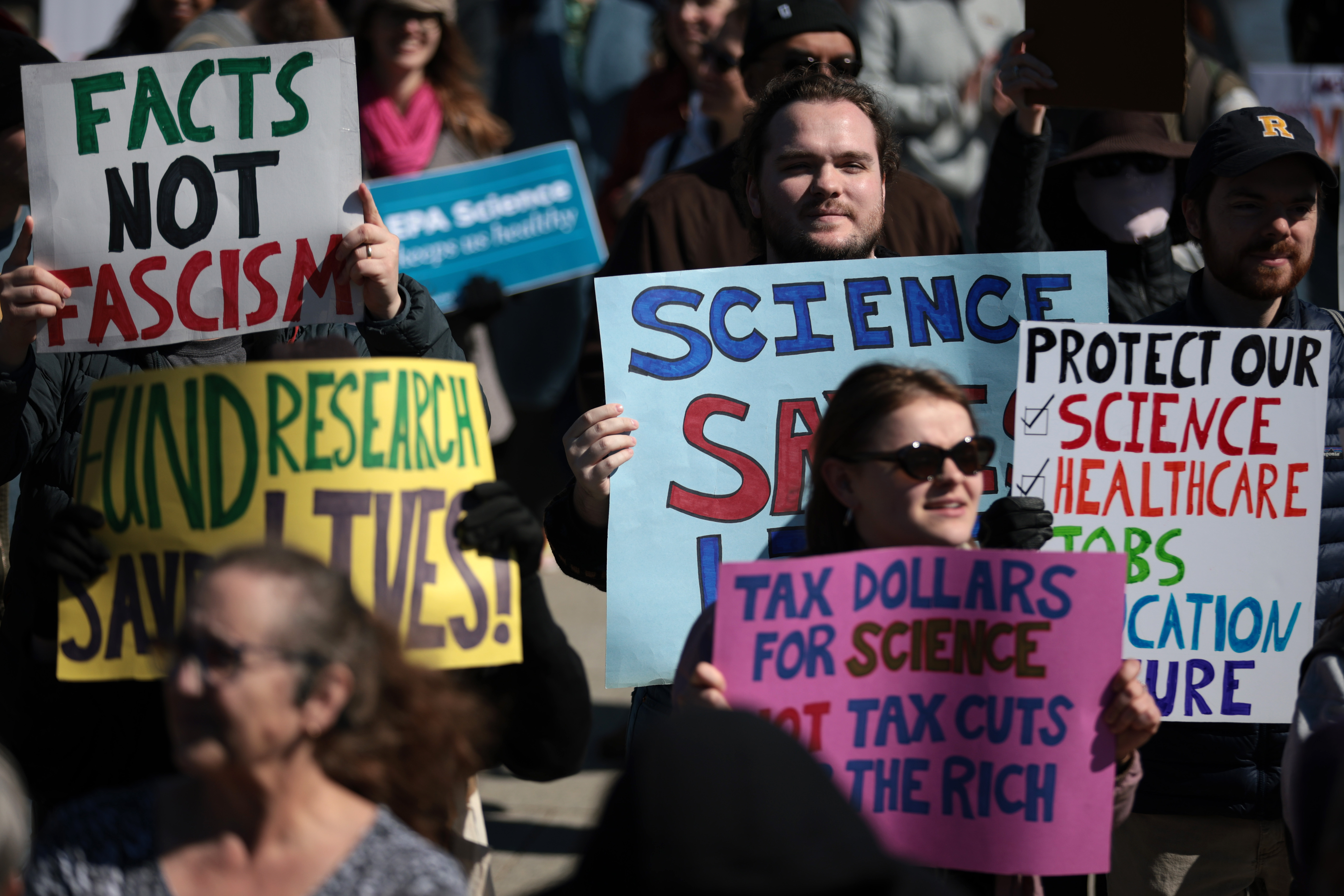
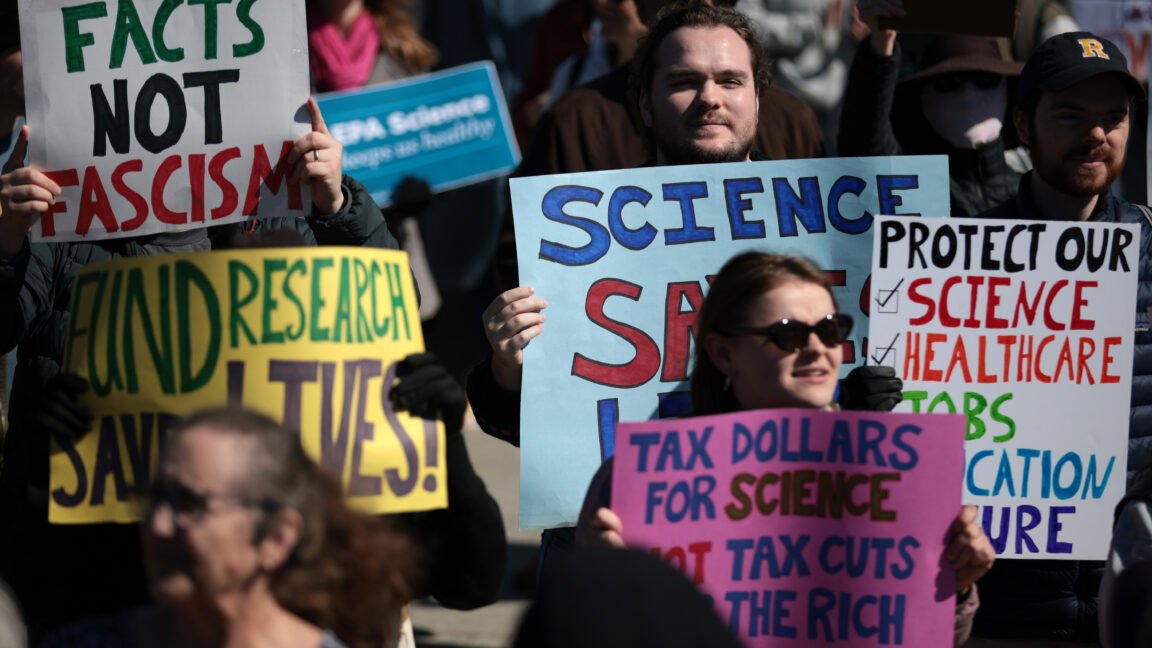
Activists participate in the Stand Up for Science 2025 rally at the Lincoln Memorial on March 7, 2025 in Washington, DC. Credit: Alex Wong/Getty Images
Activists participate in the Stand Up for Science 2025 rally at the Lincoln Memorial on March 7, 2025 in Washington, DC. Credit: Alex Wong/Getty Images
Near the end of May, the Office of Management and Budget (OMB) proposed a new rule that would govern how the federal government handles the grants it issues, including those that fund the vast majority of scientific research in the US.
If formalized, the rule would make political priorities the prime determinant of what science gets funded and sideline the opinions of scientific experts. Grants could be canceled due to political whims, and new layers of bureaucracy would inhibit basic scientific activities like publishing papers and attending conferences. Unlike the executive orders it echoes, it would have the force of law behind it and be significantly harder to challenge in court.
Before coming into force, however, the proposal must go through a process that includes public feedback and (potentially) changes in response. The deadline for that feedback—Monday, July 13—is rapidly approaching.
I’m here to explain what makes this proposal so dangerous, why your feedback matters, and how you can craft an effective submission.
Why this matters
In Ars’ initial coverage of the OMB proposal, I identified many potential problems with the rules. They specifically sidelined peer review as the primary meausre of scientific merit; gave political appointees the final decision on funding; allowed the government to cancel any grant at any time after it was issued; allowed decisions to be made based on vague political litmus tests like “in the national interest” and “aligned with administration policies and priorities”; and required political appointees to approve any spending for conferences or publishing.
The OMB justifies these changes as an effort to “improve transparency, accountability, and oversight” and “reduce recipient burden.” Its goal, as stated in the introduction to the rules, is “ensuring that American tax dollars are not wasted or misused, activities performed under Federal awards are consistent with law and policy, and recipients are held accountable when they fail to meet relevant standards.”
But it’s not at all obvious why that’s the case. There’s no reason to think, for example, that decisions made by political appointees based on vague standards would be any more transparent than those made by peer reviewers based on scientific merit. Or that the ability to cancel grants after they’ve funded part of a research project would avoid wasting American tax dollars.
As I wrote at the time, these changes would cripple US-funded science. We’d enter an era in which each new administration might mean wholesale grant cancellations in line with changing priorities. Any projects requiring long-term planning would be impossible. Using basic academic terminology would place grants at risk of rejection or termination on political grounds. Funding decisions would be made based on what one political party wanted to be true rather than on scientific merit.
While I’d like to think I have a proven history of level-headed reporting and analysis, I can understand why many would see this as an exaggeration. But I’ve read a lot of the ensuing coverage, and I think that initial appraisal holds up.
And you don’t have to take my word for it. The American Association for Cancer Research describes the OMB proposal as “a major threat to the National Institutes of Health” and criticized “the Administration’s concept of ‘Gold Standard Science,’ which is a term the Administration uses to terminate research not because it is unsound but because it does not fit a preferred political or methodological agenda.”
It went on to say that “if this OMB-proposed regulation is ultimately finalized, it will severely weaken the US federal research grant program that has supported American innovation and medical breakthroughs for decades. It will also upend the collaborative and evidence-based model that has resulted in US leadership in cancer research and medical science.”
Shane Jacobson, CEO of the American Cancer Society, had similar thoughts. “Codifying shifting policy preferences into formal federal regulations risks triggering repeated cycles of overhaul with each change in administration,” he said in a statement. “Such back-and-forth would create a chronically unpredictable environment, making it extremely difficult for institutions and investigators to plan and sustain the multi-year, long-term research essential to clinical trials and breakthrough discoveries that patients urgently need.”
Nancy Brown of the American Heart Association echoed these worries, saying, “Policies that undermine independence or shift decisions away from established scientific and public health expertise risk weakening the innovation and collaboration needed to meet current and future health challenges.”
And it’s not just the people in the biomedical sciences who are worried. The American Geophysical Union called the change “a rule that would rewrite the terms of US science” and accused the government of “using the language of scientific rigor as a screen for political gatekeeping.” Its statement echoed a number of the concerns in Ars’ coverage.
“Political officials would have the authority to reject proposals that passed rigorous expert evaluation if they determine the work does not advance ‘the President’s policy priorities’ or is inconsistent with ‘the national interest,’ which could change or reverse course at any moment,” its statement said. “We have spent generations building peer review precisely because decisions about which science to fund should rest on scientific merit, not political alignment. This proposal would undo that.”
The American Physical Society was equally blunt. “These proposals would let political preference override expert peer review, restrict travel, limit collaboration, impede the sharing of results, and affect programs that train the next generation of scientists,” it said. “The proposed federal rule would establish regulations that would have politics shadow every research dollar, making it far harder to undo, no matter who holds office next.” In a follow-up, it said, “The proposal crosses the line, threatening all science, under any administration, now and into the future.”
“This latest move is a brazen power grab by the Director of the Office of Management and Budget to buck the will of Congress and the American people and will make future discoveries less likely,” said Sudip Parikh, CEO of the American Association for the Advancement of Science. “If this rule becomes final, Americans’ hopes for future cures, national security, and economic strength will rely on the scientific sensibilities of the nation’s chief bureaucrat.”
So no, I’m not exaggerating or being excessively negative. There is widespread agreement that this rule likely represents the greatest threat that US science funding has ever faced.
Why you can make a difference
The Trump administration’s assault on various aspects of precedent and governance has left people with a sense of learned helplessness. And many have been willing to wait to let the courts sort things out or find themselves hoping that the damage done before the midterms won’t be that bad.
None of that is the case here. There is reason to act, and the time is now.
The federal rulemaking process requires that any proposed changes be subject to public comment and that the agency must respond to any substantive comments. It doesn’t require that the agency submitting the proposed rule act on those comments, and there are many good reasons to believe that the OMB will try to force these changes through despite any opposition. But the audience for your comments is not only the OMB.
The sources we’ve consulted have consistently pointed out that high-quality public comments serve several purposes. One of the clearest statements we’ve seen comes from Elizabeth Ginexi, a former program director from the National Institutes of Health.
She noted:
A large volume of substantive comments serves three purposes:
- It creates a record of opposition that courts can review if the rule is challenged
- It forces OMB to defend each provision individually, potentially causing them to drop or narrow the most indefensible ones
- It signals to Congress that the rule is controversial enough to warrant legislative action or appropriations riders
In other words, even an OMB filled with ideologues might be compelled by the comments to recognize that some aspects of this proposal are legally indefensible and sacrifice them to give the remainder a chance to survive court challenges. The comments can also provide material for said court challenges. Finally, the public comments can help Congress identify a basis for interventions that could block the rule from taking effect.
By crafting a high-quality public comment in response to this rule, you can make a real difference. Maybe not in the immediate term by influencing the OMB. But you can provide the raw material for ensuing efforts to claw back a reasonable future for science in the US.
Quality feedback
Make sure your comment is high-quality. Simply copying and pasting a suggested response won’t move the needle, since any identical comments can be dismissed as a group. We want to force the OMB to respond substantively to as many individual comments as possible.
Fortunately, a number of guides provide guidance on crafting effective feedback. The piece from Ginexi linked above contains helpful advice and some short examples about halfway down the page. The Society for Neuroscience has posted slides from a talk on the topic online; it also offers brief suggestions for what to include in a comment. The advocacy group Stand Up for Science has posted advice on writing comments, along with an extremely lengthy and detailed submission that demonstrates just how comprehensive a comment can be.
The short version: Explain why you have an interest in the topic and are qualified to comment on it, explain the damage specific aspects of the proposed rule will cause, and point out where the rule is contrary to or unsupported by existing law. To help identify which aspects to comment on, Ginexi provides a helpful breakdown of the different sections of the OMB’s proposal.
All of us have benefited from the pursuit of scientific knowledge uninhibited by political concerns. We rely on technology that has arisen from that research to communicate, navigate, identify risks, track our health, treat problems when they occur, adapt to our changing environment, and more. Everyone will be harmed if political hacks start using the powers OMB wants to give them—Lysenkoism is an example from history that makes that clear. So even if you don’t have a career in the sciences, you can make the case that you’ll be harmed.
When you’re ready to submit, navigate directly to the rule and submit a comment there. But many of the organizations that have come out against it have made their own interfaces that they feel simplify the process of submitting a comment. These include the Society for Neuroscience, the American Geophysical Union, and Stand Up for Science. The American Physical Society also provides a nice interface that allows people to comment on specific aspects of the OMB proposal.
The bottom line is that the proposed OMB rule represents a real crisis—likely the biggest threat US science has faced since government-funded science began to take off in earnest shortly after World War II. You and the people you care about will be impacted by the changes, even if you’ve never considered a career in research. But your comments on the rule can make a difference, even if the Trump administration and Russel Vought, its head of OMB, are completely indifferent to anything you have to say. Thankfully, the tools and advice you need to submit an official comment to the public record are easy to access.
If you want to submit comments, it’s very important to remember that the deadline is July 13, less than two weeks away. That’s enough time to get organized and set aside whatever time you need but not enough to be casual about it. If you care about scientific research in the US, the time to act is now.
Save any material you use to prepare your comments because it will likely be useful when you need to start pressuring your Congressional representatives to act.
While I’ve tried to gather the most useful resources I could find, I’m sure I’ve missed some. Please share any others in the comments.

John is Ars Technica's science editor. He has a Bachelor of Arts in Biochemistry from Columbia University, and a Ph.D. in Molecular and Cell Biology from the University of California, Berkeley. When physically separated from his keyboard, he tends to seek out a bicycle, or a scenic location for communing with his hiking boots.
What's Your Reaction?
 Like
0
Like
0
 Dislike
0
Dislike
0
 Love
0
Love
0
 Funny
0
Funny
0
 Wow
0
Wow
0
 Sad
0
Sad
0
 Angry
0
Angry
0












Comments (0)