

European officials accuse FIFA chief of enabling Russia’s return to international football
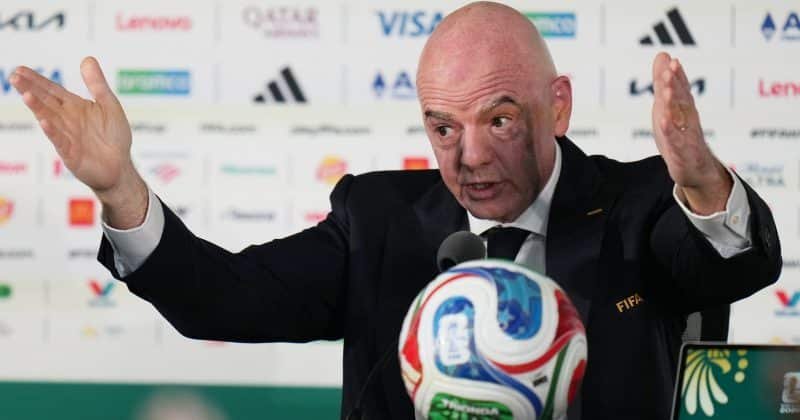
FIFA President Gianni Infantino wants to bring Russian football back into the fold. Europe’s political and sporting establishment wants him to know that’s not happening without a fight.
EU Sports Commissioner Glenn Micallef has publicly criticized Infantino’s proposal to reintegrate Russian teams into international competition, citing “real security risks” and the “deep pain caused by the war.” The pushback comes as Infantino has argued that the ban on Russian teams, in place since February 2022, has only fueled “frustration and hatred” rather than advancing peace.
The U-15 flashpoint
The tension escalated sharply on July 1, 2026, when 44 Members of the European Parliament sent a formal letter protesting the inclusion of Russian U-15 teams in FIFA’s inaugural U-15 World Cup. The tournament is scheduled to take place in Azerbaijan.
The MEPs’ letter referenced the forced deportation of approximately 20,000 Ukrainian children amid the ongoing conflict.
Infantino’s position is that youth categories, specifically, should be exempt from the broader ban. His rationale is rooted in reconciliation, the idea that young athletes shouldn’t bear the burden of geopolitical conflict.
Ukraine’s Foreign Minister Andrii Sybiha didn’t mince words. He called Infantino a “moral degenerate” for what Sybiha views as a willingness to overlook the humanitarian catastrophe still unfolding in Ukraine.
UEFA draws a hard line
UEFA President Aleksander Ceferin has stated clearly that Russia should only be permitted to return to international competitions after the cessation of hostilities. That position puts UEFA, which governs European football, in direct tension with FIFA, its global parent body.
In 2023, there was a brief discussion about allowing Russian youth teams back into UEFA competitions. It was rejected. The fact that the same debate is resurfacing, this time with Infantino actively advocating for it, suggests the FIFA president sees a window he’s willing to push open regardless of who’s standing on the other side of it.
Russia’s national teams and clubs have been banned from FIFA and UEFA competitions since February 2022, shortly after Russia launched its full-scale invasion of Ukraine. Russia had hosted the 2018 World Cup just four years earlier.
What this means for global sports governance
FIFA operates as a global body with 211 member associations. Infantino’s framing of the ban as counterproductive reframes a political question as a sporting one, suggesting the solution lies in inclusion rather than exclusion.
When 44 MEPs coordinate a formal protest letter, that’s a meaningful slice of the European Parliament making a deliberate statement about the limits of sports diplomacy. The 44 MEPs represent a cross-section of European political opinion unified by a single concern: that FIFA is moving too fast toward normalization while the conditions that prompted the ban — an active military invasion and ongoing humanitarian crisis — remain unchanged.
UEFA’s willingness to publicly contradict FIFA’s president suggests a deeper institutional rift. Ceferin’s insistence on tying Russia’s return to the end of hostilities sets a clear, conditions-based benchmark that directly undercuts Infantino’s more flexible approach.
Disclosure: This article was edited by Editorial Team. For more information on how we create and review content, see our Editorial Policy.
What's Your Reaction?
 Like
0
Like
0
 Dislike
0
Dislike
0
 Love
0
Love
0
 Funny
0
Funny
0
 Wow
0
Wow
0
 Sad
0
Sad
0
 Angry
0
Angry
0






Comments (0)