

Film Friday: Ilford Delta 100 Perfectly Blends Contrast and Tonality
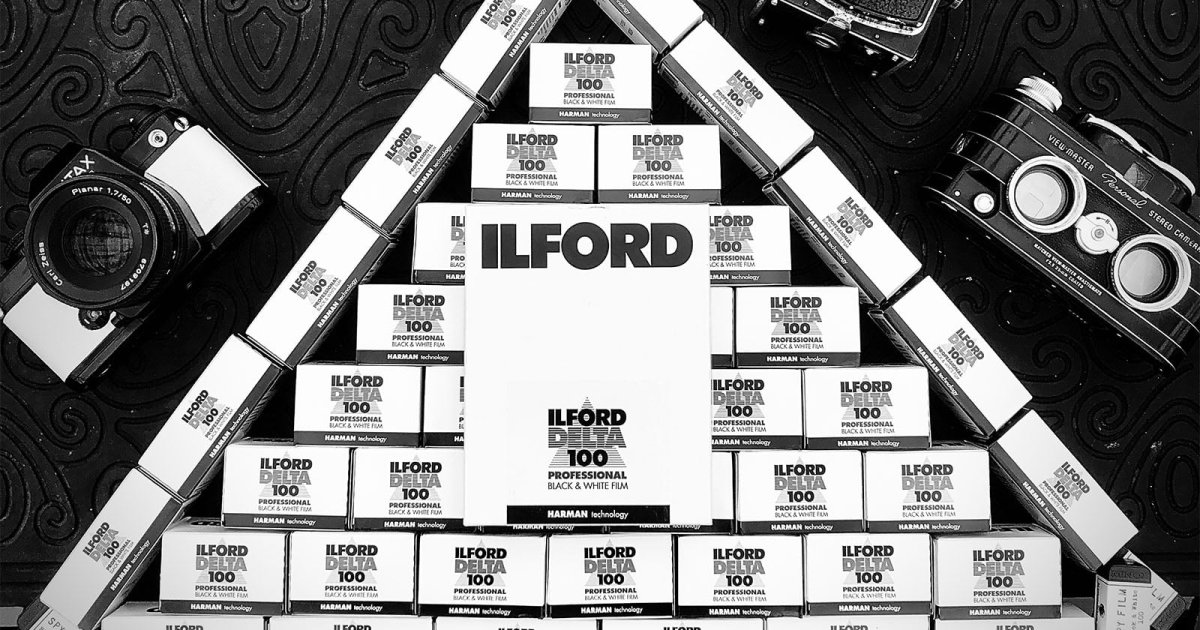
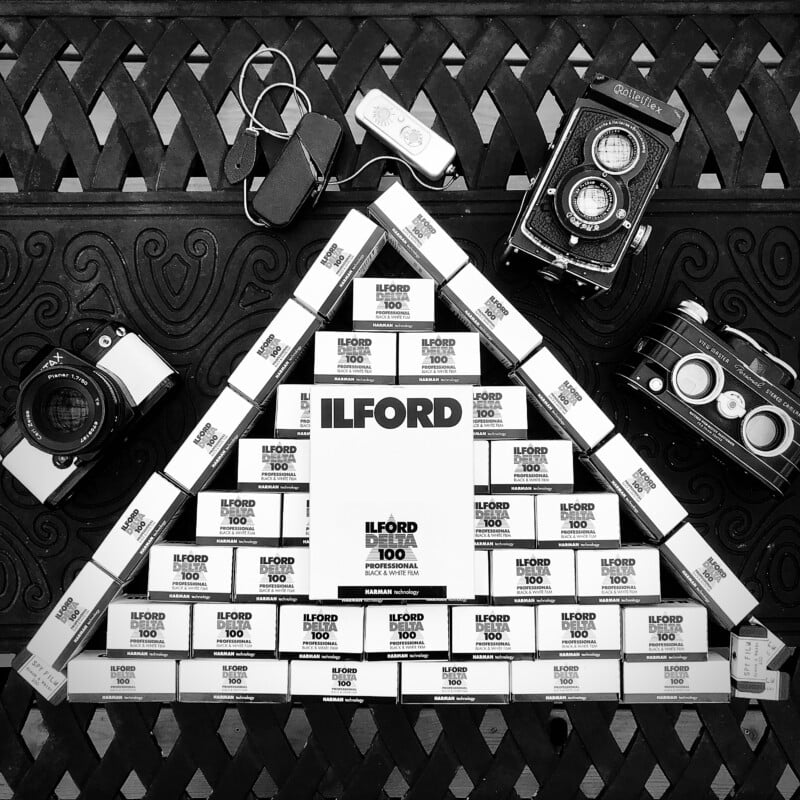
When we first conceived of our Film Friday series, we had a few different motives in mind. The first was that we had long noticed that some black and white films were more popular than others with our customers. We sold a lot more Kodak Tri-X than we did Ilford XP2, for example.
So, we wanted to use Film Fridays to try and shine a spotlight on some of these films that we felt photographers, in general, overlooked. But even we were not immune to such tendencies, therefore, another of our motives was to provide an incentive for us to use the films of which we had little or only passing familiarity. Ilford Delta 100 was actually one of those films for many of us at Blue Moon Camera.
So we have taken our own advice to heart and spent a great deal of effort exposing several rolls of this film and really taking our time to get to know it a bit better. Spoiler alert: we like what we have found.

As is our usual modus operandi, let’s begin with a bit of background info on Delta 100. The film was introduced by Ilford in 1992 and was the second of the eventual three-part Delta family of films. It followed the 1990 release of Delta 400 and would later be joined by Delta 3200 in 1998. At the time, these films were a direct answer to Kodak’s TMax line of films and match it punch for punch — both film families include ISO 100, 400 and 3200 emulsions after all.
Like the TMax films, Delta films also incorporated the newer tabular grain film technology, breaking off from the traditional use of cubic grain emulsions (We’ll get a bit more into this grain here in another paragraph or two). While the Delta films have never quite overtaken Ilford’s long-running HP5 and FP4 emulsions, they have been quietly holding their own for the past 30+ years. A big part of this longevity is due to the fact that they are different films than FP4 and HP5, with their own look and feel — even if the differences are nuanced and subtle. The Deltas have provided that nice counter-harmony to the HP5/FP4 duo in much the same way that TMax has for Tri-X (and Plus-X once upon a time).
With our introduction and brief look at Delta’s history out of the way, it is time to dig in a bit more on this film’s characteristics and what we liked about it specifically.

The first thing that comes to mind is Delta 100’s grain structure. As we mentioned above, the Delta films are tabular grain films as opposed to cubic grain. Essentially, this refers to a different way of forming the silver crystals that allows film emulsions to respond to light. Tabular grain films like Delta or TMax use flatter, more uniform crystals, which provide greater sharpness and resolving power while also being less visible in the scanned or printed image. We knew this going in but were still impressed once we had scanned a few rolls of Delta 100 and started working with the images much more closely.

It is accurate to say that Delta 100 is fine-grained, but that doesn’t tell the whole story. There is more to it than its grain being fine, it is how smooth its grain is that really comes across in the images we made. In the past couple of months, we have now spent time looking closely at TMax 100 and Fuji Acros II, and comparatively, we would venture that Delta 100 feels smoother than TMax 100. It is on par with Acros II, even if Acros II is still a bit finer and smoother. Nonetheless, this is the quality that made the most favorable first impression.

After grain, we next looked at contrast and tonality, and again we would employ the adjective “smooth” to describe Delta 100. It has such a soft and subtle transition of tones. The nice thing about Delta 100 though, is that it manages to be both rich in tonality but still have nice deep shadows and bright highlights. It really does find the perfect balance here. It doesn’t have quite as much drama to its contrast as Acros II does, but it also holds onto the subtleties of its shadow tonality better than that film. And likewise, Delta 100’s highlights remain wonderfully clean, even when those highlights end up a tad overexposed. Meanwhile, its tonal range is full of nuance, akin to APX or RPX films, but not as soft as those films either. It feels kind of weird to say a film excels by being perfectly in the middle of the range because that makes it sound like it isn’t excelling in that regard either. But Delta 100 does excel, it just excels at being that perfect blend of contrast plus tonality.

For this meet-and-greet with Delta 100, we also did a lot of long-exposure work. If you are going to spend time with a film, you might as well really spend some time with that film. But doing so also gave us the opportunity to get a feel for its reciprocity failure characteristics as well. Delta 100 does not have exceptional reciprocity failure, or lack thereof. But what it does have is very consistent compensation needs, making it easy to predict how much extra exposure you need to give the film for those long shutter speeds.

Delta 100 likes to have a bit of extra time starting at 1-second exposures. Not a great start. By the time it reaches 10 seconds, you should be adding a full stop, so that the calculated 10-second exposure should in reality be 20 seconds. But after that, its compensation needs grow pretty slowly. At 60 seconds, it only needs about 1.25 stops according to the Ilford data sheet. At that rate, you’ll be out to five- or six-minute exposures before you hit a full second stop. The sample image we showed of the sign in the water was a four-minute exposure that was metered at two minutes — so only an additional one stop was added there.
We’ll close out this review by pointing out two other perks with Delta 100. The first is that it benefits from a ton of published info, both by Ilford and by users of the film, regarding how to process it in a wide variety of film developers. This is always a nice bonus. Having that info makes it easy to experiment with Delta 100 in different developers, which can tailor the look and feel of the film in a wide manner of subtle ways. For example, we processed all our samples in D-76 1:1, which produced a nice fine grain and middle-of-the-road contrast. But you could also try Ilford DD-X for the best “image quality and finest grain,” according to Ilford. Or Kodak HC-110 or Ilfotec HC for maximum sharpness. Or stand develop it in Rodinal 1:100. Look up Delta 100 on the Massive Dev Chart and you’ll find over 200 lines of film speed, developer, and dilution combinations to try. You could shoot Delta 100 for the rest of your life and spend years not seeing every combination.

The second selling point of Delta 100 is all the formats it is available in. Of course, you can get it in 35mm and 120, and perhaps you are not too surprised to hear it is available in 4×5 as well. But you can also get a box of 8×10. Those are the common formats. Delta 100 takes it further as it is a member of Ilford’s ULF (Ultra Large Format) program and thus can also be had in such formats as 8x20in, 6.5×8.5in, or even 16x20in! It also happens to be one of the seven films we currently cut into Minox format. Fall in love with Delta 100, and you would be hard-pressed to find a camera that you couldn’t load with this film – unless you are into 110, 126, 127 or Kodak Disc. But we think you get our point. Since many of us tend to fall in love with a film and then use it exclusively, it is a nice benefit to know that if at some point a Graflex Crown Graphic 4×5 or a Deardorff 8×10 joins the family, we won’t have to learn a new film while learning that new camera.

So, that concludes this review of how Delta 100 has impressed us. We can honestly say that these rolls we recently shot will not be the last rolls of Delta 100 in our near future. Now we’d encourage you to include some in your near future. If you happen to visit our web (or brick and mortar) store today, you will even find Delta 100 at an automatic discount! Enjoy!
Image credits: All photos by Zeb Andrews and Blue Moon Camera and Machine and captured on Nikon FM2N, Hasselblad 500C/M, Hasselblad Flexbody, and Reality So Subtle 6×6 Dual Pinhole.
This story is brought to you by Blue Moon Camera and Machine in Portland, OR. Blue Moon offers film, development services, printing, and even an ever-rotating line of film cameras and lenses. PetaPixel Members receive 10% off all lab services with Blue Moon: Join today! This story was also published here.
What's Your Reaction?
 Like
0
Like
0
 Dislike
0
Dislike
0
 Love
0
Love
0
 Funny
0
Funny
0
 Wow
0
Wow
0
 Sad
0
Sad
0
 Angry
0
Angry
0












Comments (0)