

‘Girls Like Girls’ Review: Hayley Kiyoko Gives Tumblr Lesbians a Dreamy Excuse to Kiss at the Movies
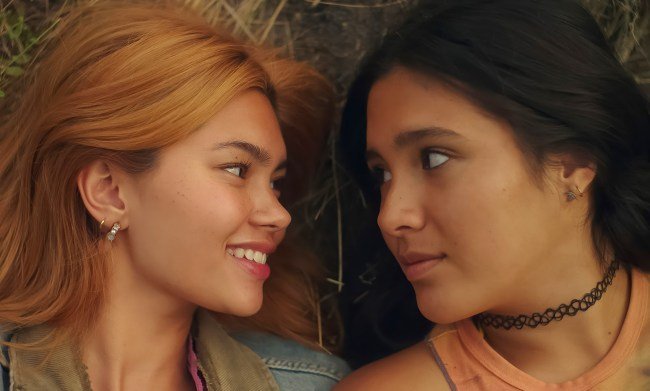
Hayley Kiyoko‘s “Girls Like Girls” arrives in theaters this weekend carrying an unusually heavy burden. The directorial debut of a beloved queer artist affectionately known as Lesbian Jesus (yes, that’s really what Kiyoko’s fans like to call her) would be enough to generate serious buzz on its own. But the 35-year-old singer-songwriter’s first major movie is also based on her landmark music video from 2015, a legendary text for a certain generation of very online queer women.
Hovering around 163 million views on YouTube today, the original “Girls Like Girls” music video is a viral Tumblr-era phenomenon that helped shape sapphic culture in the digital age. Kiyoko’s sun-soaked fairytale — about two teen girls falling in love against a tumultuous backdrop of suburban longing and hidden desire — even inspired the pop icon to write a best-selling YA novel about its characters in 2023.


Translating that text to the big screen seemed like an obvious next step for Kiyoko. And, at a time when studios are frantically searching for creative ways to compel internet audiences toward real-world experiences, it’s also a savvy business move from distributor Focus Features.
The need for a feel-good queer movie is palpable this summer, too; more than a decade since the original “Girls Like Girls,” the culture surrounding Kiyoko’s hit song has changed as much as the entertainment industry itself. When the track and music video debuted in 2015, same-sex marriage had only just become legal nationwide in the United States. Now, many LGBTQ Americans are willing to pay more for safe and inclusive experiences — precisely because civil liberties and onscreen representation feel less secure than they once did.
 ‘Girls Like Girls’©Focus Features/Courtesy Everett Collection
And yet, for “Girls Like Girls” the movie, the final result is less a standalone work of great cinema announcing Kiyoko as a feature director, and more an act of dreamy devotion designed to comfort her core fanbase. That’s not necessarily a bad thing. But it does change who, and perhaps what, this soulful and peculiar film adaptation is for.
Far from a concert movie, “Girls Like Girls” is a nostalgic period romance that demonstrates its director’s enduring connection to the bite-sized love story she co-directed with Austin S. Winchell in 2015. Unfortunately, the earlier version’s charms don’t always translate to a larger canvas, which leaves “Girls Like Girls thin as a feature. Co-written by Kiyoko and actress Stefanie Scott (who also appeared in the music video), the new film’s uneven script struggles to build an accessible world that’s as emotionally rich as the personal memories many viewers will bring with them to theaters.
 ‘Girls Like Girls’©Focus Features/Courtesy Everett Collection
Set in 2006, “Girls Like Girls” follows grieving teen Coley (Maya da Costa) as she moves to Oregon to live with her estranged dad (Zach Braff). There, Coley falls for the magnetic but emotionally unavailable Sonya (Myra Molloy), and the broad strokes of the girls’ story, along with many of the original video’s most recognizable images, will be familiar to Kiyoko’s longtime fans.
Shimmering pools, yellow bikes with butterfly handles, and rushed glances over tall fields of grass produce enough pining between Sonya and Coley to fuel a thousand AIM drafts. Their spark is underscored by a recurring piano riff from the namesake song, but Kiyoko smartly expands her film’s retro musical influences to a wider aughts catalog rather than just turning “Girls Like Girls” into a feature-length vehicle for her own greatest hits: needle drops ranging from Imogen Heap to Tegan and Sarah evoke a version of the early 21st century that feels equally tailored to Millennials who came of age alongside Kiyoko as it does the scads of Gen Z listeners who are currently fascinated by the Y2K nostalgia craze. In this vein and at its best, “Girls Like Girls” manages the melodramatic juice of something like “The O.C.” while lightly brushing against melancholia reminiscent of Sofia Coppola‘s “Virgin Suicides.”
 ‘Girls Like Girls’©Focus Features/Courtesy Everett Collection
Kiyoko understands that the most compelling part of young queer love isn’t always the romance itself but the dizzying realization that an intimate and important friendship has become something much more complicated. Da Costa proves particularly effective in conveying that feeling, possessing an expressive gravity that doesn’t need dialogue to land, even as many of her scripted emotional beats prove awkwardly broad.
On the flipside, Sonya (through no fault of Molloy) proves to be such a frustrating love interest. Sure, getting pushed away repeatedly like you’re a stoner hanging onto Alicia Silverstone in the opening act of “Clueless” is a tried-and-true lesbian tradition. But the chemistry between Coley and Sonya rarely burns hot enough to justify the pain being inflicted, and movie-goers who aren’t already deeply invested in Kiyoko’s “Girls Like Girls” lore could feel left out — even watching the longest version of this story.
In my case, that meant spending huge chunks of the movie pondering how Braff’s acting career had taken him from “Scrubs” to queer cult cinema. And, ironically, “Girls Like Girls” improves the moment Kiyoko’s nostalgic fantasy starts to crack. As Coley and Sonya begin arguing about a mutual attraction that’s become impossible to ignore, their dynamic finally grows some teeth.
 ‘Girls Like Girls’©Focus Features/Courtesy Everett Collection
An intense confrontation that forces the girls’ adolescent feelings into the open offers one of Kiyoko’s most inspired moments of directing, if only because it risks taking a clear perspective. That’s especially true considering some of the earliest beats in “Girls Like Girls” appear surprisingly indebted to heterosexual coming-of-age movies: several key scenes between Coley and Sonya are framed less through the girls’ interior experiences than through visual shorthand that emphasizes their bodies, beauty, and desirability through comedy. There’s nothing inherently wrong with queer women being allowed to occupy the same romantic space in film that countless straight actors have enjoyed for decades, of course. And, in some ways, that kind of representation is long overdue.
But Kiyoko is far more compelling as a narrative storyteller when she abandons those conventions to instead focus on the specific kind of inner chaos that’s always been layered into her lyrics. “Girls Like Girls” doesn’t truly come alive until it stops trying to imitate other stories about young love and instead allows its main characters to explain why queerness ultimately isn’t the problem between them.
The screenplay grows more complex and rewarding as the central relationship weakens, effectively forcing Sonya to deal with her exhausting boyfriend (Levon Hawke) and pushing Coley to connect with her father who, for whatever reason, spends a lot of time hand-making turquoise jewelry. Outside of their mutual interest in decidedly lesbian hobbies, Braff and da Costa don’t always seem like they’re operating in the same cinematic universe. But family scenes help ground Kiyoko’s tearjerker in universal questions of shame and self-acceptance that land harder through Coley’s arc than the on-again-off-again fling surrounding her growth.
I’m gay enough to remember when a tale like this would’ve absolutely wrecked me. The femme-for-femme romances of “Glee” and early CW dramas, like “Riverdale,” were important to me during an imperfect transitional period for lesbian media. If “Girls Like Girls” had arrived in theaters back then, I suspect I would’ve embraced it with open arms. (Or, in the case of the hotties I saw making out in the AMC elevator after the movie, open mouths.)
 Director Hayley Kiyoko, on set, for ‘Girls Like Girls’©Focus Features/Courtesy Everett Collection
But queer cinema has evolved dramatically over the past decade, and so have many film lovers. Leaving Kiyoko’s movie, I wasn’t particularly moved by the experience, but many of her other fans at my screening were. Queer couples and friend groups lingered in the lobby and parking lot, processing the movie and its ending (which, yes, remains as maddening as ever) together. And while their reactions didn’t make the movie work any better for me, they did help me remember the community Kiyoko wanted to preserve.
Unlike many auteur-driven projects, “Girls Like Girls” feels special because it is not interested in celebrating only Kiyoko. In fact, one of the director’s wisest decisions is that she never casts herself. Rather than centering her own celebrity, Kiyoko has spent years building a tribute to an imaginary place her followers inhabited long before the rest of the world took notice. That loyalty is admirable, even when the execution fails to enchant. And if “Girls Like Girls” gives a queer cinephiles an excuse to kiss at the movies in 2026, then Coley and Sonya may have finally accomplished what they set out to do.
Grade: B-
From Focus Features, “Girls Like Girls” is in theaters on June 18.
Want to stay up to date on IndieWire’s film reviews and critical thoughts? Subscribe here to our newsletter, In Review by David Ehrlich, in which our Chief Film Critic and Head Reviews Editor rounds up the best new reviews and streaming picks along with some exclusive musings — all only available to subscribers.
What's Your Reaction?
 Like
0
Like
0
 Dislike
0
Dislike
0
 Love
0
Love
0
 Funny
0
Funny
0
 Wow
0
Wow
0
 Sad
0
Sad
0
 Angry
0
Angry
0










Comments (0)