Google's simulated fruit fly brain 'mines Bitcoin' in web browser proof of concept — FutureBit says real organic neuron miner could have '10x the efficiency of the best silicon 3nm ASICs'
Sep 20, 2026 - 13:05
01
A project claimed to represent “the first organic neuron Bitcoin miner based on the fly brain” has gone live. Yes, this is a cryptomining project that leans on the fruit fly connectome recently shared by Google. FutureBit, the company behind the Apollo series of ASIC miners, introduced the world to its HashFly this week. However, HashFly is merely a proof of concept for now.
Introducing HashFly...the first organic neuron bitcoin miner based on the fly brain. Fun fact if this could be scaled on real organic neurons, it would hash at ~ 1 watt per terahash...10x the efficiency of the best silicon 3nm ASICs! pic.twitter.com/T2qxBb7XQRSeptember 13, 2026
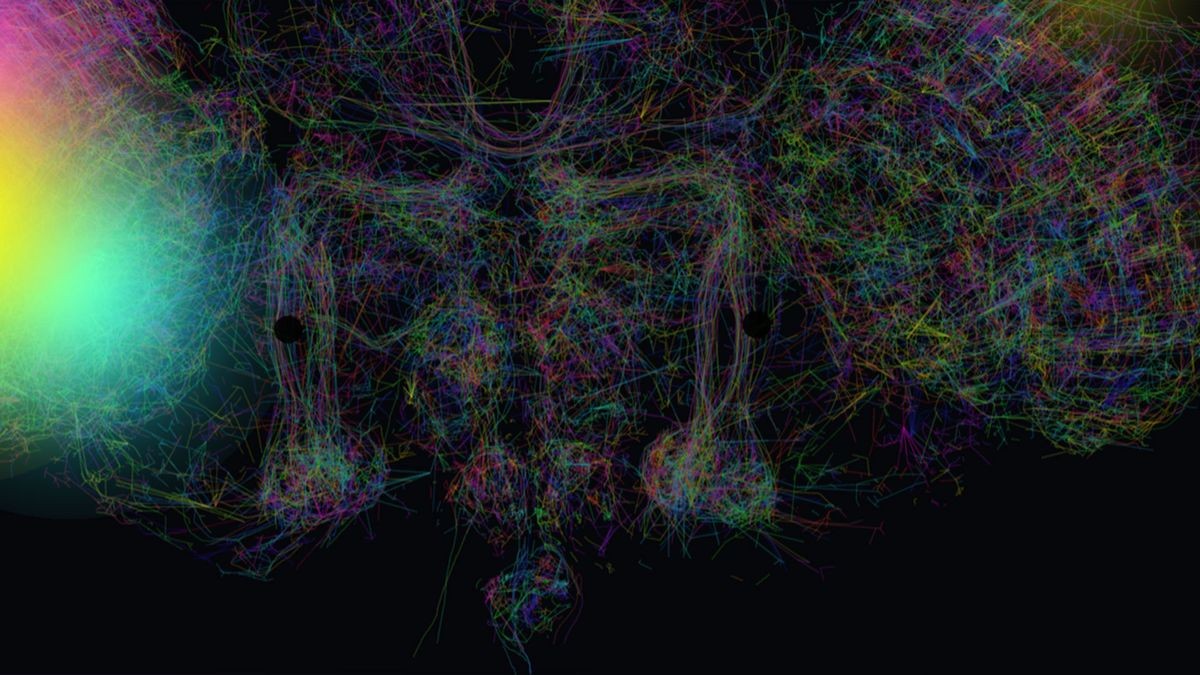
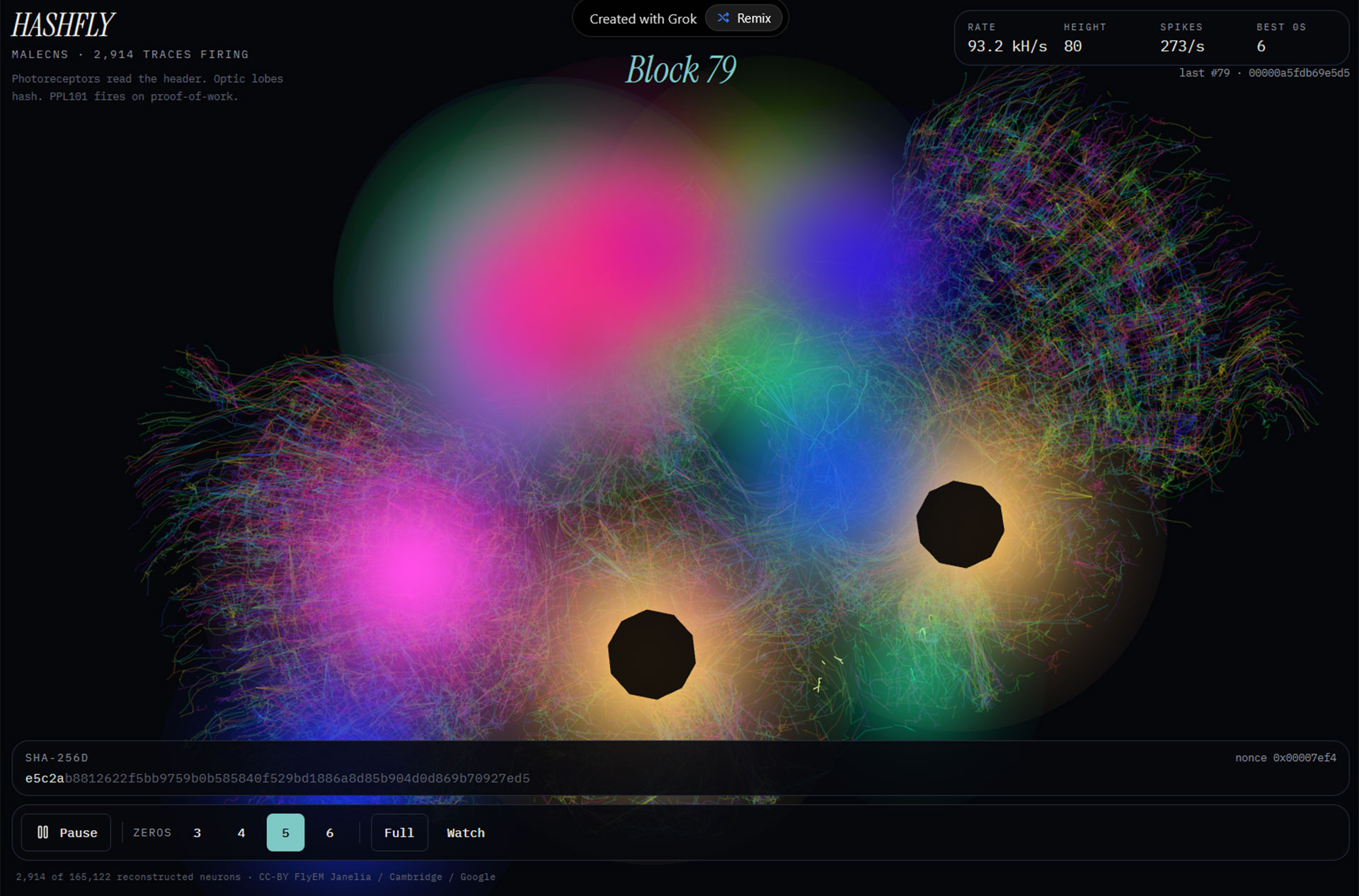
If you open the dedicated HashFly site, you can also participate in this agitation of fruit fly brains in the (vain) hope of a crypto payout. I clicked the 'Mine' button and left it running for an hour, for science, and periodically flipped back to the tab to see the gently rotating fly brain’s neuron traces firing. Looking at the website overlay, one can see the web app represents “2,914 traces firing” within the fly’s brain. It is worth mentioning that this figure is just a small subset of the full 165,122 reconstructed neurons in the MaleCNS v1.0 fruit fly connectome.
HashFly proof of concept running online (Image credit: HashFly)
We understand that FutureBit’s HashFly focuses on the simulated photoreceptors that would usually sense light in the fly’s eye. These read a block header, and neurons called PPL101 cells light up when a double-SHA-256 target is computed. You can make the target harder and easier by adjusting the ‘zeros’ up and down. Even at maximum difficulty in this proof of concept (level 6), it is far, far easier than finding a real Bitcoin hash, and I saw about 80 blocks checked off in an hour or so.
What’s the point of this proof of concept? According to its designers, it provides some more insight into the potential efficiency of organic computing, or wetware. “Fun fact,” teases FutureBit. “If this could be scaled on real organic neurons, it would hash at ~ 1 watt per terahash... 10x the efficiency of the best silicon 3nm ASICs!” These guesstimates are based on “total power used by the fruit fly, and assuming all neurons could be used to hash Bitcoin functions and continually keep firing,” says the Bitcoin mining hardware maker in a follow-up tweet.
Those who find this experiment interesting may be happy to hear that the HashFly demo will be scaled up to its logical conclusion. “We are working on simulating all neurons in the dataset with the sha256 hash function and will publish all our findings,” says FutureBit. It certainly needs scaling up if my HashFly web performance of ~100 kH/s is typical. Compare that to the firm’s 5-inch cube Apollo III, which is claimed to deliver “up to 18 TH/s of Hashpower.”
We’ve seen a few other fly brain connectome mapping-inspired projects from the fevered minds active on social media over the last week or so. Almost immediately after Google announced it had published the complete brain and central nervous system of an adult male fruit fly, we saw people seeing if it could play Doom, indulge in financial day trading, and many more frivolous pursuits.
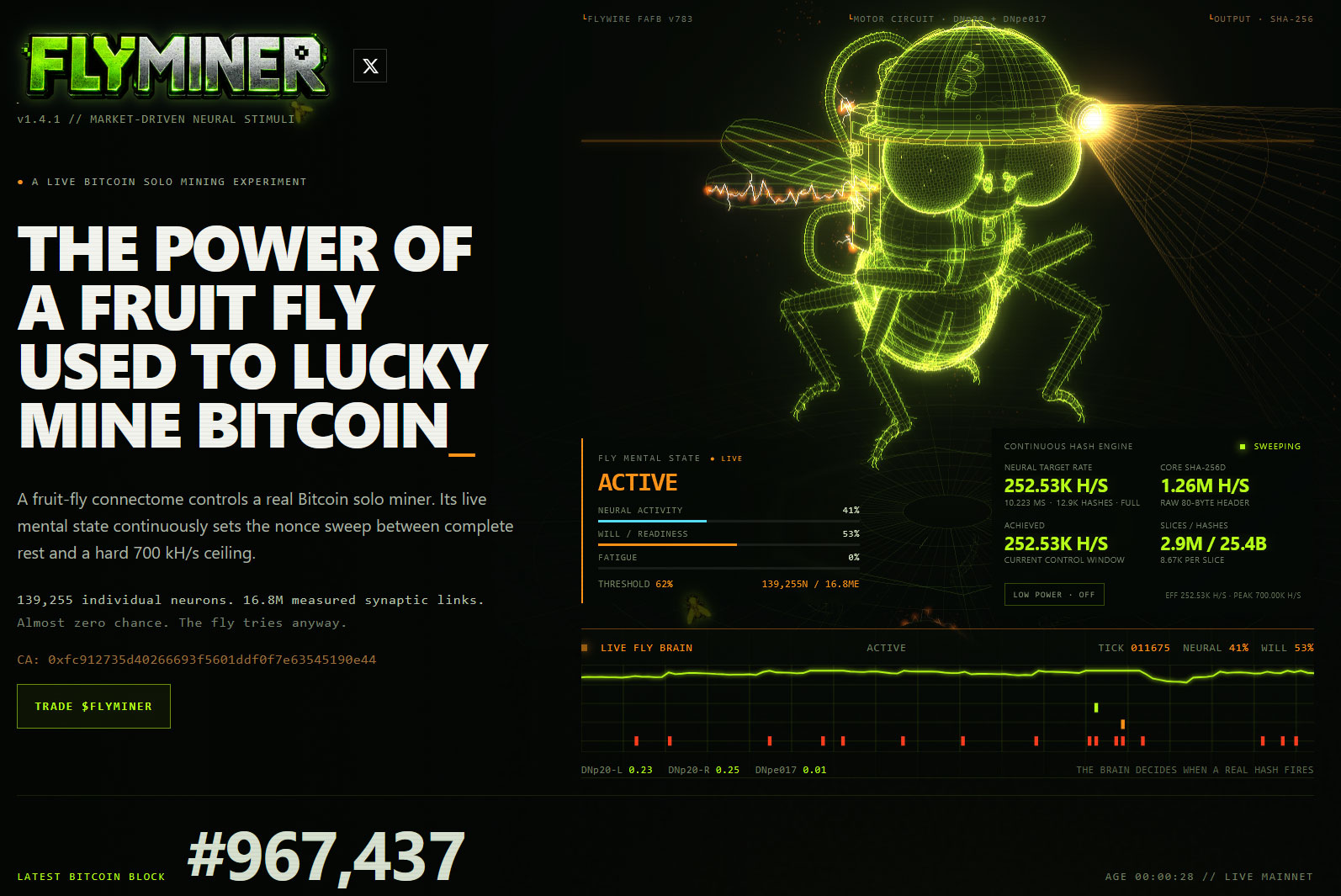
Another fly-brained crypto project - FlyMiner (Image credit: FlyMiner)
There’s even a rival cryptomining scheme dubbed the FlyMiner. Visiting this portal, you can see a fruit fly connectome that has been put under the control of an ASIC miner. Visiting that site will also be limited to a brain-nourishing, not money-spinning, activity, as FlyMiner admittedly has “almost zero chance” of mining success.
Get Tom's Hardware's best news and in-depth reviews, straight to your inbox.
Mark Tyson is a news editor at Tom's Hardware. He enjoys covering the full breadth of PC tech; from business and semiconductor design to products approaching the edge of reason.



 Like
0
Like
0
 Dislike
0
Dislike
0
 Love
0
Love
0
 Funny
0
Funny
0
 Wow
0
Wow
0
 Sad
0
Sad
0
 Angry
0
Angry
0









Comments (0)