

‘Hen’ Review: A Cockeyed Comedy Sees Europe’s Migrant Crisis Through the Eyes of a Chicken
Among the bleakest films ever made, Werner Herzog’s “Stroszek” (1977) famously ends not with the suicide of its title character, but with a haunting coda in which a chicken pecks at a miniature piano inside a surreal roadside tourist trap’s coin-operated display. It’s a visual metaphor for the inescapable banality of life on Earth, and for the dehumanizing work people are forced to do to disguise the many failures of the American Dream. It’s also the last thing that Joy Division frontman Ian Curtis saw before he killed himself. “Look into the eyes of a chicken,” Herzog has said, “and you will see real stupidity. It is a kind of bottomless stupidity, a fiending stupidity. They are the most horrifying, cannibalistic, and nightmarish creatures in the world.”


That sentiment has long endured as modern cinema’s definitive stance on chickens (despite Aardman’s best efforts), but now, after witnessing the 50 years of entropy that followed “Stroszek,” Hungarian filmmaker György Pálfi is crying fowl. Chickens are not the most horrifying, cannibalistic, and nightmarish creatures in the world, he contends. We are. How can you tell? Easy: Just look at us through the eyes of a chicken.
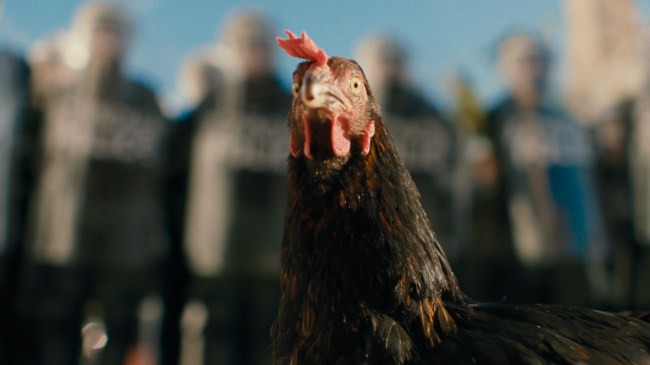
A cute, cockeyed yarn that unspools like a feathered cross between “EO” and “Flow,” Pálfi’s “Hen” tells the story of a jet-black Leghorn chicken who escapes a Greek factory farm after she’s plucked from the rest of her flock because of the color of her plumage. A worker decides to take the bird home so that his wife can serve it for dinner, but our sly heroine — played by a brave hen named Feri, in addition to her seven indistinguishable stunt doubles — makes a daring escape when her captor stops his truck to refuel. But she’s snapped up again by the teeth of a dog named Titan, who carries the chicken back to the ramshackle seaside restaurant where his owner (Yannis Kokiasmenos) has much bigger problems than what to serve for dinner.
If the precise contours of those problems are a bit difficult to deduce, that’s probably because — as we’ve already established — this movie is told through the eyes of a chicken. Sometimes literally, thanks to Pálfi’s judicious deployment of POV, which is useful for times when our ruffled protagonist is, say, trapped inside a cardboard box (there’s an excellent bit where the hen starts moving the cardboard box from the inside, a “Metal Gear Solid”-inspired visual gag that proves typical of the director’s wry humor). And what does a chicken know of Europe’s ongoing migrant crisis? Of a protest between angry citizens and riot police? Of human trafficking, and the complications thereof? To judge by the film’s regular assortment of amusingly blank reaction shots, I’d wager “very little.” The titular hen doesn’t even think to look both ways when she crosses the road after flying the coop, let alone have a good answer as to why she’s doing it.
For the most part, the hen is focused on clucking her neck, surviving the pecking order at the restaurant farm where she winds up, and potentially even laying a few eggs of her own someday (we see her hatch in the movie’s first scene, but they grow up so fast). Most of the human drama is relegated to the distant background, as Pálfi mines the humor from his movie’s conceit by using the restaurant as a lens onto the hen’s predicament rather than the other way around. The people are mere archetypes, but some of the animals we meet appear so layered and inscrutable that you’d happily watch a three-hour Nathan Fielder documentary about them. (The terse and fiery courtship between the star hen and her most aggressive suitor is soundtracked by a classic Greek love song, a flourish that stands out in a film where desperate migrants are being left for dead just off-camera.)
Then again, couldn’t every film about — and starring — real live animals be considered a documentary to some extent? Feri the chicken has been trained by the best of the business, but she remains blissfully unaware of the camera, and Pálfi takes pains not to anthropomorphize her any more than necessary. Plenty of heightened enjoyment comes elsewhere, much of it laundered through Giorgos Karvelas’ saturated cinematography, Szabolcs Szoke’s hyper-dynamic score, and the furtive way Pálfi bends the film’s crafts into something that almost resembles a chicken’s idea of a Western.
Here, the hen is a hen is a hen, and while “Hen” is prone to long and repetitive stretches in which she basically just hens around as a result of that approach, the animal’s natural obliviousness is too crucial a contrast to our own willful antipathy for Pálfi to risk muddying the difference between the two. At the risk of making the movie’s side-eyed social commentary sound more didactic than it is in practice (save for one very pointed moment towards the end that explicitly affirms Herzog’s claim), “Hen” uses a chicken’s lack of moral responsibility to highlight the mandate we have to heed our own, no matter how effectively we’ve evolved to ignore it.
No matter how good we get at farming other species, and killing our own. Pálfi does very little to goose or otherwise manipulate our emotional attachment to his chicken star, but there’s still something to be said for how easily we become more invested in this witless hen’s fate than in that of the doomed people with whom she crosses paths. By the time it reaches its end, this strange but sober film starts to point back to the beginning, cutting from a single egg being squeezed out of a hen’s vent (Google says “vent”) to a vast sea of them bobbling around inside the factory’s machines. One is easy to follow, and to care about. Thousands are a statistic. We’re smart enough to farm other animals, but people — like chickens — won’t hesitate to eat each other the minute they get hungry.
Grade: B
Dekanalog will release “Hen” in theaters on Friday, November 6.
What's Your Reaction?
 Like
0
 Dislike
0
 Love
0
 Funny
0
 Wow
0
 Sad
0
 Angry
0










Comments (0)