

How Photographers Are Using Insta360 Cameras to Protect Sharks
To celebrate Shark Awareness Day, Insta360 has released a new video created in collaboration with renowned conservationists, photographers, and cinematographers.
Shark Awareness Day is observed annually on July 14 and is dedicated to combating harmful myths surrounding sharks and helping educate people about why sharks are an essential part of a healthy marine ecosystem, which in turn has significant impacts on human wellbeing.
Sharks worldwide are facing an existential threat. Engaging imagery, presented alongside important science, can be a powerful weapon to help protect sharks from grave harm. This is a big part of Insta360’s involvement with the PADI AWARE Foundation and Shark Awareness Day.
“This Shark Awareness Day, Insta360 is inviting its global diving community to give those moments a new purpose, showing that the footage they capture can do more than tell incredible stories. It can also become a powerful tool for conservation,” Insta360 explains.
As part of this initiative, Insta360 teamed up with shark conservationist ZimyDaKid, shark photographer and politician Ari Rabin-Havt, Tiger Beach specialist Roy Mauritsen, and Emmy Award-winning wildlife cinematographer Andy Casagrande IV.
“Using Insta360 cameras to capture perspectives that few people ever get to experience first-hand, they reveal a side of sharks that many have never seen before,” Insta360 continues.
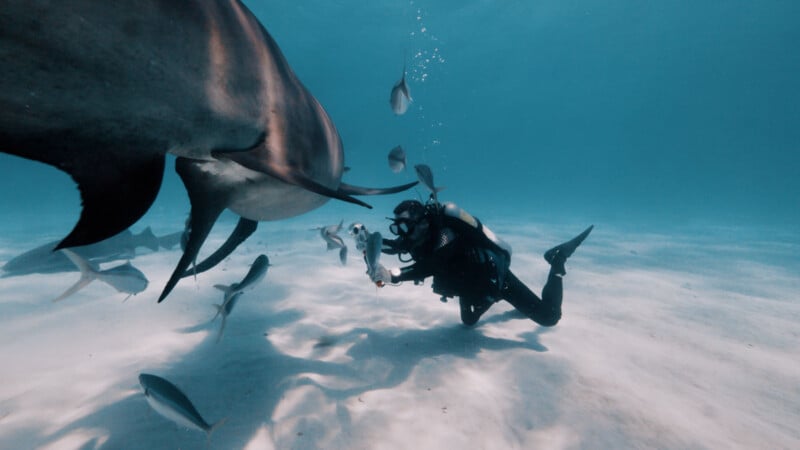 Ari Rabin-Havt underwater using an Insta360 X5 camera | Credit: Insta360
Insta360 believes that through immersive visual storytelling enabled by its cameras, people will be better able to connect with sharks and, in an exciting way, learn that sharks are not the terrifying beasts many people think they are. Instead, sharks are incredible animals that deserve and need protection.
“We’ve always believed that new perspectives have the power to change the way people see the world,” says Max Richter, Co-Founder and VP of Marketing at Insta360. “This campaign is about showing sharks through the eyes of the people who know them best. We hope those stories inspire more people to appreciate these incredible animals and the important role they play in our oceans.”
Ari Rabin-Havt: Political Manager Turned Renowned Shark Photographer
For Ari Rabin-Havt, political analyst, author, campaign manager, and extremely talented photographer, sharks and shark conservation have become a huge focus over the past couple of decades.
“18 years ago, my wife and I were on our honeymoon in Hawaii, staying at her aunt and uncle’s house on Oahu. We went to dinner with them, and her uncle asked if we’d ever been on a shark dive. He was friends with the owner of a company on the North Shore and told us we had to go. So early the next morning, we found ourselves jumping into a cage surrounded by dozens of Galapagos sharks. It was a life-changing experience for me. (My wife, not so much),” Rabin-Havt tells PetaPixel.
“I expected an adrenaline rush. Instead, it was almost meditative. Once you’re in the water with them, the fear just falls away, and what’s left is this incredibly precise, curious, ancient animal. Sitting in the water with a creature whose lineage goes back 450 million years, older than wildfire, you start to see how irrational our fear of them really is. That gap between what sharks actually are, and what we’ve decided they are, is the thing I couldn’t let go of.”
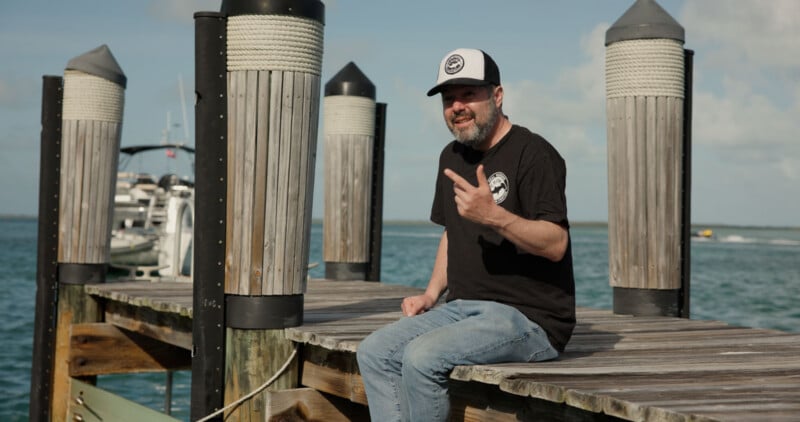 Ari Rabin-Havt | Credit: Insta360
This experience has informed so much Rabin-Havt’s life and career since then, and he is now one of the world’s premier shark photographers.
As Rabin-Havt notes, it is challenging for people to protect an animal they fear.
“Sharks have a narrative problem,” he says. “For 50 years, the dominant image of a shark has been designed to produce fear, now awe or curiosity. Both Steven Spielberg and Peter Benchley have expressed regret for the impact Jaws had on the public’s perception of sharks, and in turn on ocean life.”
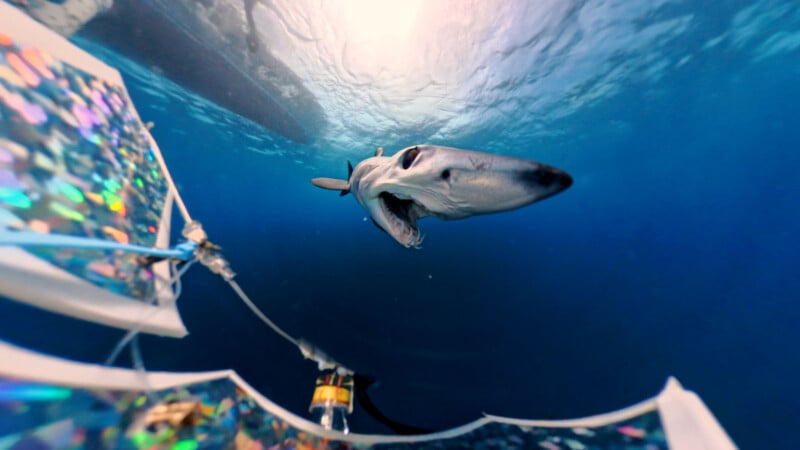 Credit: Insta360
“Photography can help reframe that narrative. When you show someone a photo of a great hammerhead moving over white sand, or the light coming down through the water around a great white, you’re not arguing with their fear. You’re replacing the picture in their head. That is what I want my images to do.
“I spent years trying to win political arguments for a living. One of the most important political operatives in American history, a Republican, once said that political strategy comes down to three things: pictures, mistakes, and attacks. Dominating the image in people’s minds is the first step to winning the argument. I hope my photography can do that for sharks.”
‘Photography can help reframe that narrative’
Science is an extremely important part of conservation, but Rabin-Havt believes scientists cannot do it all alone. He knows how the political machine works and understands how essential it is to creating real change. He also knows what makes it tick.
“Somebody must be persuaded,” the photographer explains. “Conservation doesn’t just happen because the science is good; the science has been good for a long time. It happens when the public cares enough to give a politician a reason to act.”
Rabin-Havt wants photography to help create that reason to act.
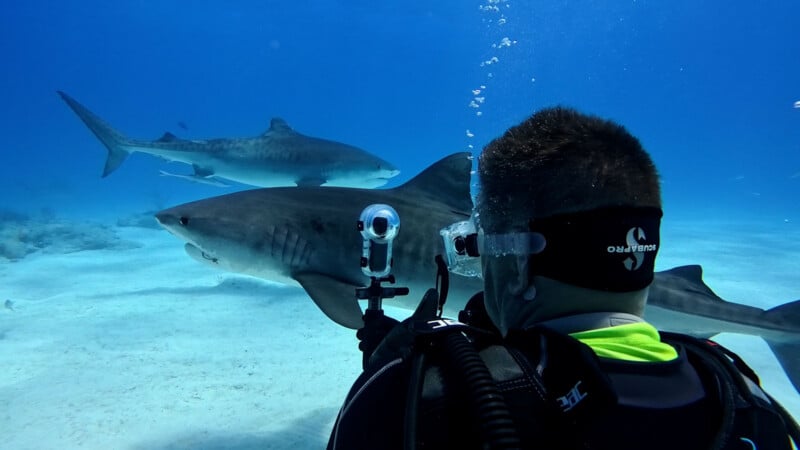
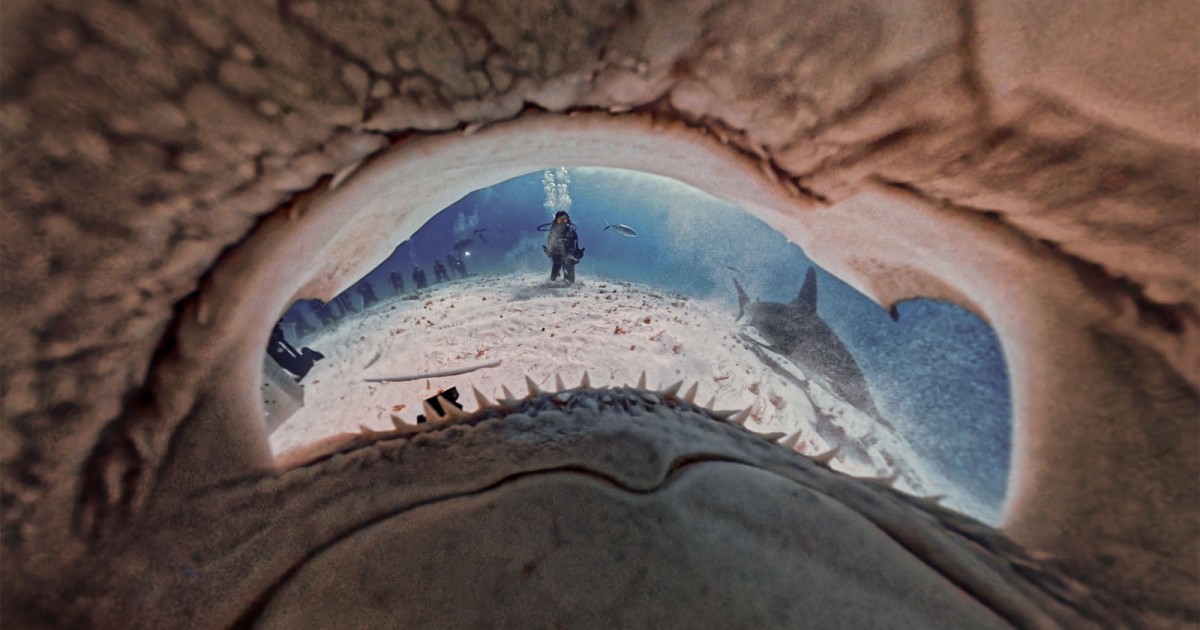
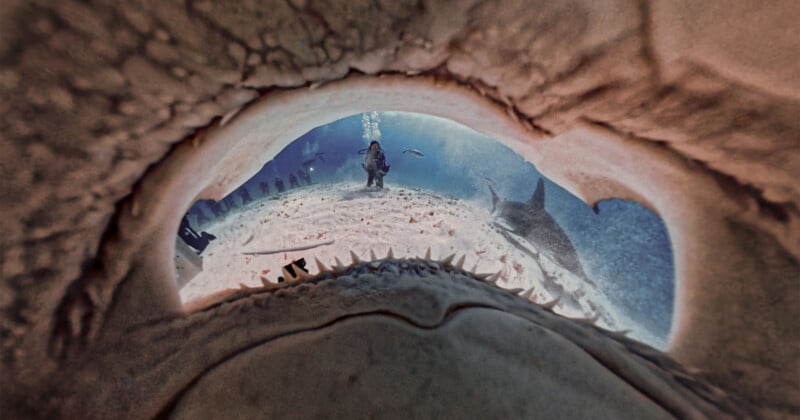
While Rabin-Havt’s primary setup is a Canon EOS R5 II inside a Nauticam housing, he says every setup has its limits and not every camera is right for every photo. Rabin-Havt made waves last year after capturing images from inside a shark’s mouth, and that was made possible thanks to an Insta360 X5 camera.
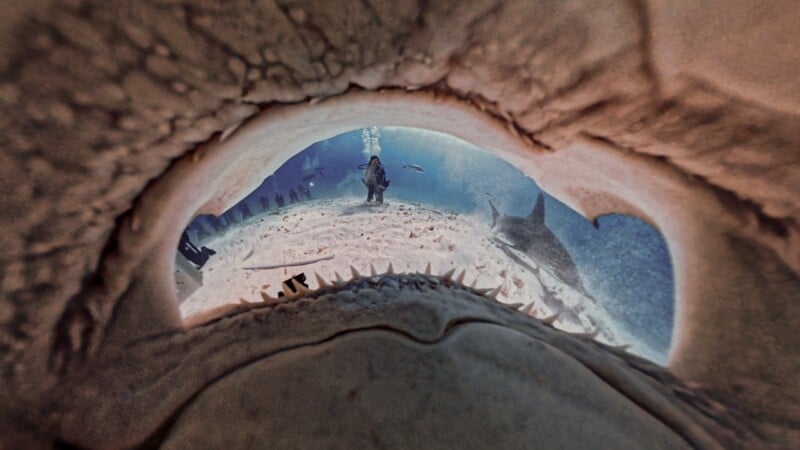 Photo credit: Ari Rabin-Havt
“The Insta360 X5 changed what’s possible. It’s tough, it’s tiny, it sees in every direction at once, and its image quality underwater is remarkable for a camera that size. I want my gear to expand my imagination, not limit it,” Rabin-Havt says.
“The shot I captured from inside the shark’s mouth came only after observing these animals in the water for a long time. You can’t just jam a camera into a shark’s mouth. It would be cruel and it wouldn’t work. The shark would just swim off. You have to give them the choice. So, we placed the cameras on the ocean floor and let the sharks pick them up and take the picture themselves. To do this, you need to trust your gear completely, and you need to know it’s safe, for you and for them.”
Since then, Rabin-Havt has safely created similar images from inside the mouth of a white shark and a bull shark.
Although it may seem like shark photography is a massive departure from Rabin-Havt’s prior life and career in politics, he says not so much.
 Ari Rabin-Havt says photographing people, like politician Bernie Sanders here, is not always so different from photographing sharks. That’s not an indictment of people, though, it’s a testament to sharks. | Photo credit: Ari Rabin-Havt
“More is the same than you’d think. Every subject comes down to patience and to earning a moment you don’t control. You learn the behavior, you put yourself in the right place, and you wait for the subject to give you something true. The real difference between people and animals is performance. People perform. Animals don’t.”
This unpredictability is a crucial part of what makes photographing sharks so special for Rabin-Havt. From his transformative experience nearly 20 years ago in Hawaii to his work today, one thing has always remained true: time spent underwater with sharks is meditative.
“The moments that stay with me aren’t the dramatic ones. They’re the quiet ones, where a big animal decides you’re not a threat and is just as interested in you as you are in them. A hammerhead making a slow, deliberate pass, close enough that you can see its eye tracking you. Or the first time you notice a great white’s eye isn’t a deep black hole at all, that the pupil is surrounded by a ring of blue. You usually only catch it because the shark is watching you. That recognition, that this is a thinking animal making a decision about you, is something a photograph can hint at but never fully hold.”
As Rabin-Havt says, sharks are not the threat. We are.
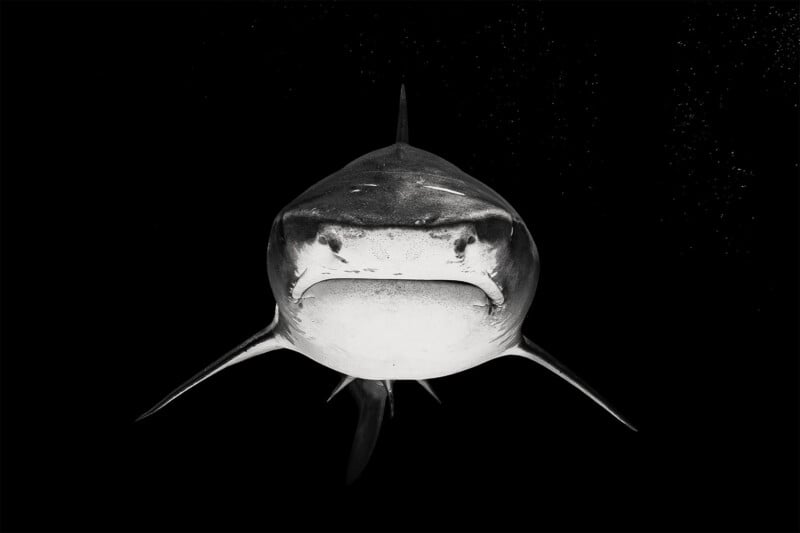 Photo credit: Ari Rabin-Havt
Photography’s Intersection With Shark Science
And that’s something he, his fellow photographers and filmmakers, Insta360, and PADI AWARE are working very hard to change.
As part of the collaboration between Insta360 and PADI AWARE, the two are launching the PADI AWARE Shark and Ray Discovery Challenge on August 2, 2026. This challenge invites all participants to revisit their previous dives and contribute data about any shark and ray sightings through the Global Shark and Ray Census.
“There is a myth that only scientists can do science — that’s not correct,” says Dr. Andrew Chin of James Cook University, a leading researcher collaborating with PADI AWARE on the Global Shark and Ray Census. “Scientists have worked with divers to describe new species and find places where they didn’t know they existed. The footage and observations sitting on our cameras and SD cards are incredibly valuable.”
Divers may have very valuable data in their possession right now. They need only look.
Image creditsInsta360, Ari Rabin-Havt
What's Your Reaction?
 Like
0
Like
0
 Dislike
0
Dislike
0
 Love
0
Love
0
 Funny
0
Funny
0
 Wow
0
Wow
0
 Sad
0
Sad
0
 Angry
0
Angry
0







Comments (0)