

I Watched Apple's Entire Keynote So You Don't Have To
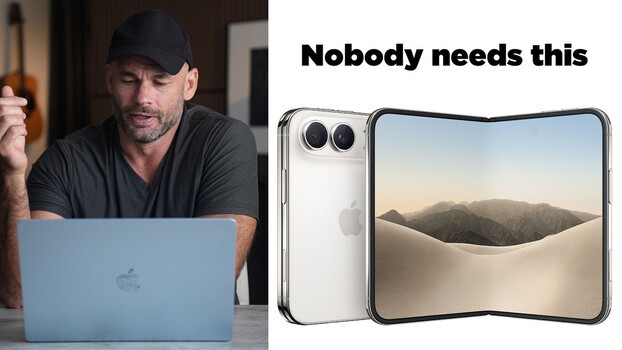
Apple just had a gigantic keynote. New iPhones, new AirPods, new Apple Watches, and the one everybody was waiting on, a folding iPhone. I sat through the entire hour and a half and took detailed notes, and I came out of it more curious than convinced.
The thing I keep coming back to has nothing to do with the phones themselves. It is the footage. The whole keynote was shot on the new iPhones, and as a working videographer, it looks incredible. What I still cannot figure out is the motion blur. Almost every movie you have ever seen was shot at 24 frames per second with the shutter locked at around 1/50 of a second, and getting that on a real camera means fine-tuning your settings and usually reaching for neutral density filters. You cannot normally do that on a phone, because people are casually shooting in wildly different light. Lock your exposure here, pan to the darker side of the room, and everything falls apart. Apple pulls it off anyway in every single one of these videos, and honestly, I would not be surprised if some of that blur is being added after the fact. If you want the actual mechanics behind why shutter angle matters, that is the foundation we cover in Introduction to Video.
The new phone does finally give you shutter speed control, which is a real answer to that problem and the single camera feature I am most interested in. Alongside it you get customizable pro controls in the camera app, which we have been asking for for years, and intelligent subject tracking, which is another thing I rely on with my professional gear that is now showing up on my phone for free.
I Do Not Understand the Variable Aperture Yet
The headline camera change on the iPhone 18 Pro is a 48-megapixel main camera with a variable aperture. I have been shooting professionally for 20 years and I am not claiming to understand everything, but I do not see why a lens this small needs one. Variable aperture matters as sensors get bigger and depth of field becomes something you have to manage. On a sensor the size of the one in your phone, depth of field is barely an issue at all. Wide open you are not getting much blur to begin with, and Apple has spent years building software specifically to fake a shallow depth of field. So why would you ever not shoot wide open?
You might think the answer is video, that the aperture will ride up and down to hold a locked 1/50 shutter. I am not sure that is what is happening. In the detailed camera settings Apple published in the keynote, one shot lists f/4, which is not a small aperture at all. And a presenter says the aperture opens to let in around 50 percent more light. Remember that a full stop is double or half, so 50 percent more light is roughly half a stop. That is close to nothing. There is clearly something here I do not understand yet, so I am going to do a full deep dive on the variable aperture and the motion blur question and make a separate video just about those two things.
The AI Promises, Again
If last year's keynote felt familiar, that is because most of the AI Apple promised then never actually shipped. This time they seem serious. Siri is supposed to finally understand and control the phone, pull information across apps, and if you let it, read essentially everything you have, including your mail, your messages, and your calendar, so it knows you completely. Apple says all of it stays on the device and that even Apple will never see it. I do not know that I believe that 100 percent, but I trust Apple with it more than I would trust anyone else in this space.
My problem is the upgrade math. Apple spent a lot of time on the new A20 chip and how much more on-device AI processing it allows, without ever really saying what this phone can do that last year's cannot. Everybody bought the 17 Pro expecting these features, never got them, and is now being told the new chip is what unlocks them. So either the features come to older phones, in which case what am I upgrading for, or they do not, in which case last year's promise is still unpaid.
One AI feature I am genuinely glad to see is Apple Reference Image, a way to prove a photo taken on the phone is real and untouched. Given that I now have no idea whether anything I see online was made by a camera or a model, that matters more than most of what was on stage. My colleague Alex Cooke dug into how that actually works.
The AirPods Are the Easy One
The AirPods 5 got the least stage time and are the easiest to understand. Active noise cancellation is now on both versions, Apple claims up to 1.5 times more of it than the AirPods 4, and they will switch themselves between noise cancellation and transparency depending on whether you are talking to someone. That sounds great, and if it turns out to be unreliable it will be maddening. They are $129, or $149 for the version with the volume swipe, longer battery, and wireless charging case, and they go on sale September 18.
The Watch Is Listening
I own the original Apple Watch Ultra, I love it, and I went into this keynote ready to buy the new one. Strip away the presentation and the hardware story is mostly that it reads your heart a little better, with background readings every five seconds. The real feature is Siri Recap, which uses ambient listening to take notes on your conversations, whether that is a team meeting or a parent teacher conference, and hands you a title, a summary, and key points. There is also a live rewind that transcribes the last 15 seconds of whatever was just said. Apple says nobody, including you, ever gets the audio. It is creepy and I can also see it being genuinely useful. It is also, once again, coming later this year in beta, so I am going to wait and see whether it ships and whether it is any good before I spend the money.
The one rumor I was actually excited about did not happen. There was a lot of talk that the new phones and watches would get direct satellite connectivity for normal use, not just emergencies, and that would have been a real change for anyone who shoots in places with no signal. Not this year.
The Foldable
We finally got it. The iPhone Duo starts at $1,999, preorders open October 16, and it ships October 23. I love that this technology exists. I just do not think it is my phone.
The two things I value most about the Pro are the cameras and the durability, and I do not think the Duo gives me either. You do not get the new variable aperture camera on the back, and you lose the telephoto, which I use constantly. I have not tested the durability yet, but I have a hard time believing something with this many moving parts survives the way a sealed brick does. I am at the beach all the time and I leave my phone in the sand. I cannot picture doing that with this.
The crease was always my objection to every folding phone, and Apple claims to have solved it with a matte surface that hides it and adhesives that let the layers slide against each other like pages in a book so the panel does not distort over time. It sounds great. Everything about this phone sounds great. My worry is entirely about reliability over the long run.
There are two parts of it I think are legitimately brilliant. The opening and closing animation is something I never would have thought of and only Apple could have pulled off, and it is slick. And there are two front-facing cameras, a better one with a hole punch on the outer screen and a second one hidden under the inner display. The trick is that you can open the phone, turn it around, and frame yourself on the inner screen while shooting with the main rear cameras. That might quietly make this the best selfie camera ever built.
Mostly, though, I do not want more screen. If anything I want less. The iPhone mini was the perfect size for me and the only thing wrong with it was the camera. An iPhone mini with the best camera Apple makes is my actual dream phone, and it is not what got announced.
I am still buying a Duo to test it, and I will give it a fair shot. You can watch my full breakdown of the keynote above, and subscribe on YouTube if you want the full Duo review when it lands.
One last thing, since if you are reading this you are almost certainly on a Mac. I built an app called Better Dock that replaces the dock in macOS, and it adds about a hundred things the one Apple ships does not do. If you run more than one monitor it will change the way you work. It is completely free right now while I build up the beta, and you can download it at betterdockapp.com.
What's Your Reaction?
 Like
0
Like
0
 Dislike
0
Dislike
0
 Love
0
Love
0
 Funny
0
Funny
0
 Wow
0
Wow
0
 Sad
0
Sad
0
 Angry
0
Angry
0



Comments (0)