

Kalshi loses again as judges rule prediction markets must obey gambling laws
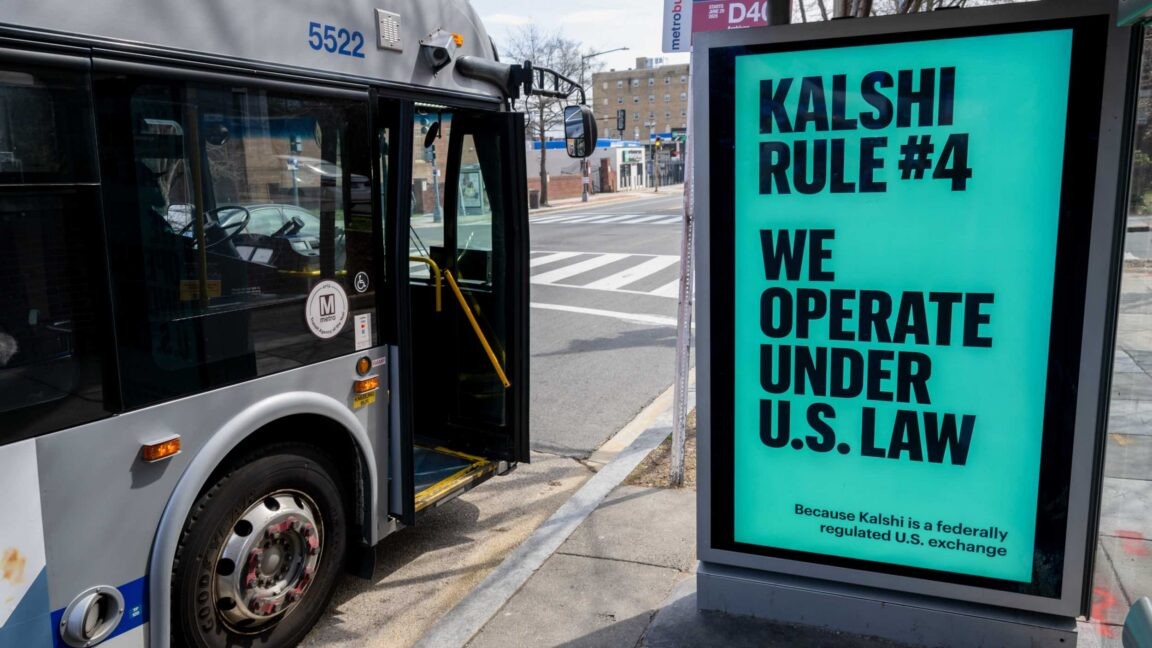
Kalshi’s defiance of state gambling laws may be headed to Supreme Court.
Credit: Getty Images | Bloomberg
Another federal appeals court has ruled that states can enforce their gambling laws against the prediction market Kalshi, which asserts that it can only be regulated by the US government. On Friday, a three-judge panel in the US Court of Appeals for the Sixth Circuit ruled unanimously against Kalshi and in favor of Ohio and Tennessee.
While the US Commodity Futures Trading Commission has exclusive jurisdiction over “swaps,” the judges found that sports wagers offered on Kalshi do not meet the legal definition of swaps. Moreover, the court found that even if Kalshi wagers were swaps, the regulatory scheme created by Congress would not prohibit states from enforcing gambling laws on prediction markets.
“We hold that Kalshi has not shown that its sports-event contracts satisfy the statutory definition of a ‘swap’ so as to fall within the scope of the CFTC’s ‘exclusive jurisdiction,’” said the ruling written by Judge Julia Smith Gibbons, a George W. Bush appointee. “And, even assuming that Kalshi’s sports-event contracts are swaps, we alternatively hold that the CEA [Commodity Exchange Act] neither expressly nor impliedly preempts Ohio’s or Tennessee’s gambling laws.”
Kalshi sued Ohio and Tennessee after gambling regulators in each state indicated they would bring enforcement actions against the prediction market. The appeals court ruling on Friday upheld an Ohio district court decision against Kalshi and vacated a Tennessee district court order that went in favor of Kalshi.
Many states are trying to stop or restrict gambling on Kalshi, which offers sports betting throughout the US despite not obtaining state gambling licenses or paying state gambling taxes. Kalshi offers sports bets in some states where gambling on sports is entirely illegal and in other states where the law has restrictions on betting that Kalshi does not follow.
“Kalshi’s contracts fall within the CFTC’s exclusive jurisdiction,” Kalshi told the Sixth Circuit. The CFTC backed Kalshi in an amicus brief and has separately sued nine states in lawsuits that allege the states are infringing on the CFTC’s exclusive jurisdiction.
States have two major wins over Kalshi
The Sixth Circuit was the third federal appeals court to rule on whether states can regulate gambling on Kalshi. There was already a circuit split, as Kalshi scored a victory in a Third Circuit ruling involving New Jersey and lost a Ninth Circuit case involving Nevada.
State governments now have two major victories to Kalshi’s one, and a Fourth Circuit case involving Maryland is still pending. New Jersey recently asked the Supreme Court to settle the matter for the whole country.
Under US law, swaps include contracts that are dependent on events “associated with a potential financial, economic, or commercial consequence.” Whether a sporting event has such a consequence is one of the key questions courts have been trying to answer.
The Sixth Circuit judges decided that “for an ‘event’ to be ‘associated with a potential financial, economic, or commercial consequence,’ the event must be intrinsically associated with a financial consequence such that we can reasonably understand why hedging financial risk or ascertaining pricing information for the occurrence of that event would be desired and beneficial (e.g., a change in interest rates).”
Kalshi’s sports-event contracts are not swaps because, unlike “contracts based on financial values or instruments (e.g., interest rates or stock prices), Kalshi’s sports-event contracts have only downstream economic consequences, assuming they have the potential to cause economic consequences at all,” the court said.
“Congress did not expressly preempt state gaming law”
The court additionally ruled that Congress did not preempt all state regulation over designated contract markets (DCMs) such as Kalshi. US law says the CFTC may prohibit DCMs from listing event contracts that involve an “activity that is unlawful under any Federal or State law.” This language “necessarily implies that certain event contracts may be listed in some states but not in others,” Sixth Circuit judges found.
Federal law has generally deferred to states on gambling, and Congress did not include an express preemption provision that would override state gambling laws, the court said. Congress specifically preempted state laws in some sections of the CEA, but not in the section outlining the CFTC’s exclusive jurisdiction over swaps, the court said.
“These provisions underscore that Congress did not expressly preempt state gaming law in § 2(a), because Congress knew how to draft an express preemption provision but chose not to there,” the court said.
The state laws that are preempted by the CEA relate to licensing and operation of DCMs, Sixth Circuit judges concluded:
The “patchwork of state regulations” that Congress sought to preempt includes only those that directly target the licensing and operation of DCMs, not ancillary laws that may incidentally burden contracts relating to a subject matter traditionally within the field of state control. As discussed above, the States’ gaming laws do not directly target the licensing and operation of DCMs. They are thus not the sorts of laws that Congress sought to preempt, and their application to Kalshi does not subvert Congress’s goals.
State gambling laws do not directly regulate the general licensure and operations of prediction markets, and the laws’ effects “are felt only because DCMs like Kalshi have decided to offer event contracts that ‘are virtually indistinguishable from’ sports bets,” the court said.
Kalshi claims court rulings prove state laws don’t work
In a statement it provided to Ars, Kalshi criticized the ruling. “We disagree with this decision and don’t believe it will survive further review,” Kalshi said. “The law does not require a swap to involve ‘intrinsic’ financial consequences—and even if it did, sports clearly do.”
Kalshi claimed that different courts issuing different rulings on the same question is proof that there should be a single national standard.
“The ruling shows exactly why a state-by-state patchwork doesn’t work,” Kalshi said. “Courts can’t agree on the basics: Some say federal law covers these contracts, and others say it doesn’t. Some recognize that sports have real economic impact, while others (incorrectly) claim they don’t. Markets can’t operate when the rules change at every state line, which is why Congress created a single federal regulator with nationwide rules.”
Obviously, companies in the US have always faced different laws in different states, and it’s not uncommon for an appellate court in one circuit to reach a different conclusion than an appellate court in another circuit. The Sixth Circuit ruling noted that courts have split on the questions raised by Kalshi, but said that Supreme Court precedents require Congress to act definitively when it intends to preempt state law.
“Principles of federalism further support our conclusion,” the ruling said. “Courts should not assume ‘a significant change in the sensitive relation between’ federal and state governments in an area of ‘traditional state authority.’ Indeed, the Supreme Court requires ‘Congress to enact exceedingly clear language if it wishes to significantly alter the balance between federal and state power’ in such an area.”

Jon is a Senior IT Reporter for Ars Technica. He covers the telecom industry, Federal Communications Commission rulemakings, broadband consumer affairs, court cases, and government regulation of the tech industry.
What's Your Reaction?
 Like
0
Like
0
 Dislike
0
Dislike
0
 Love
0
Love
0
 Funny
0
Funny
0
 Wow
0
Wow
0
 Sad
0
Sad
0
 Angry
0
Angry
0











Comments (0)