

‘Language Is a Construct, Man’: Why We May Never Get Another Spiritual Sequel Like Richard Linklater’s ‘Everybody Wants Some!!’

When Sony Pictures released the teaser trailer for “The Social Reckoning” last month, they described it as a “companion piece” to “The Social Network.” That deliberate phrase was clarified by a recent Variety item that says movie studios are coming up with linguistic workarounds to avoid using words like “sequel.” “Audiences have been trained to think ‘sequel’ means homework,” says marketing and distribution executive Marc Weinstock. “People want something new, so when you put a ‘2,’ ‘3’ or ‘4’ in the title, it gets a groan.” The jokes write themselves: “A sequel isn’t cool. You know what’s cool?”


Rather than actually making something new, however, studios are now disguising their commitment to intellectual property with half-assed deceptive marketing copy. Live-action adaptations of animated classics are now “re-imaginings.” Belated entries in decades-old franchises are ditching numbers (or roman numerals) in their titles to create the illusion that they’re fresh, like 2022’s “Scream” and this year’s “Scary Movie.” Why go to the trouble of challenging the skepticism of young moviegoers who are tired of endless rehashes when you can try to trick them instead?
Admittedly, “The Social Reckoning” isn’t a remake, nor is it a direct sequel to “The Social Network,” despite sharing a screenwriter (Aaron Sorkin, also the film’s producer and director), cinematographer (Jeff Cronenweth), and main character (Mark Zuckerberg, albeit played by Jeremy Strong instead of Jesse Eisenberg). Sony clearly wants to thread the needle of appropriately characterizing the new film while stoking audience nostalgia for its counterpart. It’s why the teaser includes a snippet of Trent Reznor and Atticus Ross’s “Social Network” theme, even though Alexandre Desplat took over scoring duties on the new film, and a cheeky reference to Mark Zuckerberg’s time in college.
For decades, films that were broadly related to, or reminiscent of, an older work without sharing an explicit connection were unofficially described as “spiritual sequels.” Think Russ Meyer’s “Beyond the Valley of the Dolls,” which capitalizes on the premise and name of Mark Robson’s hit melodrama but otherwise barely resembles “Valley of the Dolls.” Or Brian De Palma’s “Carlito’s Way,” where the filmmaker reunites with Al Pacino on a film about a gangster who longs to be an ordinary man a decade after they made “Scarface,” a film about an ordinary man who dreams of being a gangster. The fuzzy indeterminacy of spiritual sequels are part of their unique charm; they work on their own terms while eliciting thematic or emotional connections for those in the know.
An expert practitioner of the spiritual sequel, Richard Linklater especially indulges in the delight of crafting movies that rhyme with each other. His rotoscope-animated drama “Waking Life” shares much of its DNA with his scrappy debut feature “It’s Impossible to Learn to Plow by Reading Books” and his breakthrough “Slacker,” all while operating on an entirely different wavelength. “Last Flag Flying” serves as an unofficial sequel to Hal Ashby’s “The Last Detail,” complete with different but analogous military trios on respective road trips. While Linklater’s 20-years-in-the-making adaptation of Stephen Sondheim’s “Merrily We Roll Along” isn’t related to “Boyhood” at all, their lengthy production processes renders them curious bedfellows.
No one was clamoring for any of these films, yet Linklater clearly had his designs on extending concepts and ideas well past any public interest. His best spiritual sequel similarly fits this bill: a semi-autobiographical 1980s-set college baseball comedy that has no plot and stars relatively unknown actors playing horny, testosterone-fueled jocks. The Austin filmmaker had contemplated “Everybody Wants Some!!” since the early 2000s, and tried but failed to get it financed in 2009. Five years later, Megan Ellison’s Annapurna Pictures ponied up the cash and teamed up with Paramount Pictures, who still owned the rights to the script, to finance the film. Linklater had to drop out of a live-action adaptation of “The Incredible Mr. Limpet” at Warner Bros. to make this particular passion project, which only got off the ground because of the unexpected good will that arose from the commercial and critical success of his previous film “Boyhood.”
That epic coming-of-age drama ended with its main character leaving his transient childhood behind and moving into his dorm room at college. “EWS!!” begins with a cheery, wide-eyed freshman (Blake Jenner) entering an off-campus house filled with his fellow teammates. In interviews upon the release of “EWS!!,” Linklater drew comparisons between it and “Boyhood,” arguing that the former picks up where the latter leaves off.
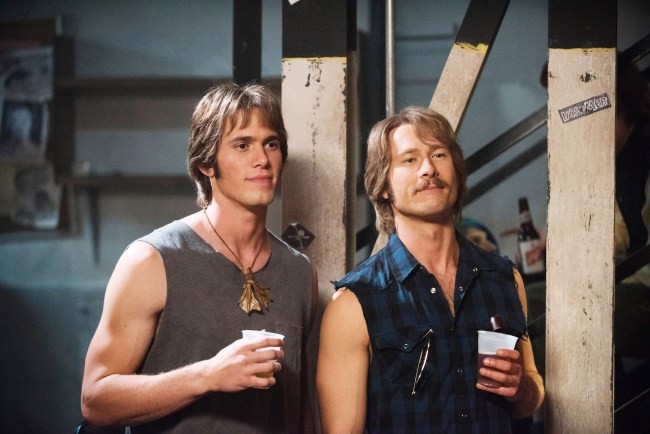
 ‘Everybody Wants Some!!‘©Paramount/Courtesy Everett Collection / Everett Collection
Of course, as most people figured out, “EWS!!” has a stronger link to one of his most beloved early works, “Dazed and Confused.” That film follows a variety of Texas high-school students on the last day of school in 1976, America’s bicentennial year. Meanwhile, “EWS!!” follows a variety of Texas college baseball players in 1980 across the opening weekend before college begins. Both works include scenes of hazing rituals leveraged against upcoming freshman students, and they also feature an indelible stoner and an older hanger-on who wants to relive his glory days. In “Dazed,” those characters are Slater (Rory Cochrane) and Wooderson (Matthew McConaughey), respectively. In “EWS!!,” Linklater collapses those two archetypes into a single figure: Willoughby (Wyatt Russell), a bong-smoking pitcher who waxes poetic about “The Twilight Zone” and “Pink Floyd” with underclassmen a decade his junior.
Similarly, “Dazed” and “EWS!!” were produced by hesitant studio partners. Universal Pictures was skeptical of Linklater’s ability to level up from his independent roots after “Slacker”; they begrudgingly green-lit “Dazed” partly because Paramount had expressed interest in making the film and they didn’t want to be scooped. To be fair, their reservations weren’t unfounded. Linklater’s initial experimental vision for “Dazed” followed two guys driving in a car listening to the entirety of ZZ Top’s “Fandango!” in a single static take. (This version recalls James Benning and Bette Gordon’s structuralist masterwork “The United States of America.”) Nearly 20 years after Paramount eagerly expressed interest in making “Dazed,” Linklater described the studio’s position on “EWS!!” as “reluctant.” (“They are still not sure what to make of it. That’s evolving.”)
It’s possible to tease out many comparisons between Linklater’s two adolescent ensemble films, but what’s arguably more interesting are the points where they differ. While both films are much more formally rigorous than their premises suggest, “Dazed” adopts a freewheeling style, with Lee Daniel’s photography capturing the impulsivity of the teenaged characters. On the other hand, the camera movements in “EWS!!” feel much more calculated and deliberate, despite the fact that cinematographer Shane F. Kelly captures similar debauchery.
Music plays a major role in “Dazed” and “EWS!!”, but the latter soundtrack incorporates a wider diversity of genres and styles: disco, funk, new wave, power pop, and, notably, rap. An early scene in “EWS!!” follows a group of five guys we just met—four white, one Black—rapping along to The Sugarhill Gang’s “Rapper’s Delight” without an ounce of self-consciousness. (In retrospect, this potentially cringeworthy moment feels like a litmus test for whether someone will ultimately enjoy the film.) “Dazed” sticks to a more narrow slice of mid-1970s classic rock: Foghat, Black Sabbath, Aerosmith, etc. “The music I was trying to reflect in ‘Dazed and Confused’ was the FM radio stuff that was just coming at you, before you developed your own taste,” says Linklater. “In ‘Everybody Wants Some!!’ there are these sixteen guys living together, which was very much my experience in college. They all have album collections too.”
 ‘Everybody Wants Some!!’Paramount
The pivotal difference between “Dazed” and “EWS!!” is a matter of tone. For all of its quotability and cozy atmosphere, “Dazed” exhibits a real dark streak in terms of casual violence and the unforgiving nature of social hierarchy. The younger characters like Mitch (Wiley Wiggins) and Sabrina (Christin Hinojosa) are tentatively embraced by older crowds but still face community-sanctioned oppression. Football star Randall “Pink” Floyd (Jason London) finds his personal choices circumscribed by authority figures who want to exploit his talent without appreciating his character. The film’s climactic moontower party, situated far away from watchful adults eyes, represents adolescent rebellion at its purest: a fuck-you against conservative institutions hellbent on maintaining the status quo.
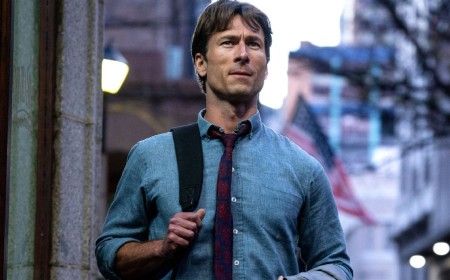
Conversely, “EWS!!” assumes a palpable sense of optimism, visually epitomized by Kelly’s warm-toned digital photography that makes night scenes feel like they’re blessed by the sun. In Linklater’s eyes, college symbolizes a fount of opportunity, a place where people can reinvent themselves, try on different identities, and embrace self-exploration. The guys on the fictional “EWS!!” team feel comfortable dancing disco, line dancing at a country bar, or moshing at a punk show, mostly in the hopes of sleeping with eligible women. “It’s adaptive,” explains Finn (a pre-superstar Glen Powell). “There are animals —salmon, spiders — that will literally die in the process of mating. I mean, what are we doing? We’re switching around our wardrobe a little bit.”
In a sense, they’re postmodern figures who reject perceived authenticity for cultural sampling in the hopes of triangulating a stable sense of self. Unlike the characters in “Dazed,” whose identities are largely dependent on circumstance, the players in “EWS!!” make choices knowing they’re in control of their own fate. This utopic view of college reflects Linklater’s own experiences playing centerfield at Sam Houston State University before a diagnosis of atrial fibrillation cut short his athletic career and pushed him into the humanities.
 ‘Everybody Wants Some!!’Paramount Pictures
“‘Dazed and Confused’ is not a movie about how things were; ‘Dazed and Confused’ is a movie about how things are remembered,” wrote Chuck Klosterman for the film’s Criterion release. Though Klosterman makes that claim to illustrate the film’s supposed unrealistic design (“The fashion seemed exaggerated. The hazing seemed implausible. The idea of teenagers in a car being shot at for wrecking a mailbox seemed ridiculous.”), he unintentionally highlights Linklater’s savant-like recall which he channels into a religious dedication to period accuracy. In a behind-the-scenes featurette from “EWS!!,” the cast expresses awe at the specificity of Linklater’s memory, from which months certain songs were most popular to the makes and models of cars that would be driven by that character. My personal favorite example is his insistence that the young actors suppress their natural instinct to hug each other while in character. “Every hug, I’m gonna say ‘cut,’ he says. “You guys are the huggy generation. We weren’t so touchy-feely.”
Even though “Dazed” and “EWS!!” are largely about kids getting drunk or stoned and talking bullshit, they facilitate such cerebral analyses from the critical class partly because they’re testaments to unrecoverable periods of time. More than any single element, what keeps them in conversation with each other are their sociological approaches to the past. By burrowing so deeply into detail, a sense of universality organically emerges that invites viewers to project their own experiences onto the work. The act of looking back on one’s own history with care instead of judgment engenders a communal spirit between the film and its audience.
“Dazed” and “EWS!!” both received politely affectionate reviews upon release. The former eventually achieved cult classic status thanks to home video while the latter still feels terminally unappreciated. It’s possible that the athletic milieu and the cross-section of hyper-masculine personalities will always keep some folks at a distance. Not that “EWS!!” would have ever been a theatrical hit, nor do I believe its politics are even slightly reactionary, but it probably didn’t help matters that such an unabashedly “dudes rock” movie arrived as Donald Trump slowly rose to power. It’s a shame because the film’s infectious sense of camaraderie, its sex-positive spirit, and acceptance of clumsy youthful introspection make it a genuine anomaly in 2016 and 2026.
“Everyone is working to keep the momentum with younger audiences, who are a little more cynical,” says an unnamed executive from that Varietyarticle about contemporary Hollywood parlance. “They’re excited about creative risks.” It’s unclear whether this person is aware of his statement’s inherent irony, or, worse, knows that deploying slippery expressions to sell leftovers isn’t a “creative risk” and simply doesn’t care. As even casual moviegoers are surely aware, films like “Dazed” and “EWS!!” are essentially extinct in this current market, no matter what vocabulary modern studios would use to market them. It remains to be seen how long Hollywood will take to absorb a simple, obvious truth, one that has been germane for years: No amount of polish will ever turn a turd into gold. To put the lesson in a different light, per Willoughby: “Language is a construct, man.”
What's Your Reaction?
 Like
0
Like
0
 Dislike
0
Dislike
0
 Love
0
Love
0
 Funny
0
Funny
0
 Wow
0
Wow
0
 Sad
0
Sad
0
 Angry
0
Angry
0






Comments (0)