

Linux desktop use surged to 22% on one workday, Cloudflare data shows

Follow ZDNET: Add us as a preferred source on Google.
ZDNET key takeaways
- The Linux desktop continues to grow in popularity.
- Cloudflare numbers show Linux at work is making gains
- AI is a big reason why more people are turning to Linux.
Web traffic analysis site StatCounter recently showed that desktop Linux had reached an all-time high of 10.65% in the North American desktop market. Many people, even many Linux fans, dismissed this proportion as fake news. However, the last time I looked at the numbers in 2025, Statcounter only showed a high of just over 5%. As I mentioned in my recent report, Linux doubling its market share in just over a year should get everyone's attention.
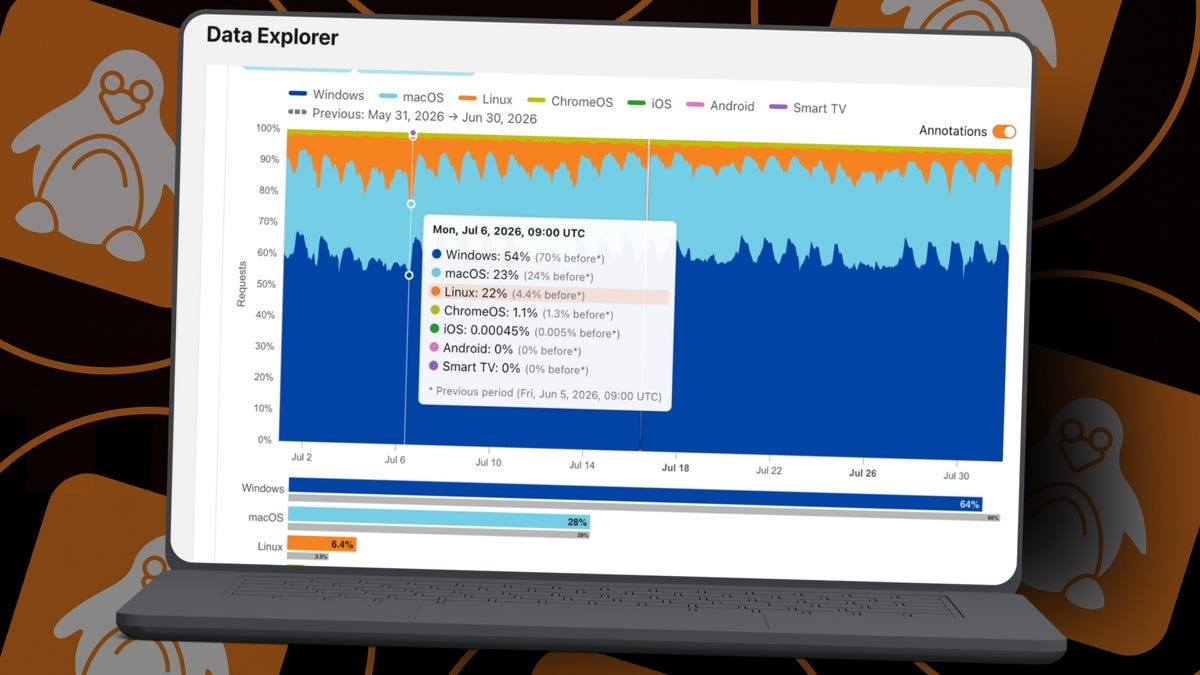
I dug deeper and found that data from popular content delivery network Cloudflare also showed that the Linux desktop has been gaining popularity. By its count, desktop Linux has now reached 6.4%. That proportion is not as high as StatCounter's, but it represents significant growth given that Linux accounted for 4.1% of North American operating systems for the same period last year.
Also: How to try out over 85 Linux distros, no installation required - with DistroSea
Cloudflare's dataset is much larger than StatCounter's. StatCounter monitors about a million websites, while Cloudflare keeps an eye on over 24 million websites. Cloudflare itself claims to cover about 20% of the web.
A deeper look also reveals that desktop Linux use tends to peak during the work week. For example, believe it or not, on Monday, 6 July, when people were back after the 4 July holiday, Linux usage jumped to a high of 22%.
The users of these systems are not AI agents or bots, but real people. I set Cloudflare to count humans rather than bots. If you include people and bots, Linux has a 9.7% market share. That proportion is similar to StatCounter's score. By Cloudflare's count, bots alone come to 19%.
Also: New to Linux? This 10-day checklist will help you settle in nice and easy
These numbers tell us that workers are leading the way to the Linux desktop. That result is not surprising. Historically, they're people who prefer control over their PCs, like open systems, or have a specific workload, such as programming or system administration, where Linux works well.
Microsoft has long known this requirement. Windows Subsystem for Linux (WSL), for example, is designed for Windows developers who also need Linux's power and tools. It's been years since Microsoft released WSL user numbers, but in 2020, there were 3.5 million WSL users.
Explaining the Linux bump
However, past performance doesn't explain present trends. So, why are we now seeing such a bump in Linux desktop growth? Experts believe this trend is largely AI developers and Linux users running AI Agents.
For example, as David Linthicum, former managing director and chief cloud strategy officer at Deloitte Consulting and AI and cloud influencer, recently observed, while "Windows 11 can technically run local AI workloads, but as you begin using multiple tools, managing different projects, and installing various dependencies, the friction starts to build," it's a different story for Linux users.
Also: Microsoft surprises with its first server Linux distribution: Azure Linux 4.0
Linthicum continued: "Linux delivered what I can only describe as a true 'AI desktop' experience. Setup was straightforward, mainstream AI instructions matched what you'd actually see in your environment, and GPU-accelerated apps simply worked -- consistently. I spent far less time troubleshooting and far more time actually executing on projects."
As for agents, Linux Foundation CEO Jim Zemlin summed up their role succinctly: "Linux is the OS of choice for AI agents."
Also: Here's my way of convincing Windows users to switch to Linux
There are other reasons why desktop Linux is finally picking up popularity, including:
- Dislike for Windows 11: Even Windows fans like ZDNET's Ed Bott are finding lots to dislike about Windows 11. Adding salt to the wound, Windows 10 is out of support.
- Many Windows 10 PCs can't be "upgraded" to Windows 11: There are ways to move some Windows 10 PCs to Windows 11, but that still leaves millions of computers that can't make the shift. For these machines, Linux is the way to keep them useful.
- Linux is easy to use: Enough of the "Linux is so hard!" nonsense. You don't need to be a shell command expert. Many Linux distros are easy for Windows users to pick up. These include my own favorite, Linux Mint; my fellow ZDNET Linux fan Jack Wallen's fave, Zorin OS; and the looks-like Windows VailuxOS distro.
- Linux gaming has come of age: Gaming has never been Linux's best point, but thanks to Steam, Linux is now a more significant gaming platform. While Linux remains a niche player in the broader PC gaming market, its share is higher than ever and growing slowly.
- Installing Linux desktop software is easy: Can you install an app on your Android phone or iPhone? Yes? Congrats, you can install programs on Linux. App stores are now the default way to install software on desktop Linux. You may not need to, though, as Bott pointed out in his Linux experiment for ZDNET: "All of my basic productivity apps -- 1Password, Obsidian, and even Microsoft Edge -- were easy enough to install, and I had no trouble using my cloud-based Office files in Edge on Linux."
So, why not bite the bullet and give Linux a try yourself? You'll be in good company, and you'll find it both useful and, dare I say it, fun.
What's Your Reaction?
 Like
0
Like
0
 Dislike
0
Dislike
0
 Love
0
Love
0
 Funny
0
Funny
0
 Wow
0
Wow
0
 Sad
0
Sad
0
 Angry
0
Angry
0











Comments (0)