

Magic's Star Trek Already Feels a Lot More Frustrating than Reality Fracture

Published Nov 6, 2026, 8:45 AM EST
Francesco is an editor with a background in academic research, journalism, and content strategy, specializing in entertainment news and curation. He works across all of Polygon's verticals, specializing in tabletop games, with a focus on D&D and Magic.
MTG Star Trek Limited is not as smooth as Reality Fracture
 Magic: The Gathering - Star TrekImage: Wizards of the Coast
A mere six weeks have passed since the release of Reality Fracture, one of the best-received Magic: The Gathering sets in recent years, and players are already primed to enter warp speed with Star Trek. Universes Beyond sets always get their fair share of criticism, and while it’s understandable that not every Magic player is attracted by Star Trek’s unique aesthetic, the most important question for Limited players is: How does the set actually play?
Polygon took part in the 24-hour early access Star Trek event on Magic Arena, and while I only had time for a dozen games between Sealed and Draft, I have one surefire takeaway: this is very different from Reality Fracture.
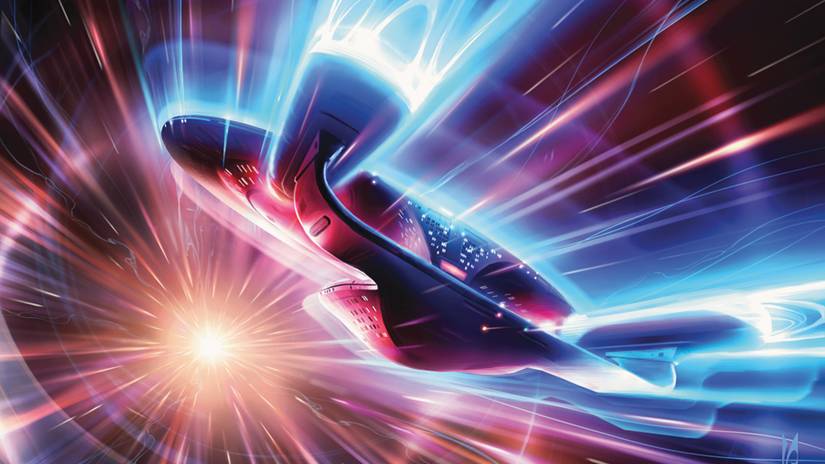
Magic’s Star Trek moves at warp speed
 Magic: The Gathering - Star TrekImage: Wizards of the Coast
Limited players loved Reality Fracture for its gameplay and mechanics. Most decks fell into the midrange archetype, focusing on “value” creatures and card advantage to take over the game. The Empower Jace mechanic was the glue of the set, allowing every combination of colors to manipulate the deck through Surveil, thus helping with mana issues and granting the card draw needed to succeed in the format.
Star Trek, by contrast, feels more like The Hobbit. Based on my first impressions, the set encourages aggressive decks that want to curve out early. Every Limited environment tends to favor creatures over spells, but this seems even more true with Star Trek. Even apparently innocuous two-mana creatures like Tenacious Drone proved to be quite annoying during early access, especially when paired with the many “pump” effects available — Sarcophagus, Ship of the Dead, for example, which truly impressed me.
The Rakdos (red-black) Klingon decks seemed very solid, as they can turn up the aggression and also back it up with good removal, which is scarce in the set. Most of the removal spells cost three or more mana or are sorcery-speed. Another strong aggro deck is Gruul (red-green) Landfall, which is able to do truly disgusting things in the first turns of the game. Just look at the pictures below.
On turn 4, my opponent already had nine power on the board (potentially 10 with Planetary Patrol's Landfall effect). On turn 5, they cast a removal spell and attacked me with a total of 14 power thanks to multiple Landfall triggers. If you have a slow-to-medium start, it’s almost impossible to recover from this game state, which leads to my biggest negative impression of Star Trek: the games feel too one-sided.
Star Trek games are hard to turn around
All of the games I played, both in Sealed and Limited, felt very hard to turn around once one of the players got the advantage. This is typical of aggro formats that rely on curving out and quickly gaining the upper hand. Unfortunately, this can create frustration and make a Limited format grow stale quickly.
By contrast, Reality Fracture still feels fresh (and you can still play it in Arena even while Star Trek events are running) because games are more balanced and usually get decided in the last turns, based on which player has accrued more value and incremental advantage throughout the game. It’s the “classic” Magic midrange playstyle that many players still gravitate towards, even if it’s very hard to find nowadays in Constructed formats.
I drafted this Golgari (green-black) graveyard deck that felt quite strong. This is a strategy that I love to play in every format, so I was confident it could get a decent number of victories. Instead, I went 0-3. The deck was too slow and had no ways to “turn the corner” after the opponent had gained the upper hand.
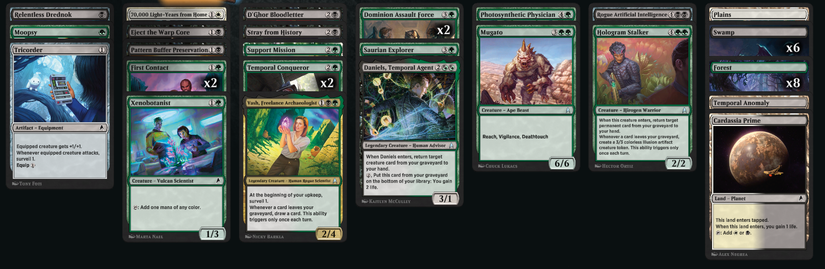 Image: Magic Arena via Polygon
Also, flooding (drawing too many lands) felt like a real issue, despite the many Surveil cards I played. I conceded a game on turn five simply because I had drawn too many lands, and my opponent was already too far ahead on the board for me to catch up. The lack of a set-wide way to mitigate bad draws is unpleasant, but I guess this is the post-Empower Jace effect. Can’t we just have that in every set?
I’m not implying that Star Trek will be an aggro-only format. Unlike The Hobbit, this is a large set, and the card pool is big enough that players can successfully build different strategies. For example, I had success with this five-color Sealed deck that simply played all the bombs, removal, fixing, and card draw I had in my pool. It was really fun. Even then, I consistently struggled to stay alive until I could deploy my bombs.
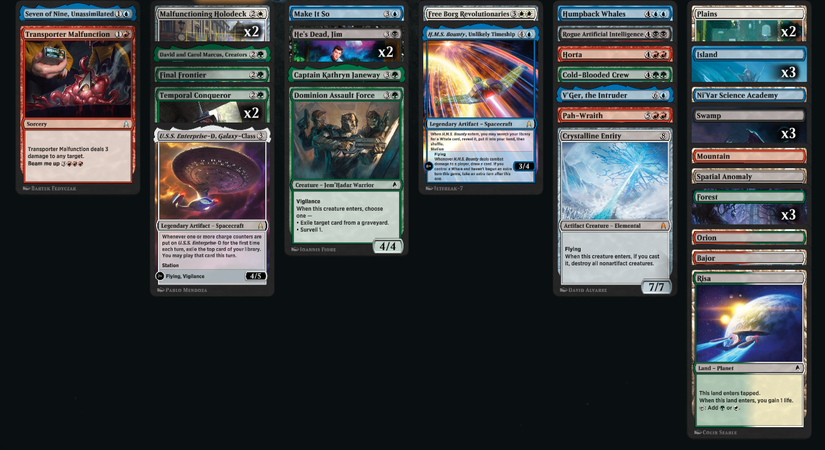 Image: Magic Arena via Polygon
On the other hand, this simple Klingon deck also won a lot of games. It’s aggressive, has a lot of removal, and is supported by some synergies and card advantage engines to make sure you don’t run out of things to do. Red feels like a strong color in Star Trek, and it can support three of the four main aggressive archetypes.
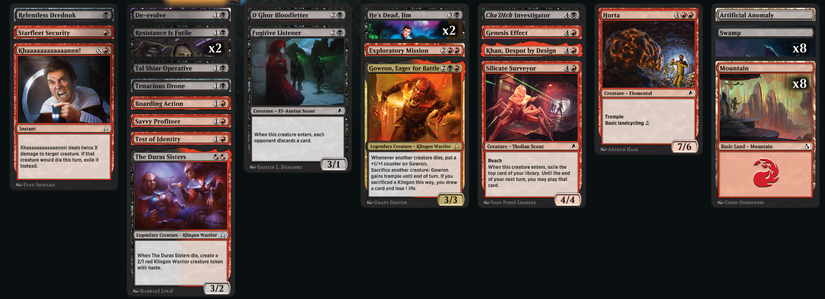 Image: Magic Arena via Polygon
If you’re heading to a prerelease event this weekend, my suggestion is to go back to the basics for this set. Focus on having a good curve, play a lot of creatures, and all the removal you can. Splashing is easy thanks to the many multicolored lands, but I would be wary of playing too many lands that enter tapped. As always, remember to have fun! May the Force be with you! (Did I get that right?)
What's Your Reaction?
 Like
0
 Dislike
0
 Love
0
 Funny
0
 Wow
0
 Sad
0
 Angry
0









Comments (0)