

NASA wires up Dragonfly and names the landing area
science
Titan-bound rotorcraft set for launch in 2028
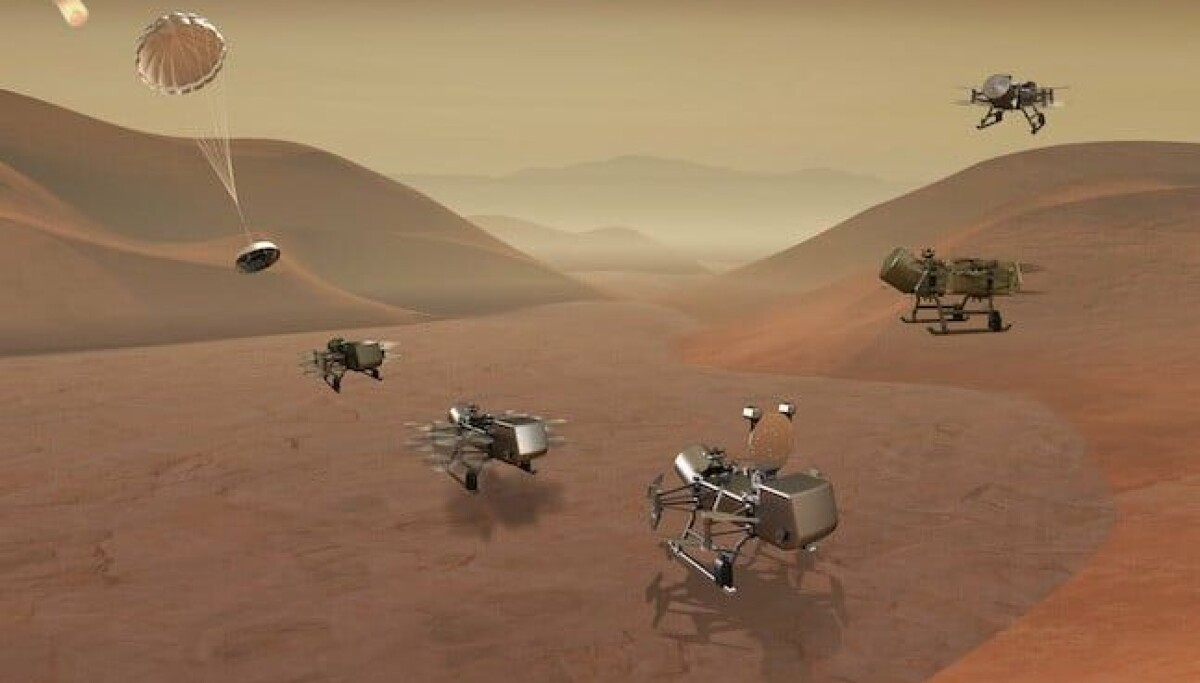
The Titan dune field where NASA's Dragonfly rotorcraft will land in 2034 has a name: Ahmakiq Undae.
The International Astronomical Union (IAU) approved the name, and NASA announced it in an update as the spacecraft's 2028 launch edges closer. It is scheduled to arrive at Saturn's moon Titan in late 2034.
Dragonfly's fabrication began in late 2024 and was completed about a year later. Most recently, engineers fitted the probe's wiring harness, which, according to NASA, includes an estimated 17,315 feet of conductor wire and 374 connectors, and weighs about 100 pounds.
The harness is accompanied by a battery weighing in at almost 300 pounds.
The nuclear-powered Dragonfly is an impressive piece of hardware. The fuselage is almost 13 feet long, and the arms will hold eight sets of rotors. The probe has landing skids and a cap on the end for its power source.
The harness fitting means other Dragonfly components can be added, including its avionics and science instruments.
During May and June, the rotorcraft was put through vibration testing, including suspending the fuselage on bungee cords to see how it behaves in the air, and a sealing test where engineers checked how well the structure keeps the environment out – Titan's atmosphere is, after all, dense, cold, and about 1.5 times the pressure of Earth's.
Dragonfly isn't the first visitor to Titan - the European Space Agency (ESA) landed the Huygens probe there in 2005. However, while Huygens was a static probe that lasted just over an hour on the surface, Dragonfly is planned to spend at least 3.3 years exploring the moon's environment.
According to NASA, the probe will explore "diverse environments from organic dunes to deposits associated with an impact crater – Selk Crater – where liquid water and complex organic materials key to life once existed together."
The probe is effectively a flying laboratory and must withstand temperatures as low as minus 290 degrees Fahrenheit (minus 179 degrees Celsius) and potentially liquid methane rain. It also requires a heat shield to protect the spacecraft during its descent through Titan's dense atmosphere. Once on Titan, the plan is for the vehicle to fly to multiple locations during its mission.
Installing the wiring harness (something familiar to anyone who has battled wiring looms on automobiles) and naming the landing zone are milestones on Dragonfly's journey to launch. Next will be connecting the wiring to science instruments as they are delivered, along with other flight components.
In 2024, Dragonfly's total lifecycle cost was $3.35 billion - approximately twice the original estimate - and the mission was more than two years late, with the COVID-19 pandemic, supply-chain issues, and additional design work pushing up costs.
The mission is currently scheduled to launch no earlier than July 2028 on a SpaceX Falcon Heavy rocket. ®
What's Your Reaction?
 Like
0
Like
0
 Dislike
0
Dislike
0
 Love
0
Love
0
 Funny
0
Funny
0
 Wow
0
Wow
0
 Sad
0
Sad
0
 Angry
0
Angry
0










Comments (0)