Nvidia's high-speed AI data center storage servers break cover, touting 2.9 petabytes of storage and extreme PCIe 6.0 performance — Wiwynn shows off SCADA server with GPU-accelerated storage
Jun 12, 2026 - 19:01
09
(Image credit: Tom's Hardware)
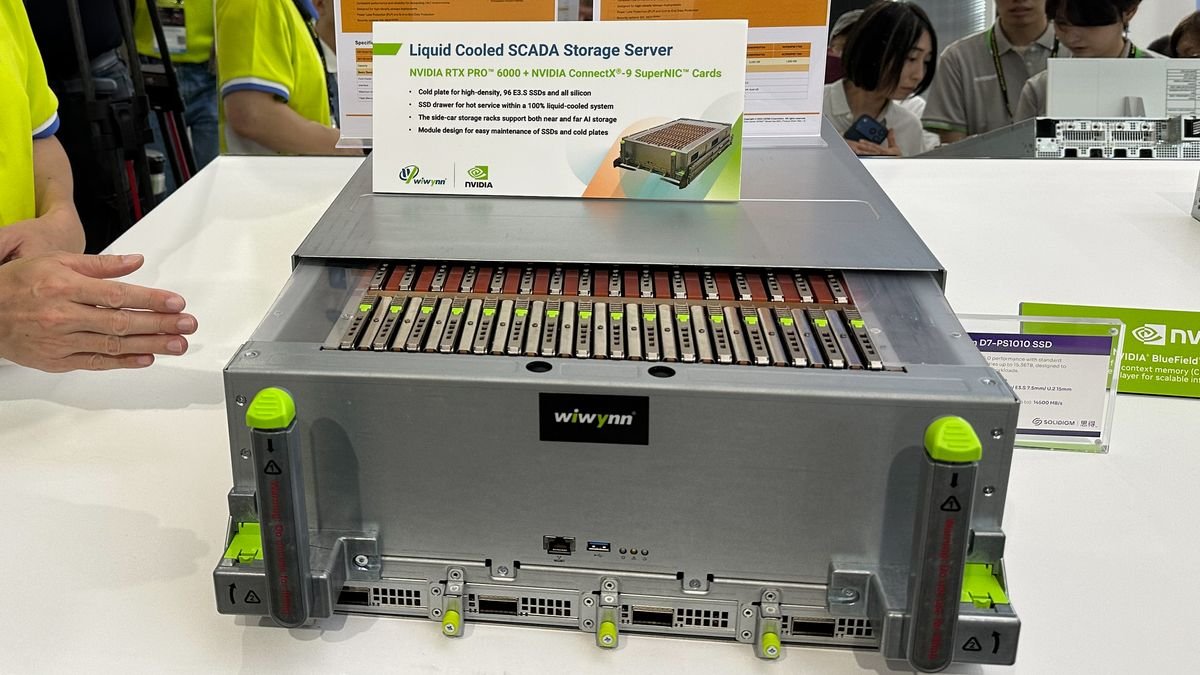
Last week at Computex 2026, Wiwynn showed off one of the industry's first Nvidia SCADA (SCaled Accelerated Data Access) servers. Devices such as this are built to handle the extreme data demands of AI data center-focused inference and training workloads, which operate with massive models and datasets, therefore requiring large, fast, and connected devices to serve as the backbone for complex, high-throughput tasks that AI workloads depend upon.
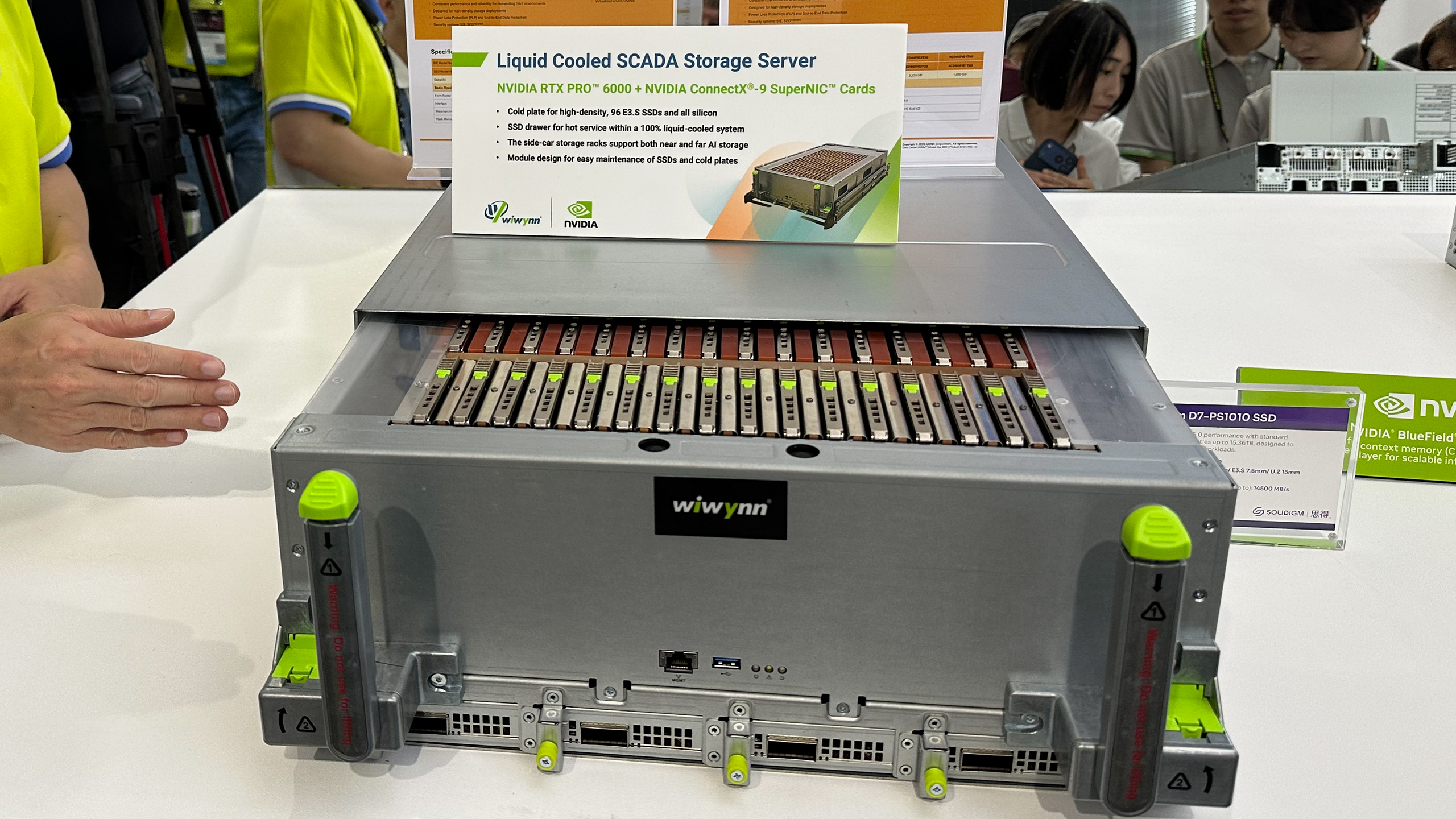
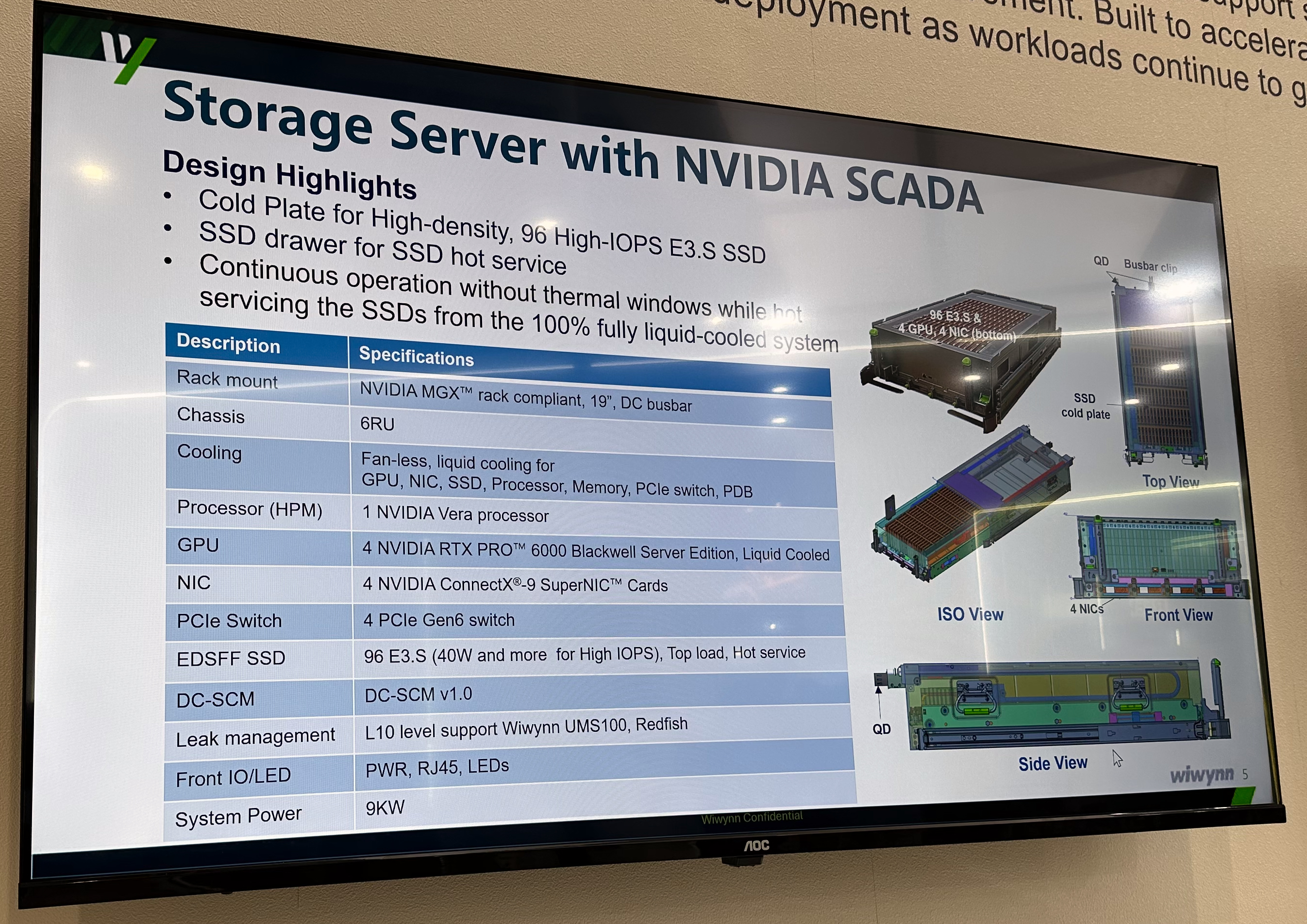
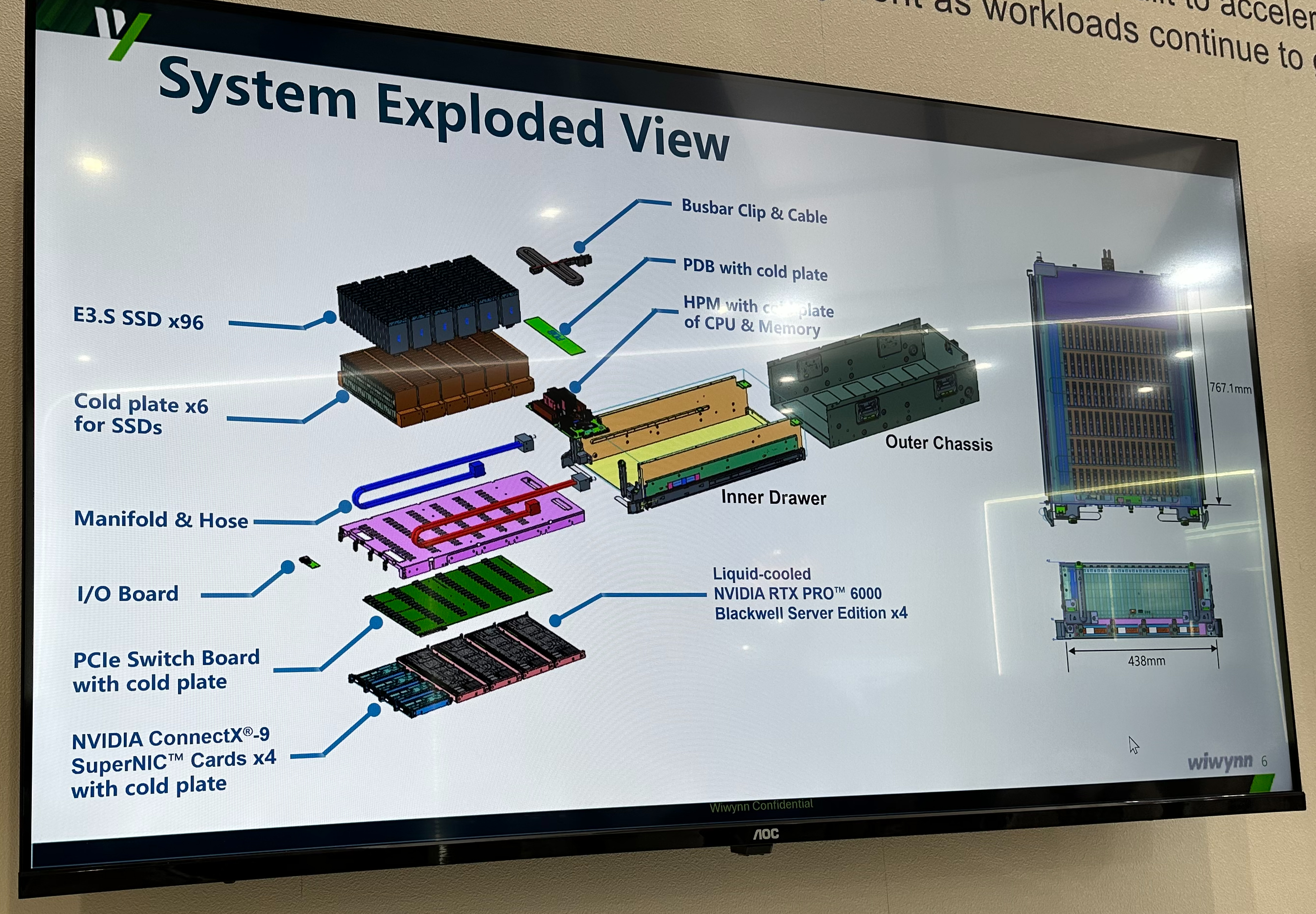
Wiwynn's SCADA server packs up to 96 liquid-cooled solid-state drives and therefore offers petabytes of storage space using currently available E3.S drives, and massive I/O performance. The machine is based on Nvidia's Vera CPU, four RTX Pro 6000 Blackwell graphics cards, four PCIe 6.x switches, and four ConnectX-9 SuperNIC cards.
Storage architecture for AI
Modern AI inference and training workloads often deal with massive datasets that exceed the memory capacity of an AI accelerator's onboard memory, which is why AI applications need to access rapid storage.
While AI training is typically dominated by large sequential transfers, AI inference workloads such as vector search, retrieval-augmented generation (RAG), graph analytics, and KV-cache retrieval often rely on fine-grained random accesses (that frequently involve data blocks smaller than 4KB) with extreme parallelism, as the system deals with thousands of GPU threads.
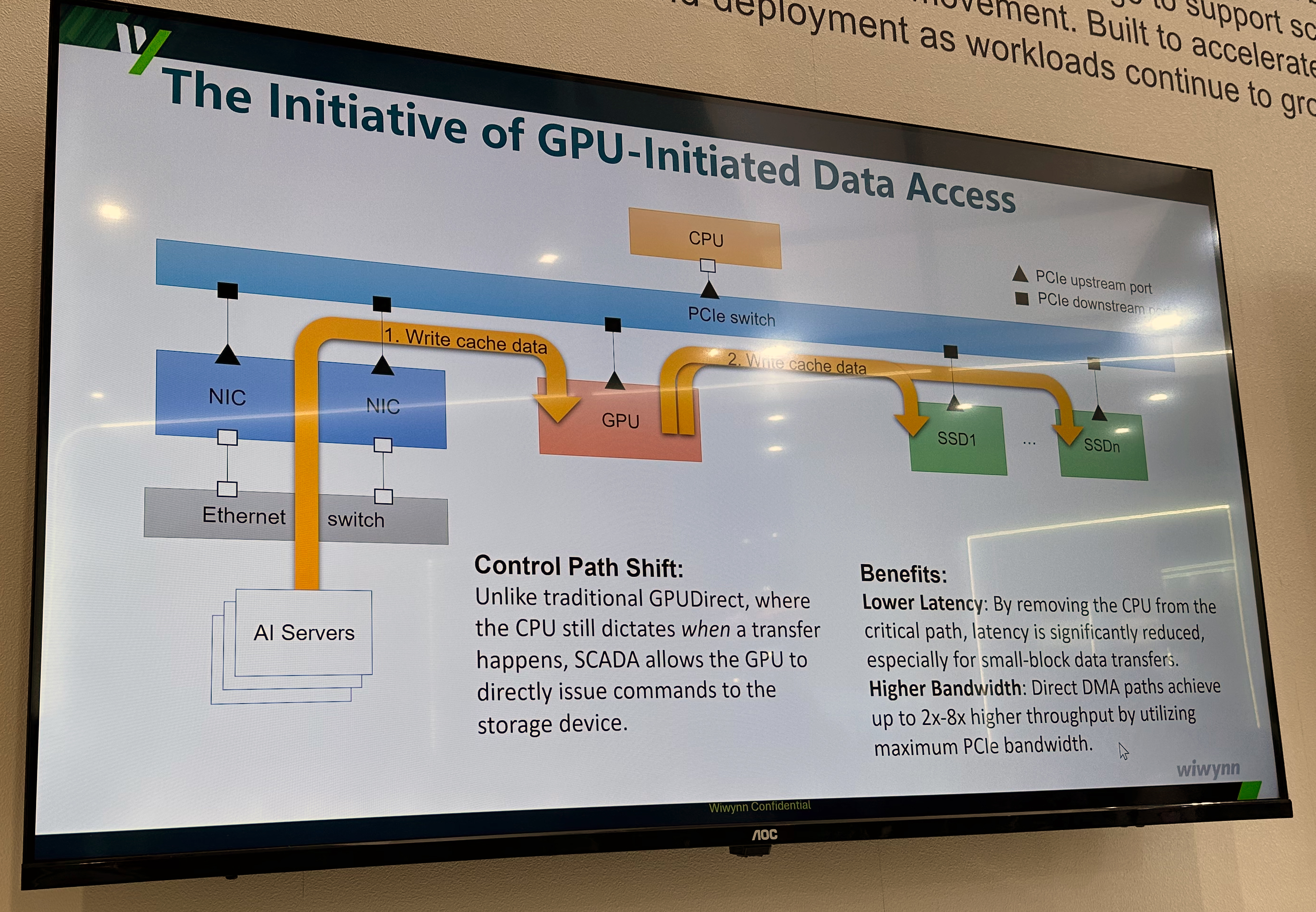
Traditional CPU-centric I/O cannot efficiently handle such workloads and creates bottlenecks because the CPU must issue commands, manage requests, and control data transfers. Even in advanced solutions like GPUDirect Storage, which allows data to be transferred directly from SSDs to GPUs, the CPU still owns the control path and can become a bottleneck.
(Image credit: Tom's Hardware)
The SCADA platform, previewed in late 2025, is designed to allow GPUs access to very large datasets directly and efficiently without involving a central processor. This is impossible to do on conventional machines, as SCADA lets GPUs themselves initiate and control storage I/O operations and the data path.
(Image credit: Tom's Hardware)
SCADA runs on PCIe 6.x hardware from partners like Broadcom and Micron, and customers can now build their own SCADA machines with commercially available components. However, SCADA servers have not yet been popularized. In fact, Wiwynn seems to be among the first server makers to even showcase a SCADA server.
Wiwynn's SCADA server
Wiwynn's SCADA server can indeed be a panacea for the problem that is AI storage. It supports up to 96 liquid-cooled E3.S SSDs, meaning that the drives will perform as expected even under high loads. When equipped with 96 30.72 TB Micron 9650 Pro drives with a PCIe 6.0 interface, the server can store 2.949 PB of data.
On the performance side of things, Wiwynn claims an aggregated random read speed of 528 million 4K IOPS, as well as sequential read/write speeds limited by the performance of PCIe switches and/or network cards rather than the drives themselves. As manufacturers expand the capacities and performance of their E3.S SSDs, servers like the one Wiwynn demonstrated at Computex will gain capacity and performance as well.
(Image credit: Tom's Hardware)
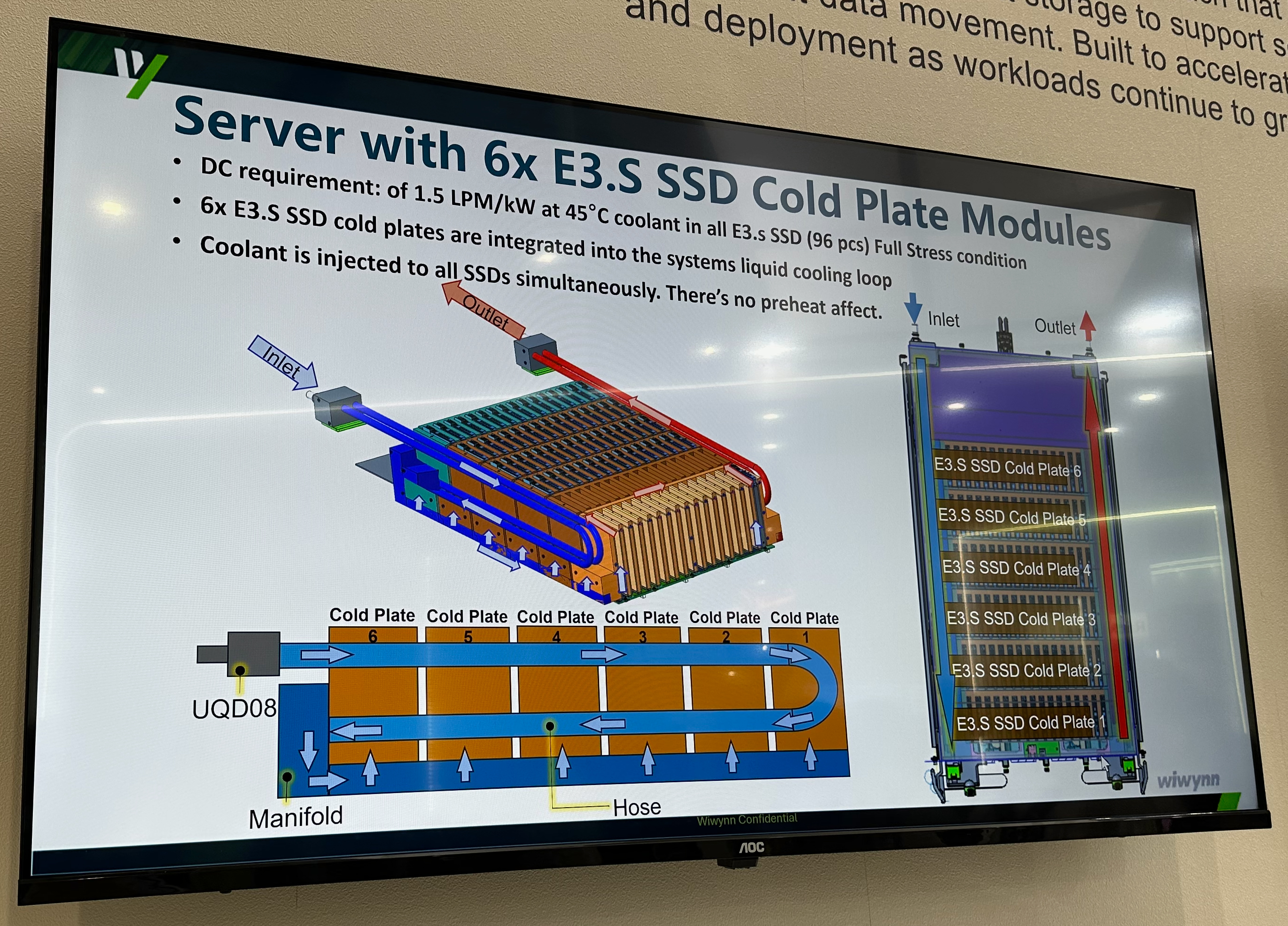
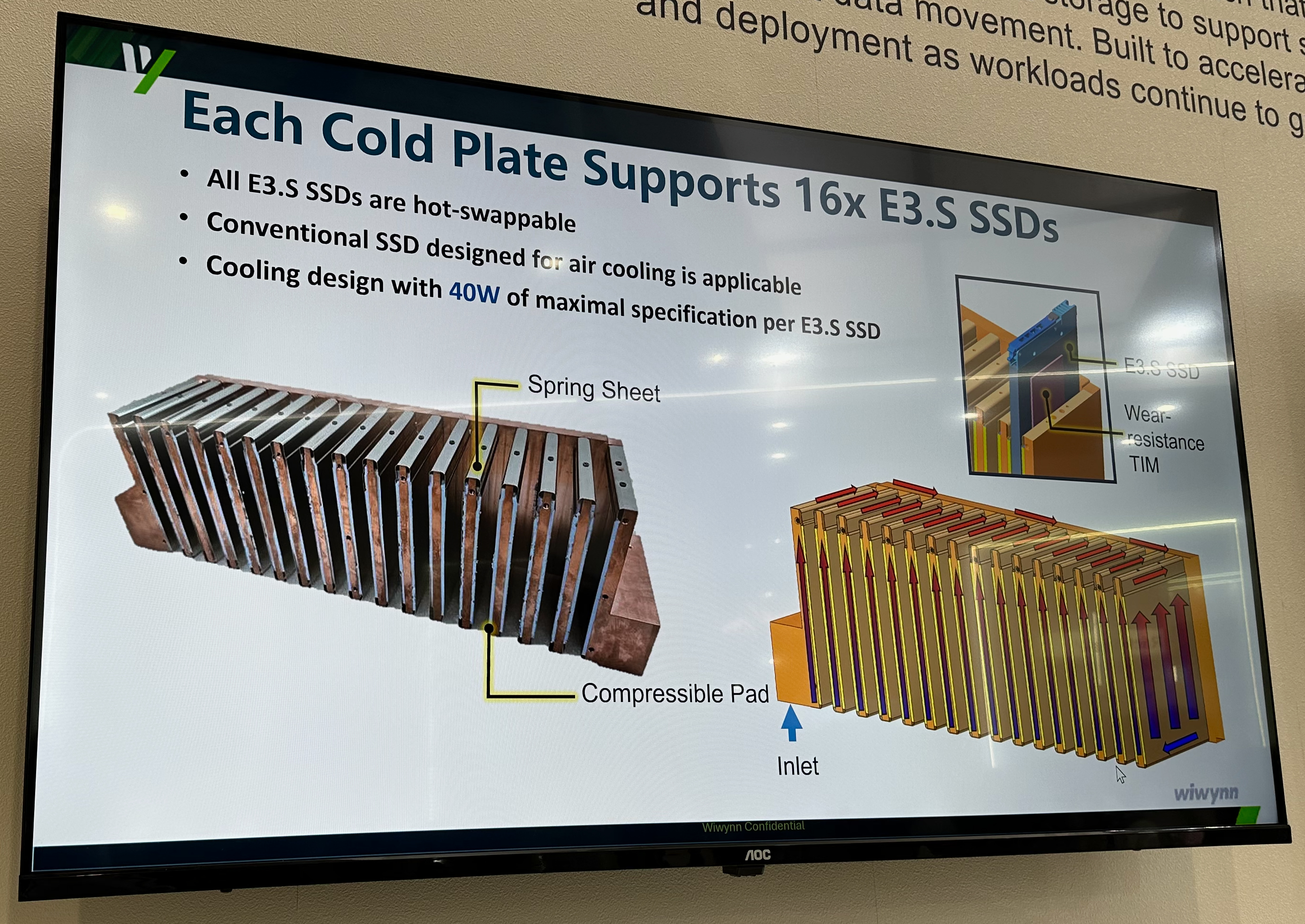
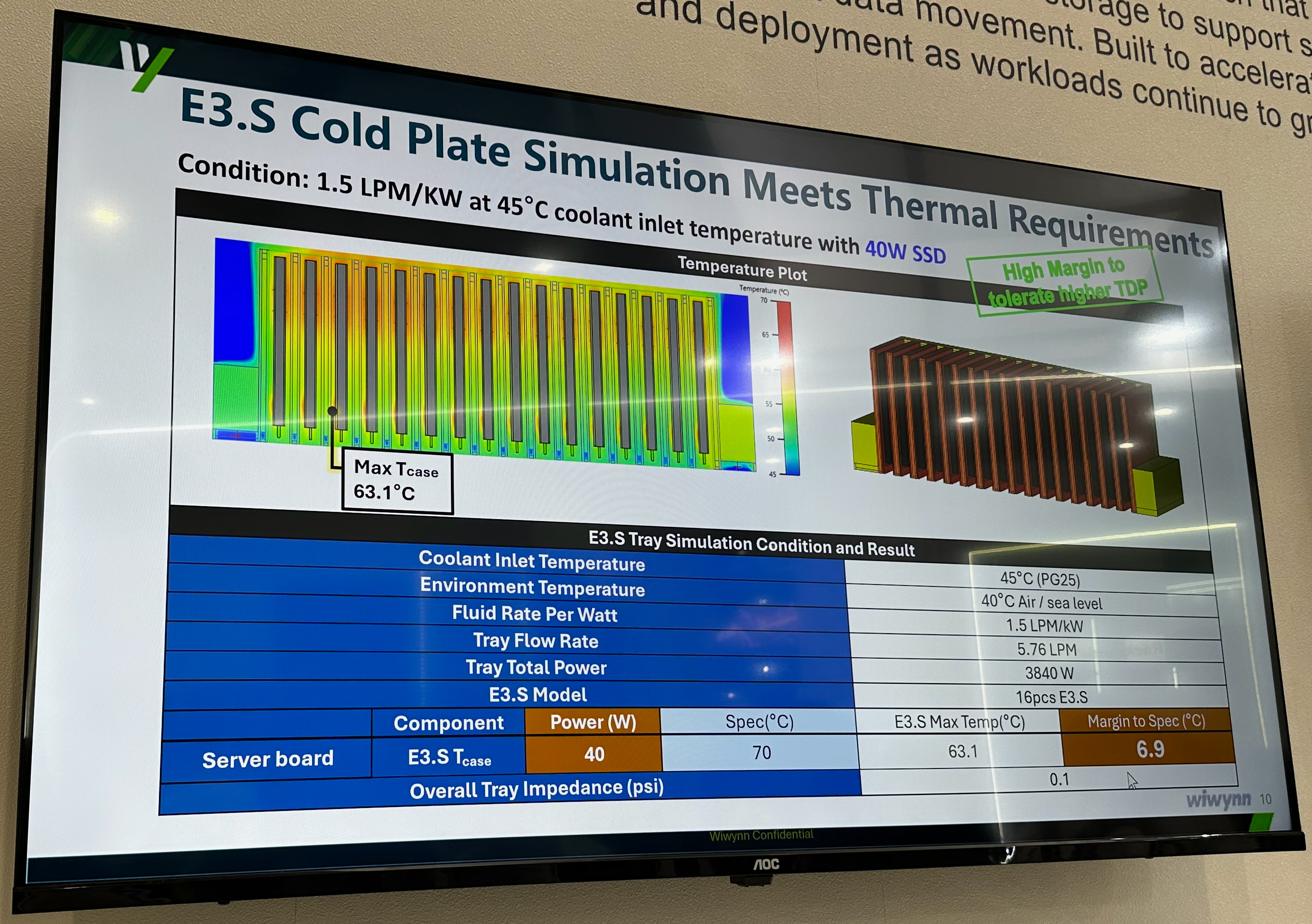
Architecturally, Wiwynn's SCADA server is an Nvidia MGX rack-compliant system in an 6RU form-actor that has a maximum power consumption of 9 kW. All key components of the machine are liquid cooled, the drives are cooled by six separate cold plate modules that are integrated into the system's liquid cooling loop so to inject coolant to all SSDs simultaneously in order to ensure consistent performance of all drives.
Positioning
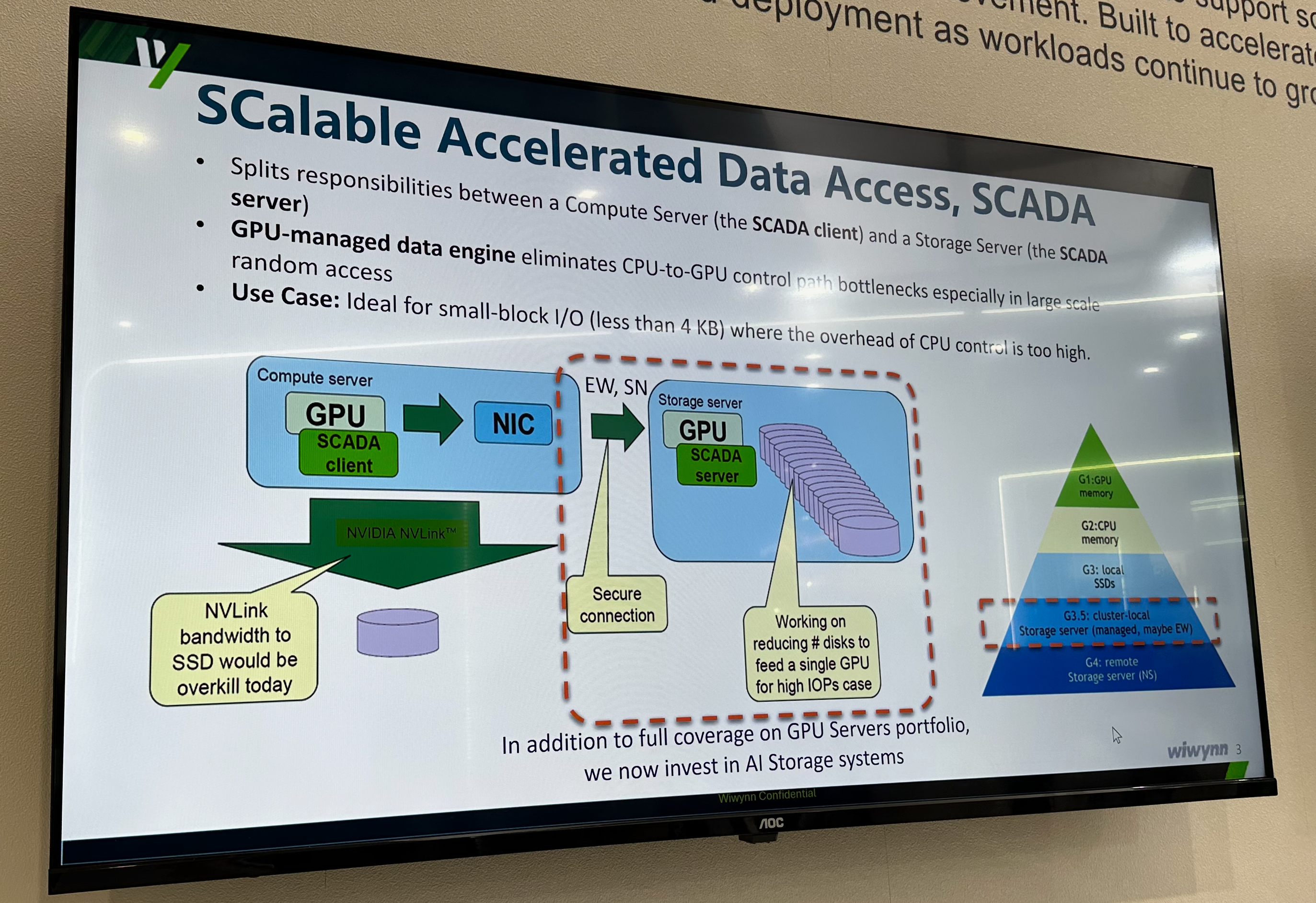
Nvidia clearly positions SCADA as tier 3.5 storage servers located behind local SSDs, but ahead of tier 4 remote storage servers that often rely on hard drives.
SCADA machines are meant to feed data to actual compute servers at a very high data transfer rate in small blocks, so its RTX 6000 Pro GPUs act more like very sophisticated storage processors that initiate and handle storage transactions, millions of small storage requests on behalf of AI applications, and pass them to the compute server via the ConnectX-9 cards, while the SSDs and their controllers still perform the actual storage functions.
(Image credit: Tom's Hardware)
(Image credit: Tom's Hardware)
(Image credit: Tom's Hardware)
(Image credit: Tom's Hardware)
In general, SCADA is a part of Nvidia's Storage Next vision, which is a collection of technologies aimed to make storage behave more like an extension of GPU memory for AI workloads.
For obvious reasons, Wiwynn does not disclose pricing of its SCADA storage server as it depends on multiple factors, including pricing of 3D NAND, DRAM, and SSDs, not to mention purchase volumes. In any case, an Nvidia Vera-based server equipped with four RTX Pro 6000 Blackwell graphics cards will not be cheap.
Anton Shilov is a contributing writer at Tom’s Hardware. Over the past couple of decades, he has covered everything from CPUs and GPUs to supercomputers and from modern process technologies and latest fab tools to high-tech industry trends.


 (Image credit: Tom's Hardware)
 Like
0
Like
0
 Dislike
0
Dislike
0
 Love
0
Love
0
 Funny
0
Funny
0
 Wow
0
Wow
0
 Sad
0
Sad
0
 Angry
0
Angry
0






Comments (0)