

Off-Camera Flash When the Weather Won't Cooperate
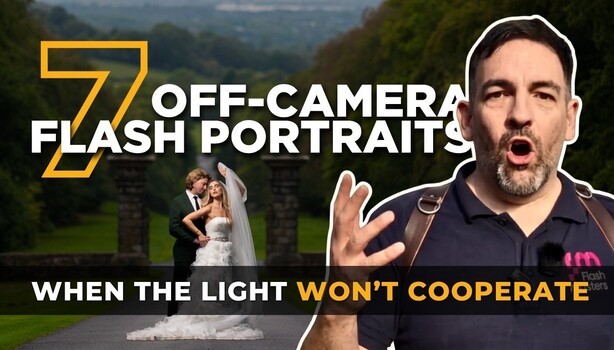
Rain forecast for hours, gone in two minutes, followed by sun, clouds, wind, and a location that shut down mid-shoot. That's the exact scenario behind this off-camera flash session, and it turns into a lesson far more useful than the tidy tutorial that was planned.
Neil Redfern walks through his entire process while the weather falls apart around him. The original idea was to shoot beautiful portraits in heavy rain, but the sky refused to cooperate, so he pivoted to showing how he adapts when the light changes every few seconds. He moves through several completely different setups at one location, each using different lenses and techniques. Redfern is honest that the results look a little scattered, and that's the point. Wedding photographers in the UK often get 10 to 15 minutes with a couple and zero control over the conditions.
Redfern teaches off-camera flash using a layering approach, and he leans on it throughout the shoot. The first layer is his "canvas," an underexposed base frame shot before the flash even fires. The second layer is the light he paints onto that canvas. For the dramatic sky-filled shots, he reaches for a Sony 16-35mm G Master and lights his subjects with a MagBox Pro 24 powered by a Godox AD200. To compress the scene down a long pathway, he switches to a Sigma 135mm f/1.8, and for a reflection shot using a mirror, he mounts a Viltrox 35mm f/1.2 wide open so the seams disappear.
One of the most practical habits Redfern repeats is the "safe shot." Before he tries anything creative, he locks in a guaranteed, well-composed frame. Only then does he chase the spontaneous moment, the Brenizer-style panorama, or the mirror reflection. If the creative idea fails, he still has a keeper. He also shoots on a Sony a9 III, whose global shutter lets him use full flash power at any shutter speed without high-speed sync. Most of you won't own one, so he explains how the same shots work with HSS, just at slightly higher flash power.
Redfern's guiding principle deserves its own place in your workflow: the couple must always be the brightest point in the frame. When ambient light climbs and the subjects stop standing out, the whole image loses its punch. That single rule explains why he keeps pushing his shutter speed as high as 16,000 to kill ambient light and let the flash define his subjects. It also connects to a broader shift happening across wedding and portrait work right now. As cameras gain global shutters and absurd native ISO flexibility, the creative bottleneck moves away from gear limits and toward decision-making under pressure. The photographers who thrive aren't the ones with the fanciest bodies. They're the ones who can read changing light and commit to a plan in seconds. Redfern shooting this in bright sun, drizzle, and heavy cloud within a single session is a live demonstration of that skill, and it's something you can practice with almost any modern camera and one off-camera light.
The final stretch moves into Lightroom and Photoshop for a compositing lesson using two raw files: one holding the MagBox, and a clean version without her. Redfern first tests Adobe's Generative Fill, then compares it against a manual composite. His verdict is worth carrying into your own editing. Generative Fill handles small, out-of-focus areas well enough for social media, but zoom in and the resolution drops where it fills. For prints, albums, or large displays, he aligns both layers with Auto-Align, masks in the clean background with a soft brush, and gets a sharp, high-resolution result that holds up under scrutiny. He also shows a Lightroom feathering feature for sky masks that keeps foliage edges from turning muddy.
Watch the full session above to see how the weather saga ends and exactly how Redfern blends the two frames.
What's Your Reaction?
 Like
0
Like
0
 Dislike
0
Dislike
0
 Love
0
Love
0
 Funny
0
Funny
0
 Wow
0
Wow
0
 Sad
0
Sad
0
 Angry
0
Angry
0









Comments (0)