

PC modder bolts 5.5-pound aluminum heatsink to RTX 4060 — convection-only cooling seems to work fine in a testbench-style installation
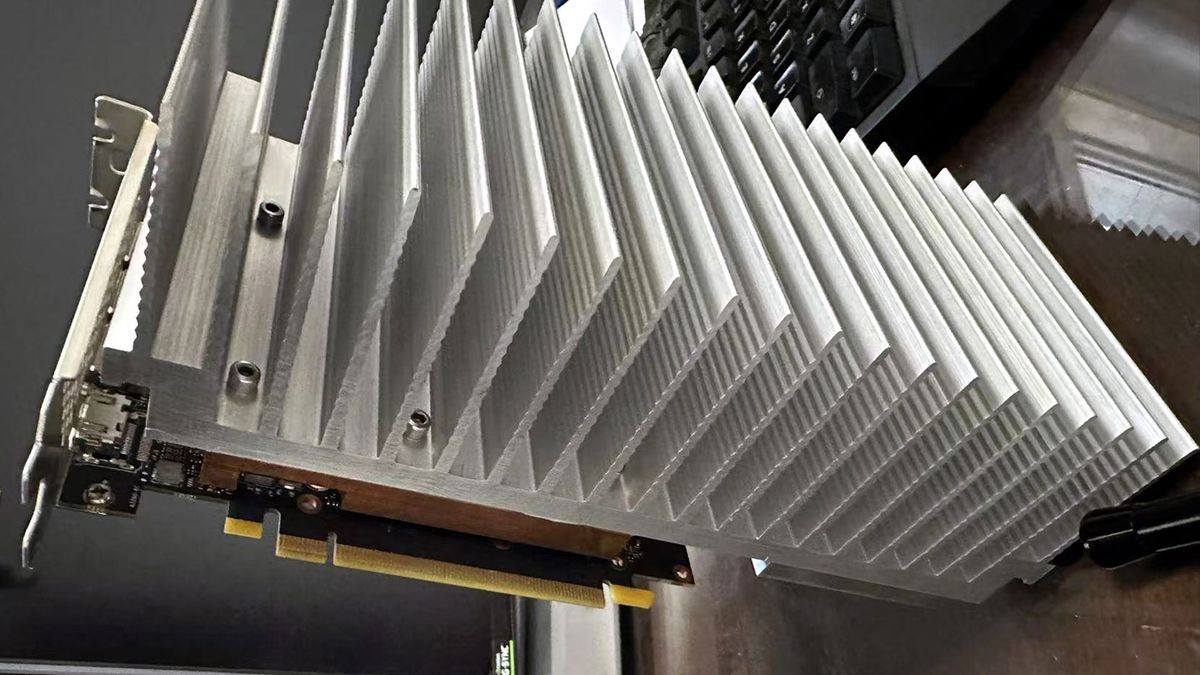
A PC gamer has DIYed a passive Nvidia GeForce RTX 4060 graphics card system. Perhaps unhappy with the Palit GeForce RTX 3050 KalmX 6GB still being the pinnacle of commercial passive graphics cards in 2026, Bilibili user NexFrame (h/t Fanless Tech) has bolted a hulking finned aluminum heatsink onto an RTX 4060.
NexFrame appears to be a small or up-and-coming ‘brand’ with a penchant for passive PC systems, from what we can understand from their Bilibili bio (machine translation). Unfortunately, we don’t have a lot of information about this passive 5.5-pound (2.5kg) aluminum heatsink-wearing RTX 4060, like whether it is tuned to run cooler than a standard model for fanless operation.
Squinting at the Bilibili video source, a system monitor window seen towards the end of the video appears to show that the GPU is running in a gaming scenario at 58C, with a 71C hotspot. Meanwhile, the graphics fan is running at 0 RPM, which seems accurate. However, the modder doesn’t seem to be taking it easy on the GPU. Further down the system info screen, we see the GPU reportedly pulling 198W. A standard actively cooled RTX 4060 would consume far less than that under load, more like 115W to 120W, so some data must be mangled here, or being misreported.
Elsewhere in the images shared by NexFrame, we can see that the CPU is also being cooled passively. It looks like a hexacore Intel CPU has been combined with a Noctua NH-P1 Passive CPU cooler. This commercial passive cooler was capable of keeping a CPU consuming up to 75W cool and stable enough over extended periods during our review testing. The system monitor tool overlaid on NexFrame’s game testing session shows the CPU sipping between 35 and 50W.
Passively cooled PCs are of interest to a significant number of enthusiasts for eliminating what is typically the noisiest component of a modern PC – fans. In a standard gaming PC, there will be fans built into the CPU cooler, on the GPU shroud, in the PSU, and also arranged at strategic places around the case. Even so-called liquid cooling systems usually rely on their CPU or GPU contact heatsinks being attached to an array of fans cooling a radiator in the case. Just think how blissfully peaceful your computing experience could be if all these moving parts were eliminated.

Follow Tom's Hardware on Google News, or add us as a preferred source, to get our latest news, analysis, & reviews in your feeds.
Get Tom's Hardware's best news and in-depth reviews, straight to your inbox.
What's Your Reaction?
 Like
0
Like
0
 Dislike
0
Dislike
0
 Love
0
Love
0
 Funny
0
Funny
0
 Wow
0
Wow
0
 Sad
0
Sad
0
 Angry
0
Angry
0










Comments (0)