

‘Ramones had leather jackets when they got spat on. We didn’t!’ David Byrne on touring with Talking Heads and taking advice from Lou Reed

In May 1977, Talking Heads along with Ramones toured the UK starting at Eric’s Club in Liverpool. Did touring as punk exploded have an impact on you? SpiritofWacker
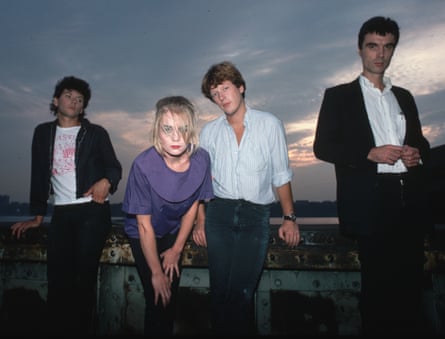
There was something really great about that tour because other than maybe a few singles the audience had never seen us, so there was a lot of curiosity and openness to us and Ramones, as different as we were. Later on, fans kind of decided they liked this band or didn’t like this band, but everything happened very quickly. I remember we did a show at the Roundhouse [in London] where somebody in the audience was gobbing on the bands and, of course, Ramones really didn’t like this. Understandably enough, they didn’t see it as a sign of – ha! – respect: “We’re with you so we’re gonna spit on you.” Ramones got more of that than we did, but at least they had leather jackets. We didn’t.
Ever since the Stop Making Sense tour, it seems to me that your live shows have been a quest to unchain the band from the physical restrictions of the typical rock concert. If that is so, where do you go from here? Lucifer_Sam
From various tours I’d realised that my guitar could be wireless. Then I did a tour with St Vincent where the brass players had started in marching bands, so were used to being mobile. I thought: “OK, what about drums?” I looked at drumline in American football and samba schools in Rio. I asked my longtime percussionist Mauro [Refosco] how many players we’d need to break down the drum kit into components and he said six. I took a big gulp and said: “I think we can afford it.” Then I discovered a Hungarian company which had invented a Midi keyboard on a self-powered rack. Suddenly, the whole band were liberated to move about, which democratised the concert experience for the musicians and the audience, who get to understand what each one does.
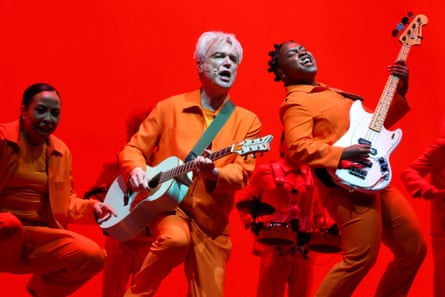
Although the sound of six players constituting a drum kit is identical to one playing it, the effect of six people working in perfect sync is heartening: humans are not as dysfunctional as we think, we can work together to produce something joyful. On my current tour we have four drummers but more dancers, who play instruments such as clarinets. I put in a curved video screen that can put us in different places, like the moon, a forest, a New York street … Each song has a different location. I don’t know where we go next, but I couldn’t go back to having everything on wires.
In your fabulous show you tell the audience that, “Happiness and hope are a form of resistance.” Sorry if I misquote. What makes you happy? PortsyP
The quote is almost right. I read a quote from the actor and director John Cameron Mitchell. He said: “Love and kindness are the most punk things you can do right now.” It’s the reverse of punk being associated with angry guitars and shouting vocals. The thing that you think might be the least punk of all is where we’re at now: things that might have seemed too sentimental constitute a kind of resistance.
True Stories is a wonderful film – why haven’t you directed a feature since? Was it not artistically satisfying? OttoMaddox
It was very artistically satisfying and I had a great time doing it. Part of the problem is of my own making. I’d paid for the script-writing, the research, looking at locations and all that stuff but after that people in LA said: “Now you’ve done a film you can get somebody else to pay for that.” Which I did, more than once, but if somebody’s putting up some money, they want a say in what you do. Sometimes, they can be helpful. Other times, you get waylaid. I ended up thinking: “Damn, I could be writing a record and doing a show at this point.” So I went back to that. I would love to do a film with digital cameras, editing on a computer. You don’t need big editing machines now. You still need actors, locations, the writing, sets and everything else, but you have more control over it than you used to. So, yes, I hope to eventually make another film.
Do you think that being born in Scotland [and to Scottish parents] maybe made you an outsider looking in at American culture? AD2023
When I was very young we moved first to Canada and then eventually to the US. It didn’t make me completely alienated, but I felt like Americans didn’t know that other people do things a little bit differently. They didn’t know that there are different kind kinds of humour and so on. I mean, Scottish humour is very specific. I find it very funny and it can be very dark. Every country lives in its own bubble to some extent, but if you’re a little bit outside that you have a different perspective. I’m not saying it makes you smarter, you just look at things differently.
Have you ever found yourself living in a shotgun shack? PeteTheBeat
I probably heard that phrase [used in Once in a Lifetime] from a radio preacher or something, but a shotgun shack is generally in the American south. They’re designed to fit into a narrow piece of land, and are called a shotgun shack because if you shoot a shotgun through the front door, it goes through every room. I did find myself staying in one once, with my daughter, at an Airbnb in New Orleans.
What was working with Brian Eno like? Did you use his oblique strategy cards in any decisions about the music? eternalsceptic
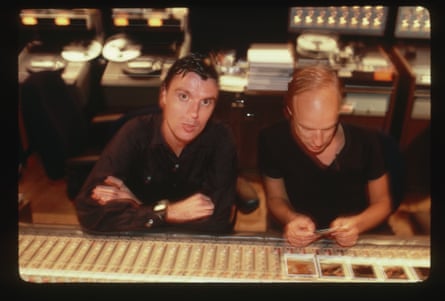
It changed over the years. I felt he was somebody who had a feeling and an understanding for what we were trying to do. At first, his goal was to capture what the band was doing. Once that was achieved, he brought ideas such as adding funny sounds, not having the songs all written – so we could improvise – and as he calls it, “using the studio as an instrument”. It was fun and we got to things that we’d never have got to if we’d stuck to one way of working. As a producer, he’s very much a cheerleader. Rather than scratching his chin and saying, “I don’t know if this works yet”, he’ll go: “This could be the beginning of something incredible, let’s keep pushing in that direction.” The box of cards were present. I don’t know if they were ever really used, but they contain clever ideas, to help you break out of any ruts or ingrained thinking.
Our Lips Are Sealed by Fun Boy Three is a thing of beauty and a joy. How did you end up producing it and the parent album, Waiting, and what was it like working with those boys and girls? EddieChorepost
I suspect that Terry Hall must have liked what we were doing and thought I might understand his kind of songwriting. I did love his songwriting, but they were all really creative. Like Brian, my role was to be a cheerleader but when I didn’t have something constructive to do, I needed to step back and let their ideas come to the fore. Terry had written Our Lips Are Sealed with Jane Wiedlin for the Go-Go’s but wanted to do his own version. I started meddling with loops, repeats, different sounds and so on, saying: “We gotta come up with something that doesn’t sound like their version, but it’s still the same song.”
It strikes me that Life During Wartime could translate to being on tour in a band – “A van that’s loaded with weapons, sleep in the daytime, work in the night-time”, etc. Am I on the right track? jimd
A young band just starting off on tour where the guitars are their weapons? I can’t say you’re wrong, but it hadn’t occurred to me. I do think the song as a whole seems in a way more relevant than ever, especially in the US, with the ICE raids and all that.
I love the story of Lou Reed interviewing Talking Heads while eating ice-cream with a dubiously dirty [heroin] spoon. timwthornton
Lou had seen us in [New York City music club] CBGB a couple of times and said: “Come back to mine afterwards and we’ll talk about your songs.” We were really excited but nervous and in awe because we were big fans of his solo stuff and the Velvet Underground. He proceeded to eat two quarts of the ice-cream he had in his fridge, but was creative as well. He started playing our song Tentative Decisions on guitar and suggested it could be slowed down, and slowed down to the speed of a Velvet Underground song. Which was pretty cool, but we didn’t slow it down as far as he suggested. At the time, my arms were covered in dark hair. Kind of ape-like. He said: “You should never wear a short-sleeved shirt on stage.”
What's Your Reaction?
 Like
0
Like
0
 Dislike
0
Dislike
0
 Love
0
Love
0
 Funny
0
Funny
0
 Wow
0
Wow
0
 Sad
0
Sad
0
 Angry
0
Angry
0







Comments (0)