

Review of the Haida NanoPro X in 1 Ultra-Low Reflection Magnetic Filter
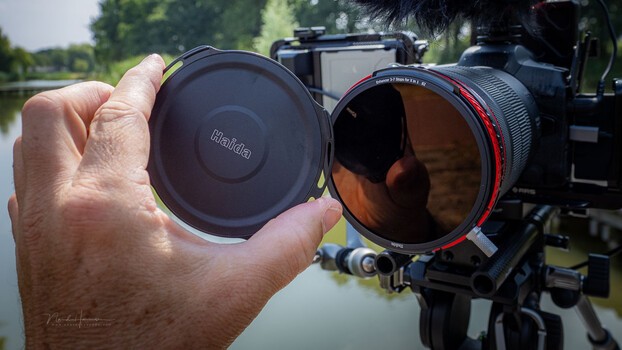
For those who like long exposures, a variable ND filter is often not the best choice. If you're filming, the variable ND is a must-have. It allows full control of the exposure. Unless your camera has a built-in ND filter, the Haida X in 1 filter set can be a great choice. I took a closer look.
A couple of years ago, Haida released the VND-CPL NanoPro II, a variable ND filter with a built-in polarizer. Both can be set separately, and it offers a 3-7 stop ND range. I've been using the filter ever since with great satisfaction.
The VND-CPL doesn't show the much-feared X-cross when set to 7 stops ND, which is important. There are a few small things that you have to keep in mind though. It can be difficult to tune in the polarization without turning the variable ND by accident, and vice versa. If you are aware of it, it doesn't pose a problem. It is also difficult to combine filters.
Now Haida has introduced the X in 1 filter set. It can be considered a second edition of the VND-CPL. Better said, it is a huge upgrade that makes it much more versatile and perhaps more useful, in a sense.
What Is the Haida X in 1?
Instead of one filter that contains the variable ND and polarization, the Haida X in 1 consists of a pouch containing the VND-CPL filter, a 2-stop magnetic Enhancer filter, a magnetic 1/4 Mist Black filter, and a magnetic lens cap.
The word magnetic is important. Although the filter itself screws onto the lens, the front of the filter accepts the supplied magnetic filters. It allows for easy and quick placement and removal of extra filters.
The variable ND filter has a neutral density range between 1 stop and 5 stops. By adding the 2-stop Enhancer, this range becomes 3-7 stops. The filter is attached with a dedicated ring, making it easy to place and remove.
The set can be extended with a rubber lens hood that is also magnetic. It is necessary to read the instructions because the lens hood has to be attached before any other filter is placed. More on that later.
Haida made sure the filter has a larger diameter than the filter mount itself. This way, the risk of vignetting is reduced, especially with ultra-wide angle lenses. I believe the X-cross forming is also less pronounced if present, but I'm not 100% sure about that. But it has a minor downside.
The magnetic system is similar to the regular Haida NanoPro magnetic filter system. You can use these filters as well, allowing a wide range of filters to be combined with the variable ND filter. However, these filters have to be one size larger, which can be a downside if you already own NanoPro Magnetic filters. For instance, if you use the Haida X in 1 in size 82mm, the magnetic filters have to be 86mm in size.
How It Is Used
The use of the filter is almost completely self-explanatory. You screw the filter onto the lens and set the desired ND strength. A latch needs to be pulled out before the setting can be changed. If the desired strength is reached, the latch falls into place and locks the setting.
Next, you need to set the desired amount of polarization by rotating the filter. It's as easy as that. It is pretty much the same as with the previous edition of the filter. However, thanks to the latch, the ND strength is locked in place.
If the maximum strength of 5 stops isn't enough, it is necessary to add the dedicated magnetic ring and the 2-stop Enhancer filter. This filter is named the 3-7 Stops Enhancer filter, to help you remember what the combined ND strength will be.
Instead of the 3-7 Stops Enhancer, it is also possible to place the supplied 1/4 Mist Black filter. If you're not familiar with this type of filter, it adds a subtle glow around lights. If desired, both filters can be used as well.
The Lens Hood
One thing that is not completely self-explanatory is the optional lens hood. Using a filter like the Haida X in 1 prevents the use of a regular lens hood. The manufacturer offers an optional magnetic rubber lens hood that fits perfectly onto the variable ND. At first, I tried to use the hood with the 3-7 Stops Enhancer in place, but that didn't work. The magnet isn't strong enough.
However, I was using the lens hood the wrong way. It turned out I had to place the lens hood directly onto the variable ND filter. The 3-7 Stops Enhancer is placed inside the lens hood itself, as is the 1/4 Mist Black filter. It is mentioned in the small booklet that is provided with the Haida X in 1, so it might be worth reading it.
When a filter is placed inside the lens hood, it becomes extremely difficult to remove it. Grabbing the filter by the side is next to impossible. The best way is to push the filter from the inside, but you will touch the glass. This isn't ideal.
The lens hood will block stray light, but it's rather shallow. It will work for focal lengths between approximately 24mm and 35mm. For longer focal lengths, it will not have that much benefit. A matte box would be more effective, but I wonder if such a system would be usable with the magnetic system.
The Image Quality
The Haida X in 1 filter is completely color neutral, as far as I can determine. Of course, the polarization can warm up colors, which can be expected. However, the ND filter seems to be neutral throughout the complete range.
The filter has a low-reflection coating. Haida promises a reflection rate below 0.1%. This is 60% less than a standard coating. It prevents flaring and ghosting as much as possible.
I have tested the filter in the 1-5 stop range with a 24mm focal length on full frame, and the 3-7 stop range with the supplied extra 2-stop Enhancer filter. I did the same test with a 15mm focal length on full frame.
For this test, I first maximized the polarization effect. When increasing the ND strength, I left the polarization ring as set. The results with 24mm show a good, consistent result. However, increasing the ND strength rotates the polarization filter. It emphasizes the need to first set the ND strength and after that the polarization.
There is a slight glimpse of X-cross forming at the maximum strength. However, keep in mind that this is a 3:2 ratio. Most video material is in the 16:9 format. In that case, any X-cross that starts to form will start to appear off-screen.
Adding the 3-7 Stops Enhancer will produce vignetting at a 15mm focal length. It will even show if the ratio is set to 16:9. I also noticed an extreme darkening in the two opposite corners of the frame. This is probably not fully the X-cross appearance, but also influenced by the polarization setting.
Keep in mind that polarization will always have issues when used with extreme wide angle lenses. The polarization is never even across the frame. This is enhanced by the ND strength, making it more problematic to use these kinds of filters with a large field of view.
Conclusion
I've been using the Haida X in 1 since I received it. It works as expected, of course. The addition of having neutral density in the 1-3 stop range is very welcome. I have had more than enough situations when the minimum setting of 3 stops with the first version of the filter was one or two stops too much. This new filter prevents the need for a higher ISO setting.
With the Haida X in 1, there is now enough range for every situation. I can use only one stop, or two, all the way up to five. With the Enhancer, the range is extended to seven stops. I think it's a clever design choice, making it less prone to the X-cross problem.
Although the filter can be used with ultra-wide angle lenses, there is a limit. A focal length of 15mm is a bit too wide for this filter, even with the 16:9 frame ratio. Also, with this field of view, the polarization is better kept at a minimum.
The addition of a 1/4 Mist Black filter is clever. But since the use of this kind of filter is mainly aimed at the appearance of light sources in the frame, its use case isn't exactly the same as a neutral density filter. Unfortunately, it can't be used without the variable ND filter in place. An additional magnetic ring in this set would be welcome.
Speaking of extra filters, the system is compatible with the normal Haida Magnetic NanoPro system. However, since the outer diameter is larger than the lens diameter, you are forced to use one size larger. If you already own these magnetic NanoPro filters in the lens diameter you have, they won't fit onto this filter.
The new Haida X in 1 is a welcome upgrade from the previous version. It's versatile, offers good image quality, and the choice of a magnetic design offers a lot of flexibility on set. It's perhaps not perfect, but I can recommend this filter to anyone who is serious about filming.
What I Like
- Variable ND with built-in polarizer
- ND range limited to 1-5 stops to prevent X-cross forming
- Additional 3-7 Stops Enhancer for the extra ND strength
- 1/4 Mist Black included
- Magnetic system works fast and reliably
- Increased diameter allows use on wide angle lenses up to 20mm without issues
- Compatible with other Haida NanoPro magnetic filters
- Latch for fixing the chosen ND strength
- Easy to use
- Lens hood accessory available
- Nice lens case included
- No color cast visible
What Could Be Improved
- The variable ND filter should also be magnetically attached to the lens
- An additional magnetic adapter for the 1/4 Mist Black filter to use it separately
- An easier way to remove a filter from the optional lens hood
Lastly, a disclaimer. Although Haida provided the X in 1 and lens hood without any additional costs, the review is not influenced or controlled in any way by Haida. The findings and conclusion are my own honest opinion.
The Haida NanoPro X in 1 Ultra-Low Reflection Magnetic Filter set will be available in September 2026 for $186.
What's Your Reaction?
 Like
0
Like
0
 Dislike
0
Dislike
0
 Love
0
Love
0
 Funny
0
Funny
0
 Wow
0
Wow
0
 Sad
0
Sad
0
 Angry
0
Angry
0











Comments (0)