

Why Pointing a Light at a Wall Beats a Soft Box Every Time
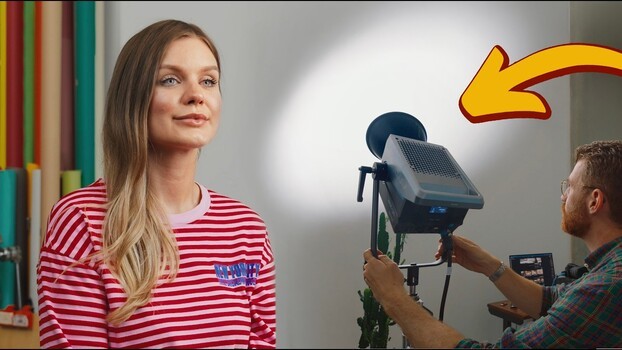
The softest, most usable light in a room often comes from the simplest move: pointing a single fixture at a white wall and turning it all the way up. Get this foundation right and the rest of your lighting becomes a matter of small refinements rather than a fight against the space.
Tyler Stalman walks through the exact sequence he now uses every time he lights a room. The first decision is whether to work with the natural light or kill it entirely, and Stalman closes the windows because the ambient light is too strong to compete with. He then brings in the Nanlite 720C, a full RGB fixture equivalent to 720 W, and instead of reaching for a modifier, he aims it straight into a wall. The wall becomes a giant, soft source, and because softness scales with the size of your light source, the result looks refined with almost no effort. Your walls have to be white for this, since bounced light picks up whatever color it hits, though a white ceiling or hung bed sheets work as substitutes.
From that base, Stalman layers rather than restarts. He adds the Nanlite SB-RP90 soft box, which opens with a single pull on a handle instead of the usual wrestling match, and sets a Forza 500 II as the key. Placement is where the character comes from. Off axis gives separation, on axis reads flat and artificial, and pushing the key well behind a subject who's looking off camera produces the cinematic edge lighting you see in Netflix interviews. Raise the same light and the look turns dramatic; lower it and it softens into a front fill. He finishes the studio setup with a Nanlite Pavotube 30C as a rim light, a small touch that separates a subject from the background and reads as professional.
The kitchen section is where the approach earns its keep. Floor space is tight, and Stalman doesn't want stands crowding the frame, so he mounts a projection attachment PJBM2545 on the 720C. The attachment is a real lens that throws a tightly controlled beam, letting him shape the light into a square that hits only the white area of the kitchen and bounces back as a soft source. Because the beam is focused, very little output is lost crossing the room, so the light stays bright even after it bounces. He also kills the pot lights, unscrews a few bathroom bulbs that pulled attention, and adds negative fill with black poster board to cut a blue spill leaking past imperfect blackout blinds.
The principle running underneath all of this is worth holding onto as gear keeps getting more powerful. High-output RGB fixtures like the ones here let you treat an entire wall or ceiling as your modifier, which changes how you think about small spaces. Instead of dragging a large soft box into a cramped kitchen and eating up floor space, you can place a bright, focused source far from your subject and let the room do the softening. Full RGB control matters here too, because matching your added lights to the color temperature of practical lamps already in the scene makes those background lights feel like they're actually reaching your subject. This is the same logic behind bounce photography with speedlights, scaled up to continuous fixtures strong enough to fill a room, and it rewards anyone shooting interviews, portraits, or content in spaces they don't fully control.
The payoff Stalman keeps returning to is fewer stands in the working area and light that reaches into a scene without physically sitting inside it. Watch the video above to see each stage build on the last and how the finished kitchen setup compares to the bare pot lights he started with.
What's Your Reaction?
 Like
0
Like
0
 Dislike
0
Dislike
0
 Love
0
Love
0
 Funny
0
Funny
0
 Wow
0
Wow
0
 Sad
0
Sad
0
 Angry
0
Angry
0










Comments (0)