

Ridley Scott on Telling Love Stories from ‘Thelma and Louise’ to ‘The Dog Stars,’ Shooting With 11 Cameras, and Why Silence Is the Best Sound Effect
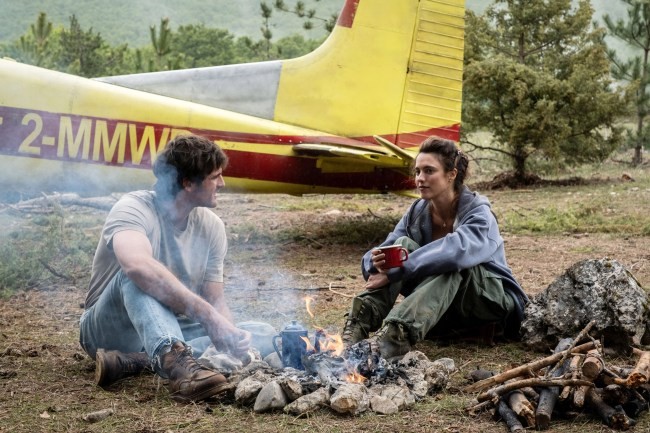
Part of the appeal of Ridley Scott‘s latest film, “The Dog Stars,” is that it gives the audience several movies for the price of one: its story of a mechanic (Jacob Elordi) searching for human connection after a virus has wiped out most of civilization is part dystopian drama, part buddy comedy (in the scenes between Elordi and survivalist Josh Brolin), part Kubrickian horror film, and part kinetic action movie.
In the end, however, “The Dog Stars” turns out to be primarily a love story between Elordi and young widow Margaret Qualley — but because this is a Ridley Scott movie, the love story is subtle and barely consummated. “When I go to Hollywood, they’ll pitch me on a story and say ‘it’s sentimental,’ or ‘it’s melodramatic,’ like it’s a compliment,” Scott told IndieWire on the latest episode of the Filmmaker Toolkit podcast. “I say, ‘Stop.’ Those two words are terrible.”


Scott prefers understated love stories like the one he depicted between Susan Sarandon and Michael Madsen in “Thelma and Louise.” “He was so underrated, Michael,” Scott said. In the scene between Sarandon and Madsen in the hotel room where they say goodbye, or the moments between Elordi and Qualley where they tentatively let their guards down, Scott tries to keep the emotional expression as restrained as possible, something he attributes to his British lineage.
“I think Churchill once said that the English and Americans are divided only by the same language,” Scott said. “You’ve got to earn the emotion. As soon as the music comes up, that means it’s not quite working. [Elordi and Qualley] never consummate the relationship, other than a kiss.”
The biggest difference between Scott’s approach on “Thelma and Louise” and his way of shooting “The Dog Stars” is technical. On “Thelma and Louise” he was covering scenes with only one camera that he operated himself, but for “The Dog Stars” he tended to employ between four and six cameras to cover dialogue scenes — a practice he began after “Thelma” that he has become known for in the years following “Black Hawk Down.”
“I did that for a very brief time as a director in BBC television,” Scott said of his early years before working in advertising and feature films. “There you’re doing live drama with six cameras, so I learned to pre-plan the geometry of the scene with the actors.” After his BBC years, Scott operated the camera on thousands of commercials and now-classic feature films like “Alien,” “Blade Runner,” and “The Duellists,” but after “Thelma and Louise” he decided he would be better served by multiple cameras that he could direct from a bank of monitors.
”Now the camera’s receiving through the viewfinder directly into a monitor, so I can sit there with four monitors, and I can talk to each operator as an operator,” Scott said. “Say, ‘You missed it, you got it, change your lens, you’re too slow,’ et cetera.” By the time he got to “Black Hawk Down,” Scott was shooting massive action set pieces with 11 cameras, which allowed him to get everything in one take. “That would’ve taken two days, but I did it in a morning.”
Shooting with multiple cameras isn’t just about saving time and money, however. For Scott, it’s a way of giving his actors total freedom, so they don’t have to worry about matching their action from take to take, and they don’t have to get exhausted doing the same scene over and over again. Scott arrives on set each day with detailed sketches so that everyone knows the plan. “I’m filming on paper before I get there,” Scott said. “On some sets they’re still arguing at 11 about where the camera’s going to go — I turn over by a quarter to nine every morning.”
That doesn’t mean Scott is rigid about his plan, however. “I’ll leave it on the actor,” Scott said. “Not the cameraman, the actor. If they say, ‘I don’t like it that way,’ I say, ‘What do you want to do?'” The key for Scott is finding a rhythm for the shots so that they work in relation to each other, and in relation to the overall shape of the screenplay. “You need movement, but sometimes I know when to sit still. It’s like sound. Silence is the biggest sound you can have — suddenly you go silent, and everyone starts paying attention.”
“The Dog Stars” is now playing in theaters. To hear the entire conversation with Ridley Scott and make sure you don’t miss a single episode of Filmmaker Toolkit, subscribe to the podcast on Apple, Spotify, or your favorite podcast platform.
What's Your Reaction?
 Like
0
Like
0
 Dislike
0
Dislike
0
 Love
0
Love
0
 Funny
0
Funny
0
 Wow
0
Wow
0
 Sad
0
Sad
0
 Angry
0
Angry
0









Comments (0)