

Rings of Power Just Changed the Nazgul in 1 Terrifying Way: ‘They Still Have a Human Side’

Published Nov 14, 2026, 7:00 AM EST
Sauron's Nine Rings offer healing and unimaginable power, but the price is far worse than death
Sauron's Nine Rings offer healing and unimaginable power, but the price is far worse than death
 Image: New Line
The Lord of the Rings: The Rings of Power season 3 sees Sauron begin to recruit the nine lieutenants that will one day become the Nazgûl, or Ringraiths. While details in J.R.R. Tolkien’s lore are a bit scarce when it comes to the gradual transformation of the Ringwraiths, Rings of Power initially presents the rings as miraculous gifts that transform the Men who wear them into Nazgnagôl, or "Ring-servants.” Rather than immediately enslaving their wearers, Sauron's rings heal their injuries, cure terrible afflictions, and grant them extraordinary power. The catch is that every gift brings its recipient closer to surrendering his freedom.
For Rings of Power co-creator Patrick McKay, depicting that transformation is one of the biggest reasons to make the series in the first place.
"Part of the opportunity of this show is to dramatize what the introduction of these powers, the rings, mean to all these peoples in this world," McKay tells Polygon.
As part of the series, McKay and his fellow showrunner J.D. Payne wanted to establish why anyone would willingly accept a ring from Sauron, the self-proclaimed Dark Lord, in the first place.
"It was very important to J.D. and I that there was a reason you would want to wear one, which is that it would give you wealth and power," McKay says. "The idea that, in the lore, thousands of years from now, they're enslaved to Sauron's will, they've lost their humanity, and they're ghost-like wraiths, that's a long way off."
"That's the bill coming. Right now, it's the good times."
Note: Spoilers follow for the first four episodes of Rings of Power season 3.
How Rings of Power makes the Nazgnagôl feel frightening
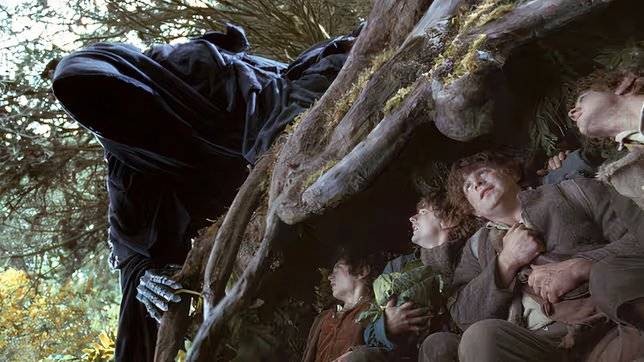
Executive producing director Charlotte Brändström wanted the Nazgnagôl to feel recognizably human while also possessing an unsettling supernatural presence. That begins right at the start of season 3, when a Nazgnagôl shows up in a battle between Elves and Orcs where Galadriel (Morfydd Clark) confronts the Nazgnagôl — and is handily defeated before escaping.
"I slowed down everything around them," Brändström says, explaining that she filmed the characters at either 36 or 48 frames per second. She also introduced echoes and reverberation into their movements and voices.
 Image: Prime Video
The Nazgnagôl's unnerving composure is just as important as their supernatural abilities. "We could feel their power by the fact that they never needed to hurry," she says. "They know the power they have."
Despite their terrifying appearances and abilities, Brändström emphasizes that the Nazgnagôl haven't completely transformed into the monsters audiences recognize from The Lord of the Rings.
"They still have a human side to them at that moment."
That distinction is crucial. Tolkien's Nazgûl are terrifying precisely because they have become so thoroughly enslaved to Sauron that almost nothing remains of their former identities. The Rings of Power is exploring how that happens, beginning with men who have understandable reasons to accept the rings and gradually revealing the price of their newfound power.
How Sauron creates the Nazgnagôl
 Image: Prime Video
By the time season 3 begins, Sauron has already recruited three kings of men to become Nazgnagôl. Early in the premiere episode, we’re given a look at the brutal audition process when five leaders from Rhûn sent by the Dark Wizard (Ciarán Hinds) arrive in Mordor to forge an alliance between the two kingdoms. Sauron recounts how their ancestors ruled Rhûn for a thousand years before the wizard showed up and cursed their flesh and that of their descendants.
After an orc kills the two that are most loyal to the Dark Wizard, Sauron reveals a small box holding the remaining Rings of Power but says he can only spare one. Then he drops a sword on the ground, implying that the last man standing can claim it. The victor is Khamûl the Easterling (Zubin Varla). After he undergoes a painful transformation, the wizard’s curse is cleansed, and Sauron dubs him “the fairest of the Nine.” Newly empowered, Khamûl is later able to confront and overpowers the Dark Wizard to effectively seize control of Rhûn.
Khamûl is also a significant figure in Tolkien's mythology. He's the only Nazgûl identified by a personal name, apart from the title of the Witch-king of Angmar. As detailed in Unfinished Tales, Khamûl is associated with the East and ranks second among the Nine. That makes his connection to Rhûn fitting, although the specific circumstances of his recruitment and his confrontation with the Dark Wizard are unique to Rings of Power.
 Image: Prime Video
We later see the same violent ritual play out with Men from the Southlands, which includes Theo (Tyroe Muhafidin). After Theo wins the contest, Sauron conducts a dark ritual that supposedly identifies his lineage: according to the Great Deceiver, Theo is descended from “a noble house of old” that were “the sworn servants of Mordor” supposedly born with special powers. Sauron rationalizes that this is why Theo was previously drawn to the sword hilt that essentially unlocked Mordor at the end of season 1. Whether or not all of this is true, Theo does accept the ring.
In an interview with Nerdist, Muhafidin described Theo's growing resentment toward Arondir, whom he holds partly responsible for failing to protect Bronwyn. “I think we find him at the beginning of the season kind of void of that hope and angered by the pain the world has dealt out to him,” he said. Sauron manipulates that desperation and offers Theo great power. By the time Theo really starts to question what the ring might cost him, it’s already too late.
The Nazgnagôl are still human, but Sauron is already taking control
 Image: Prime Video
The most devastating demonstration of the Nazgnagôl's predicament comes during the climactic battle at Gundabad in episode 4. After Arondir discovers the long-lost Celeborn (Jamie Campbell Bower) in a cell, they attempt to escape the Orc stronghold with Galadriel (Morfydd Clark) on the back of a Great Eagle. But then a Nazgnagôl confronts Arondir, and Theo takes off the mask.
Rather than immediately attack, Theo urges Arondir to leave. Unlike the Nazgûl, Nazgnagôl like Theo here still have their autonomy to an extent. Sauron’s influence and corruption have yet to completely take over. Arondir refuses to abandon Theo, and for a moment, it seems like he might actually take the ring off. Then Sauron arrives and forces Theo to kill Arondir as if he’s already exerting total control.
Arondir's death is doubly heartbreaking because Theo recognizes the man standing before him. But whatever humanity remains inside him isn't enough to prevent the Dark Lord from asserting control. We all remember the Nazgûl as these terrifying, faceless, and inhumane wraiths. Are the Nazgnagôl more or less frightening when we can still see the people beneath the mask long before they’re totally destroyed?
What's Your Reaction?
 Like
0
 Dislike
0
 Love
0
 Funny
0
 Wow
0
 Sad
0
 Angry
0








Comments (0)