

Sandra Hüller Is About to Shatter the Fall Festivals in ‘Rose,’ the Movie Michael Haneke Called a ‘Masterpiece’
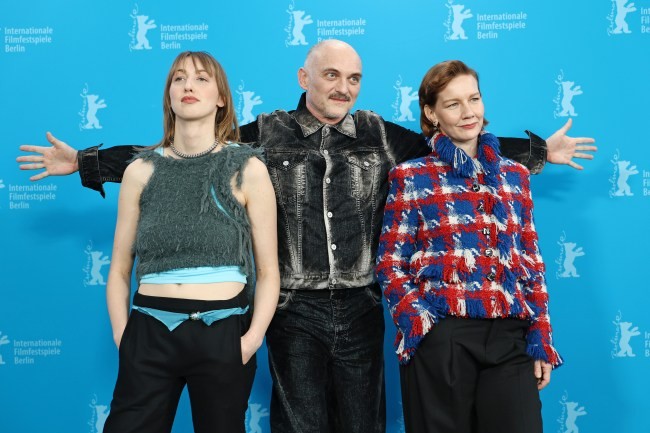
One of the strongest films of the year — in years, honestly — stars 2026 MVP Sandra Hüller as a 17th-century German soldier who’s survived a bullet to the face and disfigurement around the end of the Thirty Years War. In “Rose,” she’s also learned to disguise herself as a man to move more fluidly through the world, in a life where there’s “more freedom with trousers.” It’s an earth-shatteringly good, career-best turn from Hüller in a body of work built on career-best turns. At one point, her performance deliberately invokes Maria Falconetti in “The Passion of Joan of Arc.”
Directed and co-written by Markus Schleinzer, “Rose” won Hüller the Silver Bear Best Actress, the prize that last year went to eventual Oscar nominee Rose Byrne, back at the Berlin Film Festival in February. A deeply gifted filmmaker with rigorous control of the material but also a great deal of empathy, Schleinzer comes to this year’s festival circuit as a third-time feature director, after breaking out of Michael Haneke’s tutelage as his casting director to make 2011’s “Michael” and his 2018 follow-up “Angelo.” “Rose,” however, will put the director even more widely on the map this fall with a New York Film Festival debut and an expected (if you’re doing the math on premiere status) Telluride bow.


While this gorgeous film, shot in black-and-white, looks like an austere arthouse offering on its surface, Schleinzer delivers it with a tender touch that makes for one of this year’s grandest emotional statements. And one that belongs in this year’s awards season.
As I wrote out of Berlin: Not since Sally Potter’s breakout feature “Orlando” has a film explored gender privilege so effectively through a historical lens and via a singularly astounding European actress (then, it was Tilda Swinton). Playing Rose as a kind of gender-bending Joan d’Arc who will inevitably face plenty of persecution of her own, Oscar-nominated “Anatomy of a Fall” and “The Zone of Interest” star Hüller is tremendous in a role that allows writer/director Schleinzer to transcend the it-puts-the-austerity-in-Austria trappings of his compatriots; “Rose” is nothing short of shattering, and the centrifugal force of Hüller will, by the end, suck you into all her protagonist’s hurt. It’s an achievement built entirely upon emotional elisions, in almost imperceptible modulations of gesture and expression — especially in a final scene that cuts to black like a guillotine.
Ahead of the fall festivals, IndieWire sat down with Schleinzer for a wide-ranging chat about the making of “Rose,” his relationship with Michael Haneke, and where Haneke’s at currently given that he hasn’t made a film since 2017’s “Happy End.”
The interview below has been edited for brevity and clarity. Mubi will release “Rose” in theaters for a qualifying release in November with a wider theatrical rollout beginning in 2027.
IndieWire: How does your experience with working with Michael Haneke inform your filmmaking now?
Markus Schleinzer: I started working for him, I think at the age of 24 or 25. I became a casting director myself very early in the age of 21. Then there was a period of time where no one wanted to work with him anymore, the Austrian casting directors, because of his reputation. So they asked me and I knew little about him. We met, and it was a constant friendship. … I never studied filmmaking. So what I know about filmmaking, what I know about how to direct, what I know about this profession is what I learned from all the actresses and actors in front of my casting camera throughout the years.
How to organize a set and how to fight for the things you believe in is what I learned from Michael Haneke. Because my job was not only to do the casting for his movie, I was always on set and working on set. In some early movies I was directing the extras. On “The White Ribbon,” I had an upgrade, I was allowed to direct the children. It was in this period of time when he said, “OK, now I have the feeling I’m stealing from you. You really have to go out and become a director yourself,” and this is what I did. But it was never a pupil-and-teacher situation, and we are really good friends. But I never sent my scripts to him, and I never show him rushes because I really want to make my own mistakes.
 ‘Rose’Mubi
Has he seen “Rose”? We haven’t heard from him in a while, so I’ve been worried.
He retired. He’s 85 years old now, and then he retired, but he’s still happy. We met two weeks ago, and he was cooking a very fine dish for myself. He has done his 10 movies like his all-time idol, Robert Bresson. He did what he could do, and he’s happy now. He was there at the premiere in Austria, and he’s such a very protective and very sweet friend. When I was in Cannes with the first movie … he was calling me every other minute, “Have you won a prize? Do you know something right now?” So it’s a really sweet friendship. And “Rose,” he said, “This is a masterpiece.” He does not say this easily, which doesn’t make it easier for me to handle a compliment like this from him. But he’s happy. He’s happy with the work. He’s happy with the result.
You co-starred as Emperor Franz Joseph of Austria with Sandra Hüller in “Sisi and I,” where she played Empress Elisabeth. Is this how you met?
I knew her as an actress … but we finally met in person on the set of this movie, “Sisi and I,” and this is where we found friendship and respect. I already had started to write “Rose,” and I already was considering her for the main character. So I took this opportunity to work together with her on set as an actor. Maybe it was a bit weird for her because I was observing her the entire day when she was acting, and I was like a stalker. I ordered all the pictures she did before, and I just watched everything I could find. I was traveling, I followed her around the world and was watching what she’s doing on stage just to get an idea of her talent.
Because for “Rose,” it was so important to find someone who connects so brilliantly in these very little, very small possibilities given by the story, given by me. I never told her that I had written this for her. It just came out at the Berlinale premiere when I said this because it would’ve been embarrassing to say to someone, “I’ve written this for you,” and maybe the person disliked it. Why not? I mean, it’s a free choice to do. She liked it very much because I write in prose always … She said she has never read something like this before, that’s not a script, that’s a poem. I think that was what made her very interested in doing it. A side of maybe an interesting character she was interested to portray herself.
So if she said no, you would’ve had a problem.
Yeah, definitely. Can I say this? I would’ve shot myself. I don’t know. I would’ve put it away, locked it away, and would’ve started writing something else. Because I would never do something if I’m not completely sure about this. Being a casting director for 17 years had given me the opportunity to see what outcome it takes when the person you really believe should do this is not going to do it out of various reasons.
How did you land on this particular story? You read about a woman who lived in Prussia in the 19th century disguised as a man.
This was a birthday … a friend of mine called me saying congrats. At the end of the call, she says, “I just finished reading about a trial … about a woman in Germany who had been executed, who had been killed because she was wearing pants and then pretended to be a man. And this was exactly 250 years before your birth.” […] I was starting trying to reach out to experts and was reading about this woman. But very soon I gained more interest in women in pants. And so finally “Rose,” the script, [became] this culmination of centuries of real women who adopted male identity to claim autonomy or to survive … I think at least 300 women I came across and read throughout three different centuries. The reasons why they stepped into the pants had always been different. Some of them hoped to avoid marriage, to marry the guy they did not want to. Some of them hoped to avoid violence, aggression. Some of them wanted to achieve education. There had been patriotism, women who wanted to fight for their own country and had not been allowed to because they were women. So they pretended to be men to go to war. Of course, there had been lots of lesbian desire and maybe a trans person … But what they all had in common was the goal to live a bit more free[ly].
This touched me very much because I think this is something that we can all find in ourselves … So it started with a woman in pants, and it ended up for me as a very open reading, possible readings about the idea of what is freedom, what is your own story, and then the authorship of your own story. Who held the authorship of your own story? Are we shaped by the society we actually live in? Who are we at the end of the day? And do we want to be that person?
 ‘Rose’Mubi
Talk about the challenges of shooting in the Glasebach Valley in Germany, where you’re dealing with the elements and primarily shooting outdoors.
It was very, very hard to find this place because I was so eager to shoot this in an environment which can still be called nature and not culture. Meaning something wild, nature that had belonged to itself for some centuries and not been shaped by humans. These places are very little in Europe nowadays, and most of them are protected because there are rare plants or rare elements or rare animals. Luckily we found something like this in Germany near the so-called inner German border, this border where east and west had been divided because we were told there are still lots of landmines, so people should not go there. They have some sheeps and hope that they can get rid of the problem [using] sheep, that one day most of the sheep had stepped on landmines and exploded and things like this.
We knew that the story takes place in a period of some three years, and so we have to shoot at every season possible because three years do not take place only in summer or only in springtime. So it was very important to find a place where we can build this house or where we can build this church and just leave it there for a year to return and come back and shoot again. It was very cold summer, so it was raining all the time. It was snowing still in May. So I don’t know how we did it. We waited for one hour for this very small window of sunlight that the sun could come out to finally shoot. And then the impression that it’s not only raining all the time. So in my memory, I was wet the entire time … I was fighting for every piece of grass and every flower. And film teams, this is 40 to 70 people, when they step into grass, it’s done. Everyone had to take this very small path so that we do not disturb nature, not behind the camera. If we want, we do disturb it in front of the camera, but not behind the camera … It was so peaceful there and so quiet. And then the mobiles did not work. So it was very helpful. The animals were living there, the pigs, the horses, everyone was there. So it was very helpful to get into this idea of the early 17th century.
How would you characterize Sandra Hüller’s approach to performance?
Sandra is very hands-on, and this I like very much. What combines us is that we are both not very easily impressed. First of all, not by ourselves. Impressing ourselves is nothing that will happen easily. The script was written precisely in prose. I gave away the idea of dreams, wishes, longings, desires for the character so you’re free to choose if you want. If not, you can find similar things or your own things. We met four to five times. We repeatedly read the entire script over and over again, discussed each and every scene four to five times, and then it happened. So on a day of shooting, little rehearsal.
We started shooting for some weeks, and then she had to go to meet Ryan [Gosling] and do something [“Project Hail Mary”] with Ryan in London. And then she returned, and then we continued shooting, and then she left to do something with Tom [Cruise] again in London. And then she came back, and in between, she was doing some documentary about Ingeborg Bachmann, an Austrian author who had died in the ’70s. And then she came back and we finished “Rose” […] I don’t know when she sleeps, or maybe there are three or four of her so that luckily we can do all of our movies. I’m full of praise.
Where are you at with the Klaus Nomi biopic with Christian Friedel? You recently signed with Cinetic management, so there must be some movement here.
I finished the draft this morning […] What touches me about Klaus Nomi is that you have someone with a very, very, very great talent who is not allowed to share it with an audience. But he finally comes up with the idea to put on a mask. So he does not change his craft. He does not change his talent. He does not even change the way he was performing. He was just changing his surface to get accepted. And this is something I think still very popular nowadays with social media: How do I want to be read? And what is the idea of myself? And then how do I want to be perceived? It’s very stressful, and it became very stressful with the internet because everything will stay there forever. It’s again a story about a so-called outsider and the clash of civilization and society. But after “Rose” and after black and white, this time I chose Technicolor and a musical. There’s lots of songs and dance and even animation and things like this. It’s bittersweet and it’s again, of course, an unhappy ending. But again, I try to take on things in this matter of fact way … because this is how I see life and how the biggest emotions happen to me every day in the matter of fact way. And this touches me the most. And I can only tell stories the way I see the world.
What's Your Reaction?
 Like
0
Like
0
 Dislike
0
Dislike
0
 Love
0
Love
0
 Funny
0
Funny
0
 Wow
0
Wow
0
 Sad
0
Sad
0
 Angry
0
Angry
0







Comments (0)