

Scientists find closest star to the Milky Way's central black hole

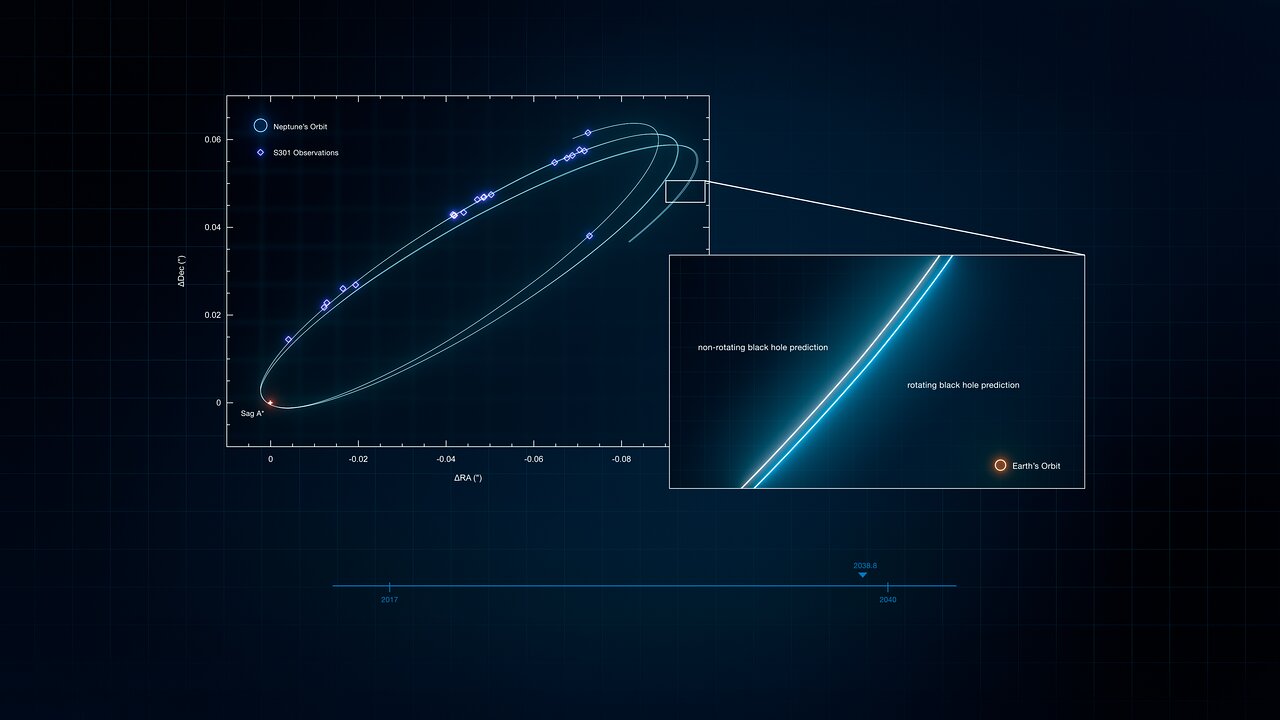
Over time, the orbit of the newly discovered star will depend on whether Sgr A* is spinning.
Credit: ESO/GRAVITY/L. Calçada
Over time, the orbit of the newly discovered star will depend on whether Sgr A* is spinning. Credit: ESO/GRAVITY/L. Calçada
So, we know there’s almost certainly some spin in Sgr A*. And it’s possible to learn something about it. The spin of Sgr A* should influence the precession of the orbit of any stars that pass sufficiently close. Unfortunately, that effect diminishes with the cube of the radius, which means we have to do one of two things: either find a star that goes close enough to the black hole, or do observations for long enough that the effects become apparent. Unfortunately, for all the stars we’re aware of near Sgr A*, “long enough” means thousands of years.
So, without a new discovery, we’d either need to up our imaging game in order to get finer-scaled information about the orbits of the stars we know about, or be very, very patient.
An extreme orbit
The new discovery comes out of a program that uses the GRAVITY instrument on the Very Large Telescope at the European Southern Observatory. GRAVITY combines light from four individual telescopes, giving it the resolution of a single telescope with a 130-meter diameter. Since 2017, a team has been using the instrument to track stars in the immediate vicinity of Sgr A*. While GRAVITY doesn’t natively return image data, the team could convert it to images.
In 2023, this allowed them to spot a star moving away from the black hole, which they termed S301. After several months of observations, they were able to estimate an orbit, which they used to predict its position in earlier data, allowing them to confirm they were looking at an actual star. This orbit suggested that, early in 2023, it had its closest approach to the black hole, one that took it closer than any star we had previously identified.
The best orbital model suggests that this star takes only 8.7 years to complete an orbit, more than three years less than any other star in the area. The orbit is extremely eccentric, meaning that it is tracing a severely squashed oval. A circle has an eccentricity of zero, while any value over one means that an object isn’t orbiting, but rather taking a one-way trip around a gravitational attractor. S301’s eccentricity is 0.9832, suggesting it is close to escaping the gravitational grasp of Sgr A*. (For context, Pluto’s eccentricity is 0.25.)
What's Your Reaction?
 Like
0
Like
0
 Dislike
0
Dislike
0
 Love
0
Love
0
 Funny
0
Funny
0
 Wow
0
Wow
0
 Sad
0
Sad
0
 Angry
0
Angry
0












Comments (0)