

Sony's Two Best Cameras Compared: Where the a7R VI Actually Beats the a1 II
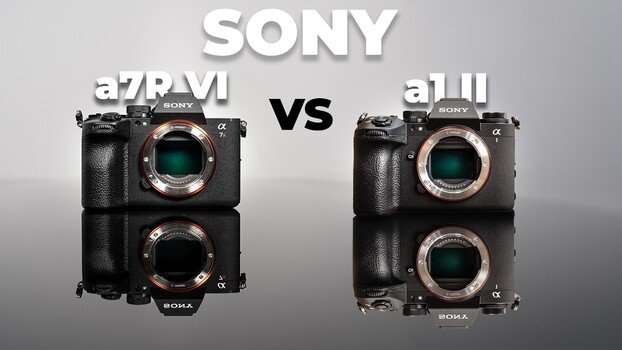
Choosing between the Sony a7R VI and the Sony a1 II is genuinely difficult, and the spec sheets don't make it any easier. On paper, the two cameras overlap so heavily that you could easily talk yourself into either one without ever really knowing if you made the right call.
Coming to you from Gareth Evans Park Cameras, this thorough comparison video puts the a7R VI and the a1 II side by side across resolution, autofocus, video, build, and price. The a7R VI edges ahead on resolution with a 66-megapixel sensor versus the a1 II's 50 megapixels, and it also claims a slight dynamic range advantage at 16 stops compared to 15. Both cameras use a full frame stacked sensor, both shoot at 30 fps with pre-capture, and both deliver autofocus that most people would call exceptional. The a7R VI also comes out ahead on the EVF, with a brighter display that holds up better at high refresh rates like 120 fps, even though both cameras share the same 9.44 million dot resolution.
Where the a1 II pulls ahead is in speed-critical situations. It makes 120 autofocus calculations per second, exactly double the a7R VI's 60, and that gap shows up when you're tracking fast-moving subjects. Rolling shutter is also better on the a1 II, which matters for fast action in both stills and video. The a1 II also adds a gigabit Ethernet port for wired connectivity, a feature that makes sense for sports and news shooters who need to move files fast on location. The buffer on the a1 II runs a bit longer too, which is largely a function of its smaller file sizes compared to the 66-megapixel files coming off the a7R VI.
Price is a real factor here. The a7R VI comes in significantly less than the a1 II, which in practical terms means a solid lens could sit in that gap. The a7R VI also has a longer-lasting battery and a backlit button panel, a small but genuinely useful feature when you're shooting in low light. For video, the two cameras are nearly identical in capability, both offering 8K at 30 fps and 4K at 120 fps with 10-bit color and log profiles, so the rolling shutter advantage of the a1 II is the only meaningful differentiator there. Both cameras support S-Log 3 and S-Cinetone, and realistically, most video work won't expose the rolling shutter difference at all. Check out the video above for the full breakdown and final recommendation from Evans.
What's Your Reaction?
 Like
0
Like
0
 Dislike
0
Dislike
0
 Love
0
Love
0
 Funny
0
Funny
0
 Wow
0
Wow
0
 Sad
0
Sad
0
 Angry
0
Angry
0









Comments (0)