

SpaceX unveils 11-million-square-foot Gigasat factory, a new manufacturing facility for space-based data centers — aims for 1 GW/year of space AI compute by late 2027 from its satellites
 SpaceX Gigasat factory
(Image credit: SpaceX)
SpaceX Gigasat factory
(Image credit: SpaceX)
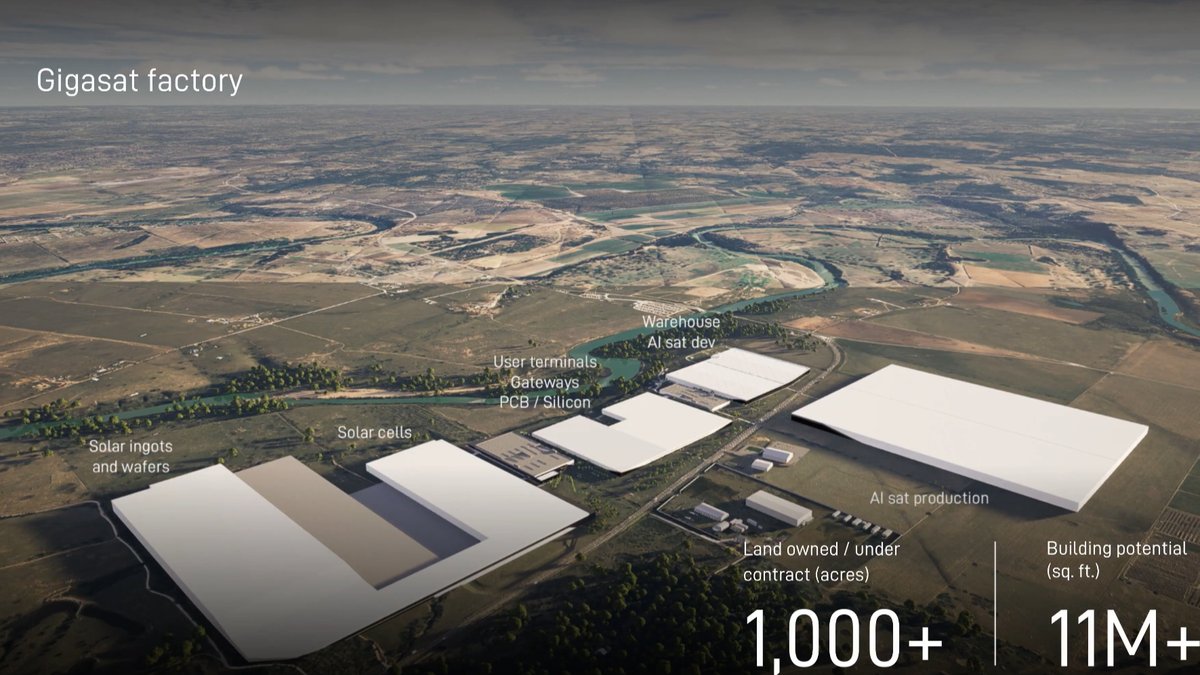
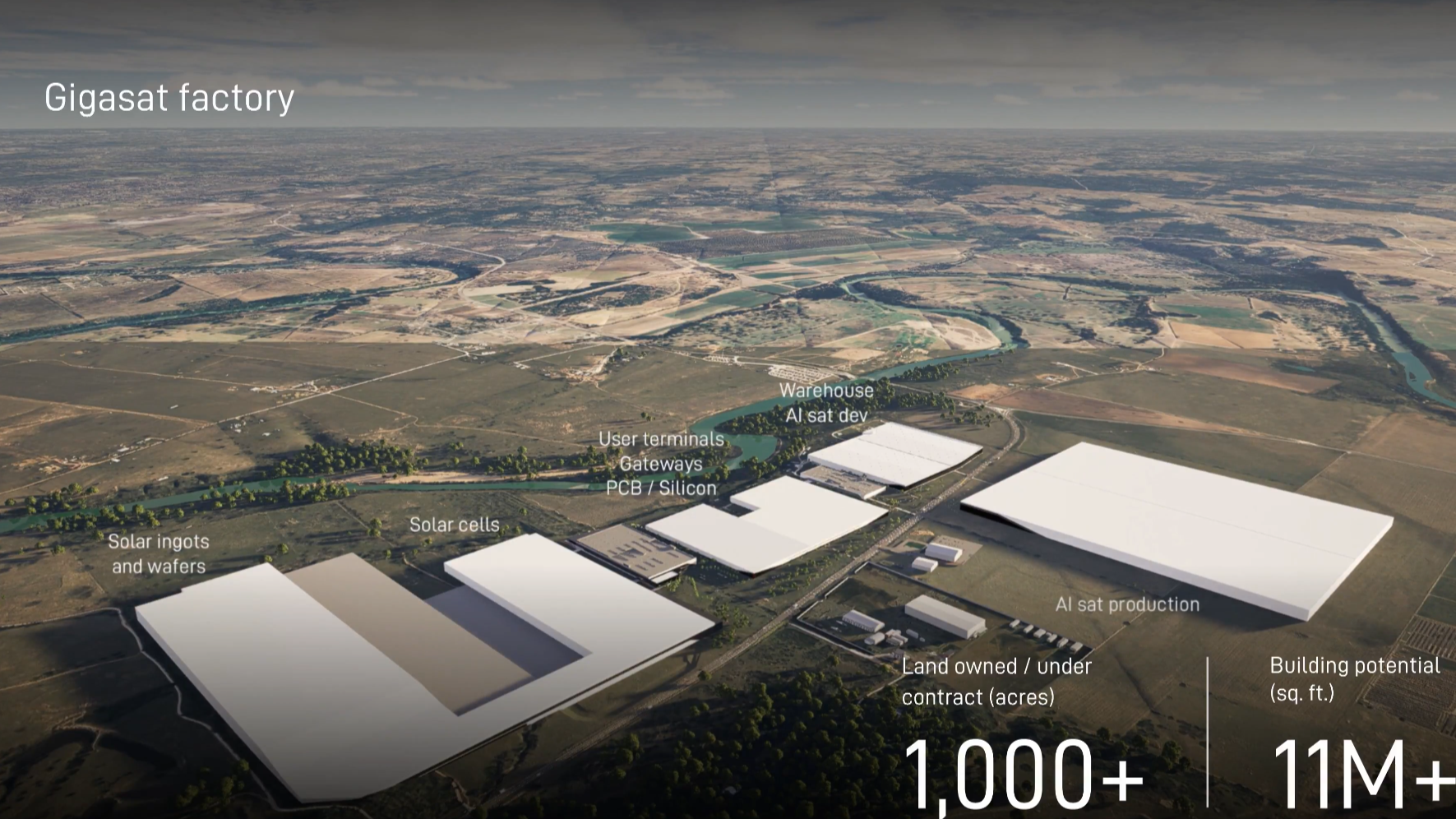
SpaceX has announced a new 11-million-square-foot Gigasat factory in Bastrop, Texas, dedicated to building the infrastructure needed to achieve the company's orbital data center goal. In an internally conducted interview posted on X on June 8, SpaceX CEO Elon Musk confirmed that the facility is expected to begin producing complete "AI satellites" by 2027. The company is targeting 1 gigawatt (GW) of orbital AI compute capacity by the end of next year, with plans to scale that figure by an order of magnitude annually thereafter.
Go deeper with TH Premium: AI and data centers
During the interview, Musk unveiled the build and specs of the proposed AI1 satellite, the company’s take on orbital data centers. The satellite will span roughly 70 meters (229.66 feet), with a massive solar array — generating power at a density of 250 W/m² — making up the bulk of the structure. AI1 will also feature vertically oriented, double-sided radiators for cooling, with the 150-kilowatt (kW) peak compute payload positioned right in the middle of the structure.
The massive 11-million-square-foot Gigasat facility — more than ten times larger than Starfactory, SpaceX's current largest spacecraft manufacturing complex — will vertically integrate much of the AI1 satellite supply chain on a single campus. The facility will manufacture solar ingots and wafers, solar cells, printed circuit boards (PCBs), silicon-based electronic components, user terminals, gateways, and the AI1 satellites themselves. The 1,000-acre site will also include dedicated satellite development and testing facilities, warehousing and logistics infrastructure, and a large-scale AI satellite production line.
According to Musk, the solar manufacturing facilities are already under construction, while the AI satellite production building is about to break ground. SpaceX expects to be producing a "reasonable volume" of these orbital data centers by the end of 2027. While each satellite will carry 150 kW of compute power, the company aims to achieve 1 GW per year of space AI compute in that same time. That would mean launching on the order of more than 6,000 AI1 satellites in a single year. For context, Starlink has about 10,500 active satellites as of June 2026.
Musk hopes to scale to 100 GW per year by 2030 and even has eyes on Terrawatt-level computing, completely solar-powered in space. "This is what we are going to try to do and think we probably can do, which is to get to roughly an annualized rate of a gigawatt per year by the end of next year at Space AI compute. And then aspirationally, scale that by an order of magnitude per year. So in two and a half years, hitting an annualized rate of 10 gigawatts a year at Space. And three and a half years, maybe 100 gigawatts," he said, while also expressing a desire to one day scale to a terawatt per year, depending on progress in chip making.
The largest AI data center anyone has actually announced is Meta's Hyperion in Louisiana, designed to scale up to 5 GW and house roughly 2 million GPUs at full buildout, at over $100 billion — and even that only reaches its first 2 GW phase by 2030. xAI's own Colossus 2 in Memphis just expanded to nearly 2 GW of capacity, with 555,000 GPUs, for about $18 billion, making it the world's largest single-site AI installation. So 100 GW/year is approximately 20 Hyperions or 50 Colossus-2s per year.
Achieving this will take an unprecedented volume of chips, and Musk's answer is Terafab — a SpaceX/Tesla/xAI venture in Austin aiming to fab 1 terawatt of compute a year, roughly 100 to 200 million advanced chips, in a 100-million-square-foot plant. However, the project itself is being met with widespread skepticism. For starters, none of the three companies has ever made a chip, yet they're starting at the bleeding-edge 2nm node. Our in-depth Terafab industry analysis explores various other reasons why this skepticism is valid.
Get Tom's Hardware's best news and in-depth reviews, straight to your inbox.
Multi-Gigawatt ambitions aside, Gigastat is a significant step towards orbital data center goals that are increasingly seen as a potential viable solution to the extreme power consumption of on-ground data centers. Not unexpectedly, SpaceX is leading the race. Manufacturing solar arrays, wiring, and satellite bodies at volume is largely conventional work — much of it built on technology SpaceX already produces for its Starlink V3 satellites, just at far greater scale — which is part of why a 2027 production start is credible.

Follow Tom's Hardware on Google News, or add us as a preferred source, to get our latest news, analysis, & reviews in your feeds.
Etiido Uko is a news contributor for Tom's Hardware covering the latest updates in big tech and the PC industry. He is a mechanical engineer and senior technical writer with over nine years of experience in documentation and reporting. He is deeply passionate about all things engineering and technology, and is an expert in gadgets, manufacturing, robotics, automotive, and aerospace.
What's Your Reaction?
 Like
0
Like
0
 Dislike
0
Dislike
0
 Love
0
Love
0
 Funny
0
Funny
0
 Wow
0
Wow
0
 Sad
0
Sad
0
 Angry
0
Angry
0








Comments (0)