

Tamron's New 16-50mm f/2.8 Puts a Fast APS-C Zoom in a Kit Lens Body
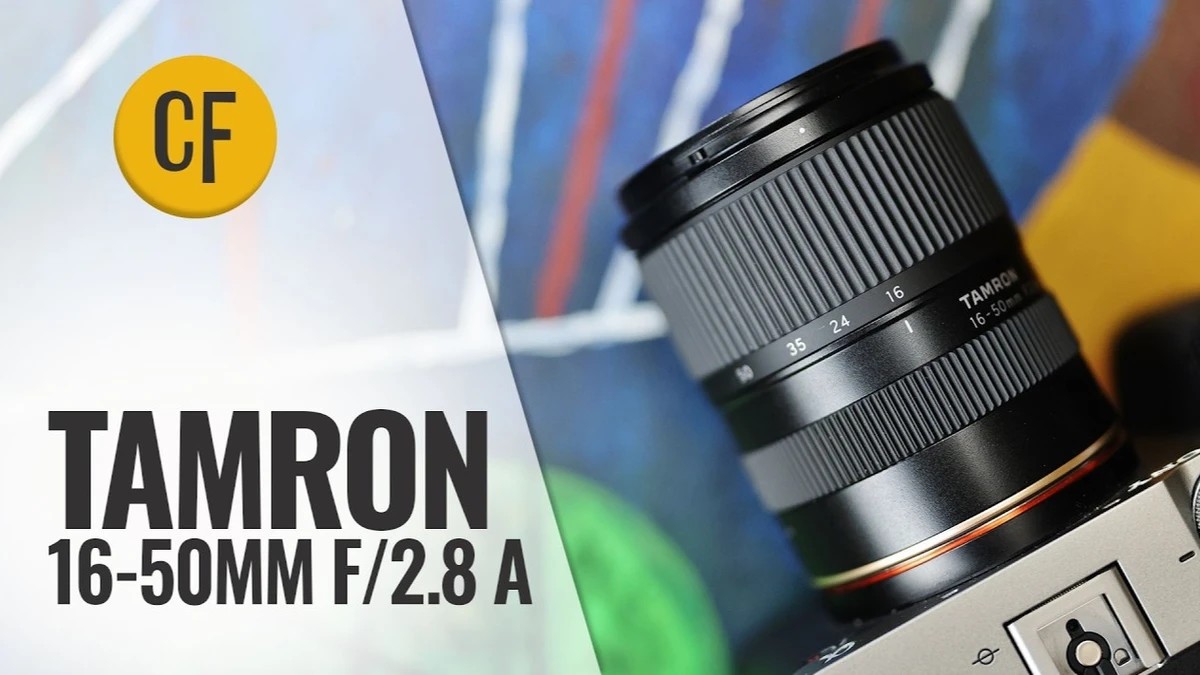
A fast standard zoom is the lens that stays on an APS-C camera for most of the day, and Tamron's newest APS-C zoom squeezes that constant aperture into a body about the size of a slow kit zoom. Shrinking an f/2.8 zoom that far usually means giving something up, so the open question is where this one gives ground and where it holds.
The lens is small enough that you could mistake it for a cheaper kit lens, and Christopher Frost runs it through a full set of optical and handling tests to see whether the results keep pace with the convenience. Tamron loaned him the lens for a couple of weeks, and he calls it a totally independent review. The Tamron 16-50mm f/2.8 sells for $529 in Sony E and Fujifilm X mounts and $549 for Canon RF and Nikon Z, which puts it squarely against the Sigma 18-50mm f/2.8 DC DN Contemporary. Tamron's lens is 5 mm longer than the Sigma, but it starts at a wider 16mm, roughly 24mm equivalent on Sony, Fujifilm, and Nikon bodies and closer to 26mm on Canon's 1.6x crop.
The body is plastic and weighs just over 300 g, yet it feels tightly assembled with no wobble, and it carries a metal mount with a weather-sealing gasket plus a USB-C port for firmware updates. The filter thread is a small 55mm. The first fast standard zoom Frost ever owned, an f/2.8 lens for Canon's APS-C DSLRs, was more than twice the size and weight. The Tamron also mounts on full frame bodies, but only in the camera's lower-resolution crop mode.
Video shooters get some of the best results here. Frost found almost no focus breathing anywhere in the zoom range, and the rubberized zoom ring turns smoothly with barely any stickiness. On his Sony a7CR, shooting in its APS-C crop mode, autofocus was silent, close to instant, accurate, and comfortable tracking moving subjects. There's no AF/MF switch, though the plastic focus ring is smooth and responds well to the motor, and the included hood is reasonably deep for a lens that reaches 16mm. The lens has no optical stabilization, which he calls "a slightly risky decision" by Tamron because not every APS-C mirrorless camera is stabilized, though newer ones are heading that way. He shows handheld footage at 50mm with and without in-body stabilization so you can see how much shake an unstabilized camera leaves in the shot.
At 16mm and f/2.8, the center of the frame is fully sharp with strong contrast, while the corners start out soft. Stopping down to f/4 helps a little, and by f/5.6, the corners look great, though the extreme edges never quite catch up. That level holds through f/11, and diffraction softens the whole image at f/16. At 28mm, the center stays excellent wide open, with a slight dip in contrast and a touch of ghosting on high-contrast edges, and contrast turns perfect at f/4. The corners are acceptable, a little sharper than at 16mm, and stopping down improves them only slightly. With in-camera corrections switched off, 16mm shows heavy barrel distortion and deep vignetting, the distortion straightens out around 23mm, and 50mm swings to strong pincushion distortion with dark corners at f/2.8, so the corrections need to stay on.
At 50mm and f/2.8, the center is just good, and razor sharpness arrives at f/4. The corners capture plenty of detail, but with slightly lower contrast and some blue-purple fringing that Frost calls "blurple," and they're at their best at f/5.6. Close up, the lens reaches about 1:4.5 magnification. It stays very sharp at f/2.8 at the wide end, while close-ups at 50mm turn softer with much lower contrast until f/4 and look perfect at f/5.6.
Flare is average at wide angles, and coma at f/2.8 goes away at f/4. Sunstars start to appear at f/8 and look bright at f/11 and f/16. He wasn't a fan of the bokeh, which turns busy in the middle distance with blue outlining on the brightest highlights, and chromatic aberration at 50mm and f/2.8 is extremely strong until you stop down. His verdict is that image quality is "generally just good enough," which is what he expects at this size and price, and he recommends the lens, especially in place of a standard kit lens.
Check out the video above for more.
What's Your Reaction?
 Like
0
 Dislike
0
 Love
0
 Funny
0
 Wow
0
 Sad
0
 Angry
0











Comments (0)