

Testing The Sirui VP-1 Vista Prime 15mm T1.6 Lenses
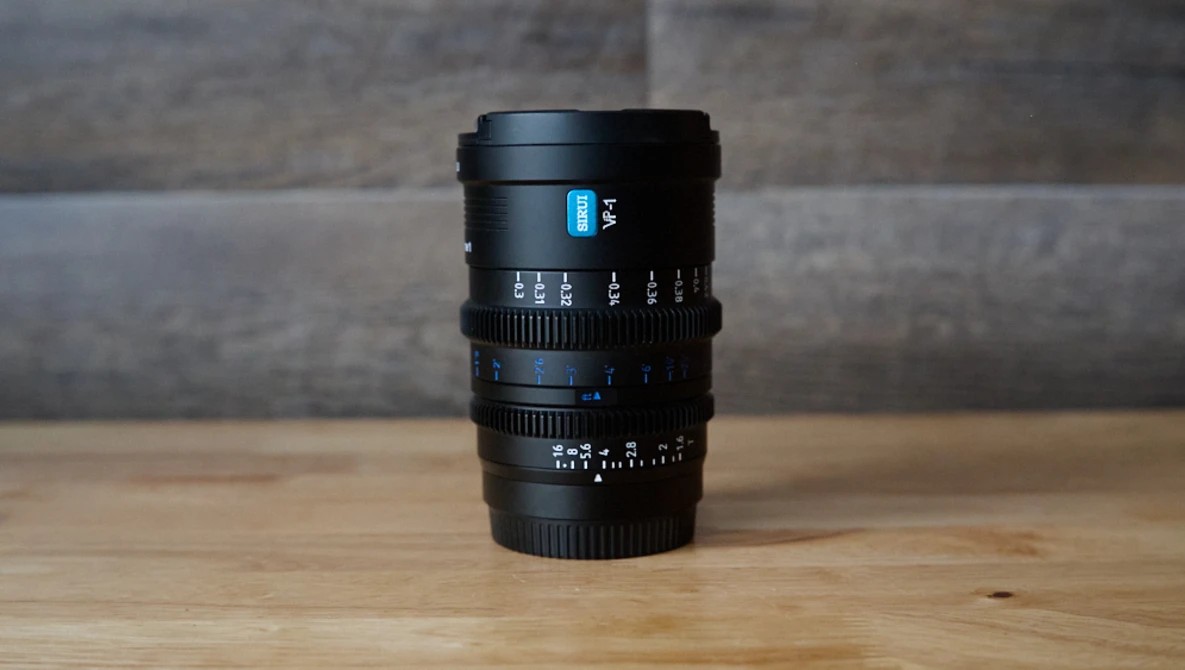
Today, let’s have a look at the pint-sized Sirui VP-1 Vision Prime 15mm T1.6.
You know, reviewing lenses is always an adventure. Unlike cameras, which generally need to be jacks of all trades, lenses tend to take on a more specialized quality. There’s your nifty fifty general-purpose prime or my standard go-to 24-70mm zoom. But almost everything outside of that range for me tends to fall into the category of “situational.” So, with that being said, when reviewing a lens, does one focus on the lens quality, the focal length on display, the ergonomics? What about lenses that are part of larger sets? Does one look at the individual lens in front of him or her or try to extrapolate truths about the larger range from a somewhat limited sample size?
I say this as I realized midway through reviewing the new Sirui VP-1 Vision Prime 15mm T1.6 that many of my reactions were as much to the specific 15mm focal length as to the extended line as a whole. In truth, the 15mm is part of a larger Vision Prime series that also includes 24mm, 35mm, 50mm, 75mm, and 150mm focal lengths. But since I have not had those lenses in to test, I’ll focus my comments today on the 15mm I’ve been fortunate enough to have in my possession for a few weeks now.
For photographers looking to expand further into motion work, Fstoppers’ Introduction to Video: A Photographer's Guide to Filmmaking covers the fundamentals of filmmaking from a photographer’s perspective.
Now, while I am generally what could be termed a “fast worker,” I will admit that I was a bit slow in completing this review. This wasn’t totally my fault. The model I had recruited to help me test its capabilities flaked out. Not once. Not twice. But three times. That, plus other commercial projects I’m working on at the moment, meant it took me longer to get around to having a look at this product than usual. Perhaps because of this delay, perhaps because of the lens’ unique attributes, the 15mm ended up settling into an unexpected groove within my collection: a casual everyday lens.
At 15mm, this isn’t a lens you’re always going to go to for every commercial project. Even with a lens with distortion as well controlled as this one, it is still not likely the focal length you’re going to pick for beauty shots. Yet still, I did continuously find myself wanting to find ways to work this lens into my day-to-day for a handful of specific reasons.
First, it is genuinely light. As someone who is appreciating more and more the value of lightening my load when trying to make it through a long shoot day, this lens immediately caught the attention of my aching muscles. The first camera I tried it on was the Nikon ZR, and that combination could only be described as “playful.” Over the course of my time with the lens, I also tried it on the Nikon Zf, Z9, RED KOMODO, Canon EOS C70, and EOS R8 Mark II. With each body, I found the lens balanced relatively well and was comfortable to hold.
You might have also picked up on the multiple brands listed in that previous paragraph. Without a doubt, one of my favorite things about this lens is that it arrived with four interchangeable mounts: Z, RF, E, and L. Now, I am not exactly known for my skill with small tools, but even I was able to change the mount easily and did so multiple times to try it out on different camera bodies. The 15mm lens covers full frame sensor cameras, but I also tried it on my KOMODO, which resulted in about a 22mm or so field of view. As someone with a number of crop sensor cameras, this is a feature I would take advantage of a lot were I to own this particular lens.
The T1.6 maximum aperture is plenty wide to let in a lot of light. With 15mm, I found myself preferring deeper stops to take in more of the scene. You don’t buy a 15mm because you’re looking for a bokeh beast. You buy it to take in more of the world.
I think that’s the other reason I ended up using this lens as an everyday lens more than I had expected. My surroundings can sometimes be more, ahem, meager than I would want. I don’t always have the luxury of backing up for a wider view. 15mm allows me to shoot in even the tightest rooms without feeling cramped. Take it outside and you have an instant landscape.
Of course, 15mm comes with the expected disadvantages. There is the expected distortion the further you get toward the sides of the frame. Interestingly enough, I found vlogging with the lens acceptable as long as you are keeping yourself/your subject in the center of the frame. The closer you get to the sides of the frame, that’s where the distortion is going to kick in. But at standard distances and with considered framing, it’s not a struggle to get the wide angle characteristics to work to your benefit.
Because my subject flaked, I ended up having to step in front of the camera myself. So, I did miss focus once or twice when doing it by focus distance. But when I was behind the camera and could really nail my focus, the lens sharpness and character were no longer in question.
The unit I reviewed had a 67mm filter thread along with standard 0.8 MOD gearing. The minimum focus distance was about 1 foot (11.8 inches). So, I wouldn’t characterize this as a super close-up lens. But there was minimal focus breathing and reasonable falloff.
I will say that focusing was also the root of the main issue I had with the lens. Not at all related to its ability to focus. Rather, there’s a practical design choice that did trip me up on multiple occasions. The lens is marked with both meters and feet for more universal usability. That’s all good. The main issue I had with my sample was that it was a black lens and the feet measurements were in dark blue. The meters were in white. But the feet measurements were dark blue on black. I have both A) poor eyesight and B) the common American aversion to the metric system. So, trying to focus by using your subject’s distance to the lens was nearly impossible because about half the time I just literally couldn’t see what the scale said. I did look and realized that there is also a metal gray version of this exact lens, which has white and gold focus markings. So, if you are going to purchase this, I’d highly recommend buying that version for pure visibility.
Pros
Lightweight
Standard MOD gearing
Wide field of view
Inexpensive
Covers full frame
Interchangeable mounts
T1.6
Smooth focus ring
Minimal distortion
Minimal focus breathing
No noticeable vignetting
Cons
The dark blue focus ring markings
The expected distortion at the far corners
Conclusion
At a suggested retail price of $649, the Sirui VP-1 Vision Prime 15mm T1.6 is a nice wildcard to have in your deck. It’s an appropriate value for a lightweight option that allows you to see the world at a larger scale.
What's Your Reaction?
 Like
0
Like
0
 Dislike
0
Dislike
0
 Love
0
Love
0
 Funny
0
Funny
0
 Wow
0
Wow
0
 Sad
0
Sad
0
 Angry
0
Angry
0











Comments (0)