

The 1-Inch Sensor Is Not One Inch, and the Name Is a 70-Year-Old Fossil
Check the active imaging area specified for the sensor inside a Sony RX100 and you get 13.2 x 8.8 mm, with a diagonal of about 15.86 mm. That is close to 16 mm, not the 25.4 mm that an inch is supposed to be. The "1 inch" printed on the spec sheet does not describe any dimension of the imaging area, and the reason runs all the way back to a glass vacuum tube that stopped being manufactured decades ago.
Measure a 1-Inch Sensor's Imaging Area and You Get 16 Millimeters
The active imaging area of a typical 1-inch type sensor, the 3:2 chip in cameras like the RX100, is 13.2 x 8.8 mm. Run those two sides through the Pythagorean theorem and the diagonal comes out to 15.86 mm. A real inch is 25.4 mm. The number was never a measurement of the chip at all, and was never meant as one; it is an optical-format designation, a category label. But read the way any normal person reads a unit, it suggests an inch of sensor that is not there. No width, no height, and no diagonal of the imaging area comes within striking distance of an inch, and the largest of those measurements is barely more than half of what the name seems to promise.
Compare that against the format most photographers use as a mental yardstick. A full frame sensor is 36 x 24 mm, with a diagonal of 43.3 mm. Divide one diagonal by the other and you get the crop factor: 43.3 divided by 15.86 is about 2.7. A 35mm lens on a 1-inch camera frames the scene like a 95mm lens on full frame. That 2.7x multiplier, not the inch, is the number that tells you how the sensor will actually behave in your hands.
The honest description of the size is unflattering, which is the whole problem. The diagonal works out to roughly five-eighths of an inch. A camera maker could label the sensor "16 millimeters" or "0.62 inch" and be perfectly accurate, and it would sound like a fingernail clipping. "1 inch" sounds like a substantial slab of silicon you could pinch between two fingers. The difference between those two impressions is the entire commercial value of keeping the old name.
The Name Came From a Glass Tube
Before silicon, television cameras saw the world through vacuum tubes. RCA introduced the vidicon around 1950, and it anchored a family of imaging tubes with names like Plumbicon, Newvicon, and Saticon that ran through broadcast and industrial cameras for the next several decades. Each one was a sealed glass cylinder, and the industry sized them by the outside diameter of that glass. A 1-inch tube, a 2/3-inch tube, a 1/2-inch tube: the number told you how fat the glass was.
The light-sensitive target inside the tube was much smaller than the glass wrapped around it. Engineers found that the usable, scannable image area had a diagonal of roughly two-thirds of the tube's outer diameter. A tube sold as "1 inch" therefore produced a picture about 16 mm across the diagonal, a little under the 17 mm that two-thirds of 25.4 mm actually works out to, because this was a rule of thumb rather than a standard. Modern type designations inherit that slack, generally running about 1.5 to 1.6 times the active diagonal, with exceptions. The number on the box described the plumbing, not the picture, and the picture was always the smaller thing.
When solid-state sensors replaced tubes through the 1980s and 1990s, manufacturers kept the tube vocabulary so that lens makers and camera engineers could often drop a chip into an existing design without redoing all the optical math. A CCD that produced the same 16 mm image circle as a 1-inch vidicon got called a 1-inch type sensor, and the label stuck. Sony still prints it carefully as "1.0-type" rather than "1 inch," a quiet admission that the unit is a category, not a measurement. The two-thirds shrinkage got baked in permanently. That is why a modern 1-inch-type sensor's diagonal is roughly two-thirds of the nominal one-inch tube diameter, and never was anything larger.
Why None of the Fractions Add Up
The same legacy math explains the stranger numbers on compact cameras and phones. A 1/2.3-inch sensor, the common size in budget compacts and many phone camera modules, measures about 6.17 x 4.55 mm with a 7.66 mm diagonal. A 1/1.7-inch sensor is about 7.6 x 5.7 mm. A 2/3-inch sensor is about 8.8 x 6.6 mm. None of those numbers is a clean fraction of anything you could actually measure on the sensor. Each fraction is a notional tube diameter, the old naming scheme carried forward and extrapolated well past the catalog it came from; the finer values, 1/2.3 among them, are lens-coverage conventions rather than callbacks to tubes anyone commonly built. Trying to reason about them as fractions of an inch is a dead end, because they were never fractions of the chip.
Micro Four Thirds hides the same fingerprint in plain sight. The "Four Thirds" name points to both the 4:3 aspect ratio and the 4/3-inch type designation behind it. Olympus and Kodak built the original Four Thirds system around a 4/3-type solid-state sensor, a designation drawn straight from the old video-tube optical-format system, and Micro Four Thirds later kept the same sensor, which measures 17.3 x 13 mm with a diagonal of about 21.6 mm. A 4/3-inch tube is nominally 33.9 mm of glass, and two-thirds of that is 22.6 mm, so the sensor's 21.6 mm diagonal runs a bit under the old rule, which is about as precisely as the rule ever worked. A hugely popular modern camera format still wears a naming convention inherited from tubes that have not shipped in a working camera since before most of its owners bought one.
Set all of that against the formats whose names at least point at real dimensions. Full frame is nominally 36 x 24 mm because the film frame it descends from was, give or take small variations between sensors. APS-C is a family rather than a fixed size, around 23.5 x 15.6 mm on most cameras and a touch smaller on Canon bodies. "Medium format" is broader still: the sensors in a Fujifilm GFX or a Hasselblad X2D are 44 x 33 mm, one common size in a category that historically ran much larger. None of those names is a caliper spec either. The difference is what happens when the spec sheet drops the name and gives you millimeters: those millimeters describe the imaging area you are actually buying, while a size in inches tells you which vacuum tube to pretend you are holding.
What a 1-Inch Sensor Actually Buys You
Strip away the naming mess and the 1-inch class genuinely earns its place. It is roughly four times the sensor area of a 1/2.3-inch compact and a small fraction of the bulk of an APS-C or full frame system, which is why it became the default for premium pocket cameras. The Sony RX100 VII packs a 20-megapixel 1-inch stacked sensor behind a 24-200mm equivalent zoom in a body around 300 grams. The Sony RX10 IV stretches the same sensor class behind a 24-600mm equivalent lens for people who want one camera to cover everything from a portrait to a distant bird. The vlogging-focused Sony ZV-1 II uses the same size sensor tuned for video and selfie framing. Canon's PowerShot G7 X Mark III and DJI's Osmo Pocket 3 ride the same 1-inch class, which tells you how completely it owns the premium-compact niche.
The 2.7x crop factor is the tradeoff you are accepting in exchange for that size. Depth of field and the total light a sensor gathers both scale with its area. At matched framing and shutter speed, a 1-inch camera at f/2.8 gives you roughly the background separation of a full frame sensor at about f/7.6, and the noise comparison lands near the same place only under matched conditions: the full frame camera's ISO raised by roughly the square of the crop factor to match brightness, the images compared at the same output size, and comparably capable sensors on both sides. You do not get full frame blur or full frame clean shadows out of a pocket camera, and no clever marketing changes that. In return, the lenses stay small, the reach gets long, and the whole package fits a jacket pocket. For a travel or everyday camera, that bargain is often worth more than the raw sensor size a spec-sheet purist would demand. If you are still building intuition for how crop factor and focal length interact, the camera fundamentals do not change no matter what the sensor is called.
Drones lean on the same class for the same reason. DJI has built 1-inch sensors into several of its consumer aircraft, such as the DJI Air 3S, where the format hits a sweet spot between image quality and the weight a small flying camera can carry aloft. A phone-sized 1/2.3-inch chip gives up image quality, and a Four Thirds sensor is cleaner but drags a heavier system behind it; the chip itself weighs almost nothing, but covering it takes a larger image circle, which means bigger lenses, a bigger gimbal, and a beefier airframe. The 1-inch class sits in the middle, which is exactly why it keeps showing up anywhere size and image quality have to be traded against each other.
Why the Industry Keeps a Name That Fools People
There is a real case for the convention, and it is not just inertia. The inch-type number still maps cleanly to the image circle a lens has to cover, the make-or-break question of whether a given lens can serve a given sensor at all. An industry that spent 40 years machining C-mount lenses and industrial optics around 1-inch and 2/3-inch tubes had every reason to keep one shared vocabulary when the tubes turned into chips, because much of the glass on the front of the camera could carry straight over, even as other optics were redesigned around the new chips' cover glass, ray angles, and resolution demands. Security cameras, machine-vision rigs, and microscope cameras still live in this world, and the type number tells an engineer at a glance which lens will fill the frame. Swapping it all over to millimeters would have snapped a working shorthand that thousands of products still depend on.
The marketing benefit is the part worth naming plainly. "1 inch" reads as a meaningful step up from a phone, and in image terms it usually is, but the number itself is doing rhetorical work the true 16 mm diagonal could never pull off. A camera maker gets to print a number about 60% larger than the real diagonal, in a unit the customer instinctively reads as a physical size, without ever technically claiming a measurement. Nobody sat down and invented the system to deceive anyone. It is a genuine engineering convention with a genuine history stretching back roughly 70 years. It just happens to flatter the product, and that is precisely why no manufacturer is racing to switch to the honest millimeter.
So the next time a spec sheet tells you a camera has a 1-inch sensor, translate it in your head before you react. The chip is about 13.2 x 8.8 mm, the diagonal is roughly five-eighths of an inch, the crop factor is 2.7, and the name is a fossil from the age of vacuum tubes. The sensor is good. The number is a costume.
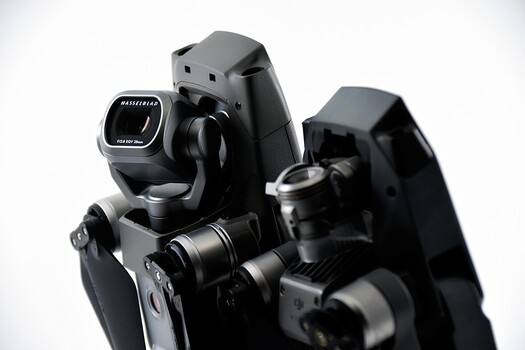
Lead image: the DJI Mavic 2 Pro (front) carries a 1-inch Hasselblad camera on its gimbal, with a DJI Mavic Pro behind it. Photo by SimonWaldherr, CC BY-SA 4.0. Source
What's Your Reaction?
 Like
0
Like
0
 Dislike
0
Dislike
0
 Love
0
Love
0
 Funny
0
Funny
0
 Wow
0
Wow
0
 Sad
0
Sad
0
 Angry
0
Angry
0














Comments (0)