

The Burning River Photograph That Helped Build the Clean Water Act Was Shot in 1952, Not 1969
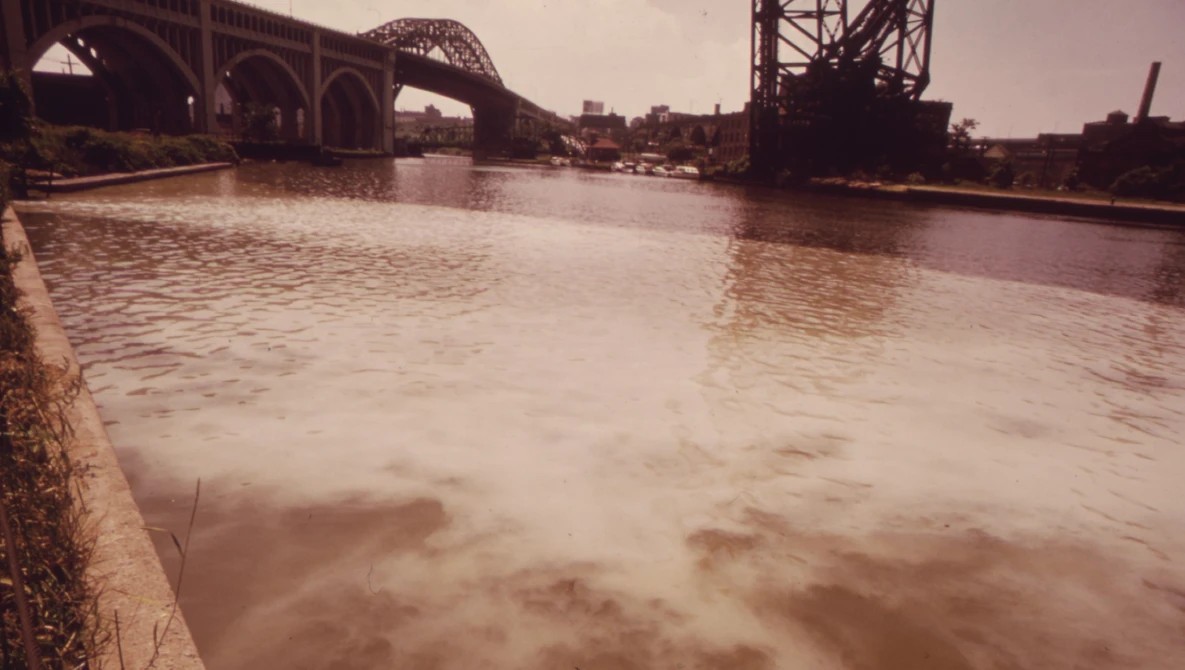
The fire that made the Cuyahoga River famous started just before noon on Sunday, June 22, 1969, under two railroad trestles southeast of downtown Cleveland, and it was under control inside half an hour. It warped some railroad ties, cost about $50,000, and earned a five-paragraph story on page 11-C of the next morning's Plain Dealer. No photographer reached the scene while it was burning, and no picture of the flames is known to exist.
A Half-Hour Fire That Nobody Photographed
Oil and floating debris drifting in the current below the trestles ignited and burned hot enough that the flames were later described as five stories high. The Norfolk and Western Railway took roughly $45,000 in damage to its bridge. The Newburgh and South Shore Railroad took about $5,000 more. Both numbers come out of the Cleveland Plain Dealer's own June 23 report, and together they are the entire financial footprint of the most consequential river fire in American history.
Cleveland's two dailies both covered it, and both covered it small. The Press ran a single photograph on the front page showing warped railroad tracks, under a one-paragraph caption. The Plain Dealer's picture showed a fireboat washing down a trestle after the flames were already out. That is the visual record of June 22, 1969: heat-bent steel and a cleanup in progress. Bill Barrow, who runs the Cleveland Memory Project at Cleveland State University, put the reason plainly to WKSU. The river had burned so many times before that "nobody even took a picture of the '69 fire when it was happening," he said. For fifty years since, he added, people hunting for photographs of the fire "had to settle for pictures of earlier fires."
There is no film of it either. Accounts written decades later describe the Cuyahoga burning on newscasts around the world, and one legal history refers to considerable television coverage, but no crew got to the trestles while there was anything to shoot. The fire was over in the time it takes to drive across Cleveland. Whatever went out on the evening news that Sunday, it was not moving pictures of a river in flames.
The 1952 Fire Looks the Way the Myth Sounds
Seventeen years earlier, the river produced exactly the spectacle the country would later imagine. On the afternoon of Saturday, November 1, 1952, an oil slick ignited near the Great Lakes Towing Company's shipyard in the Flats and went to five alarms. It destroyed shipyard structures and tugs, damaged the Jefferson Avenue bridge, and caused losses estimated between $500,000 and $1.5 million. The only reason the death toll was zero is that a Saturday afternoon left the yard nearly empty. The next morning's Plain Dealer ran a banner headline across the front page: "Oil Slick Fire Ruins Flats Shipyard."
Photographers had time to work that one. They shot from the deck of the Jefferson Avenue bridge, from the bank, and from across the channel, and the negatives are extraordinary. In one frame, firefighters stand silhouetted on the bridge while a solid front of fire advances down the water behind them. In another, a hose stream arcs clean across the river into a smoke column that fills the entire sky. The Cleveland Public Library's copy is cataloged with the date November 1, 1952, credited to the Plain Dealer, and described as oil on the river igniting and burning the Great Lakes Towing yard. Cleveland State's Cleveland Press Collection holds its own set of the same afternoon, credited to a staff photographer named James Thomas. The surviving objects are what you would expect from a mid-century newspaper darkroom: eight-by-ten prints in the Press files, a six-and-a-half by eight-and-a-half inch gelatin silver print in the library's.
None of this was novel in 1952 either. The Cuyahoga had burned in 1868, 1883, 1887, 1912, 1922, 1936, 1941, and 1948 before that Saturday, and researchers put the total closer to thirteen incidents. The 1912 fire killed five men. Cleveland was not even unusual: Columbus, Detroit, Philadelphia, and Baltimore Harbor all had fires on the water during the same industrial decades. A burning river was a recurring municipal hazard, which is precisely why the 1969 version drew a shrug from the people who lived there.
What Time Actually Printed on August 1, 1969
Time ran the Cuyahoga on page 41 of its August 1, 1969 issue, under the headline "The Price of Optimism," and the prose did most of the damage on its own. "Some river!" the magazine wrote. "Chocolate-brown, oily, bubbling with subsurface gases, it oozes rather than flows." It reported the local joke that anyone who falls into the Cuyahoga "does not drown." He "decays." It described a river that had recently burst into flames with enough intensity to nearly destroy two railroad bridges.
Next to that text sat a photograph of a vessel in burning water, captioned "Boat caught in flaming Cuyahoga." Arrye Rosser, an interpretive and education specialist at Cuyahoga Valley National Park, has a copy of the issue she bought on eBay, and she has been pointing at that line for years. "What they didn't include in the caption was this is not the 1969 fire, it's the 1952 fire," she told WKSU. There was no date on it, no archive credit, nothing to signal that the negative was older than the magazine's youngest readers. The page also carried a second image that was genuinely current: Carl Stokes, Cleveland's mayor, holding a press conference on the riverbank the day after the fire with microphones pushed into his face.
The issue's cover had nothing to do with rivers. It was Ted Kennedy, two weeks after Chappaquiddick, and Rosser thinks that cover is a large part of why a couple of paragraphs buried forty pages deep became the most durable environmental story of the decade. "The whole story of the fire got a bit garbled with this Time Magazine article," Rosser said.
How a Caption Becomes a National Memory
A photograph with no date attached defaults to the present tense, and readers finished that sentence themselves. Carol Browner, who ran the Environmental Protection Agency through the 1990s, described her own memory of it in terms that leave no ambiguity about which fire she believed she was seeing: a photograph of flames shooting right out of the water in downtown Cleveland, in the summer of 1969, with the Cuyahoga burning. She was describing a Saturday in 1952.
The likeliest explanation is ordinary editorial work. The story needed an image, the event had produced none, a spectacular frame of the same river on fire was already in the files, and the caption went out describing what was in the picture rather than when it was made. Nothing about that is fabrication. Every element of the caption is true. The single missing word is a year, and its absence transferred the visual authority of a five-alarm shipyard fire onto a half-hour oil-slick burn that damaged two bridges. A date on an archive photograph is not a courtesy to the reader. It is the difference between illustration and evidence.
The error propagated through exactly the institutions you would expect to catch it. On the Clean Water Act's thirtieth anniversary in 2002, the Sierra Club published an account stating the June 1969 fire had been captured on film, and illustrated it with the 1952 photograph from Time. The organization corrected the page after hearing from Jonathan Adler, the Case Western Reserve law professor whose 2002 paper Fables of the Cuyahoga reconstructed the whole sequence from the original newspaper files. Other accounts drifted further. One environmental history has the 1969 river burning for eight days.
David and Richard Stradling, writing in Environmental History in 2008, put the mechanism plainly: the 1969 fire became iconic not because it was severe, but because a deindustrializing Cleveland had put physical and psychological distance between itself and the river, and from that distance a burning river looked far more troubling than it ever had up close. The picture was doing the arguing, and the picture was persuasive, and whether it depicted the event in the headline stopped being a question anyone asked.
What the Legislative Record Shows
The popular version runs like this: a river caught fire, a photograph of it ran nationally, Americans were horrified, and Washington responded with the Environmental Protection Agency and the Clean Water Act. It is a clean story with a clear causal spine, and the fire genuinely did become a national symbol. Adler chose the word "fable" deliberately, for a narrative that is fictitious and still "conveys an important truth."
The people who actually drafted the 1972 law describe something messier. Lester Edelman, then counsel to the House Committee on Public Works, told E&E News that 1969 delivered a run of disasters, each worse than the last, and that he could not honestly say one of them pushed the bill over the line. He rated the Santa Barbara oil spill as the bigger impression on House members. Tom Jorling, Republican staff director on the Senate public works subcommittee, said the committee had already concluded before June 1969 that the nation's water law needed a total overhaul. Congress passed the Federal Water Pollution Control Act Amendments over Richard Nixon's veto in 1972, three years after the fire, and the fight at the end was about cost.
Cleveland's own timeline resists the story too. In November 1968, seven months before the fire, city voters approved a $100 million bond issue for river cleanup and pollution control by a two-to-one margin, paying for sewer improvements, stormwater controls, and a debris removal program. Ben S. Stefanski II, the city's utilities director at the time, later summarized it for the Plain Dealer: "We were already doing the things we needed to clean up things there, and then the fire happened." The river's real low point was probably closer to 1952 than to 1969.
The Negative Is Still Filed Under 1952
Both Cleveland archives have the provenance right and have had it right for a long time. The Cleveland Public Library's record gives the exact date, the exact bridge, and the exact shipyard that burned. Cleveland State's catalog lists the photographer's name. Pulling that metadata takes under a minute, and it is the entire piece of work that fifty-seven years of captions have skipped. Which negative Time pulled in 1969, and out of whose files, is not something the surviving record settles.
The frame keeps running anyway, under fresh 1969 captions, in anniversary packages and slide decks and textbook sidebars, every time somebody needs a picture of the moment America decided to clean up its water. It is a good photograph. It is a real fire. James Thomas and the photographers working beside him stood on the Jefferson Avenue bridge on a Saturday afternoon in November 1952 and made pictures of a river that was genuinely, catastrophically on fire. The date has been getting stripped off their work ever since.
Lead image by Frank J. Aleksandrowicz, U.S. Environmental Protection Agency, public domain. Source.
What's Your Reaction?
 Like
0
 Dislike
0
 Love
0
 Funny
0
 Wow
0
 Sad
0
 Angry
0












Comments (0)