

The Discipline of Getting Lost
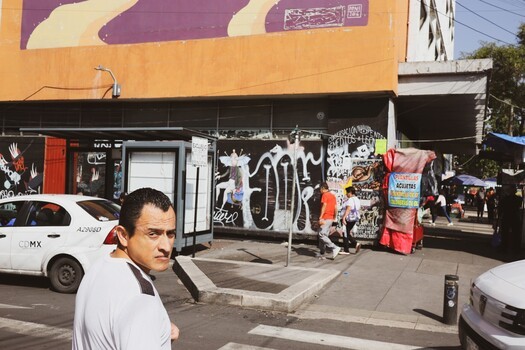
There is a certain kind of photography that does not begin with a plan, a map, or even a clear idea of what you are looking for. It begins the moment you realize you are already lost and you decide, consciously or not, to keep going anyway.
Mexico City is generous in that sense. It does not need to be persuaded to swallow you. You just step slightly off your mental grid of safe streets and familiar corners, and it starts to rearrange you from the inside. Not dramatically. More like a slow reprogramming of attention.
I went out with no assignment in mind, which is usually the most honest way I know to work. There is a camera in my bag, yes, but the real instrument is the decision to not fully understand where I am going. That is where the photography begins for me. Not when I raise the camera, but when I accept that I am no longer in control of the narrative of the walk.
At some point I found myself in a neighborhood I could not properly name. It was not on any of my usual mental shortcuts of the city. The kind of place where the architecture stops pretending to be coherent and starts behaving like accumulation. Walls added to walls. Paint over decay. Life layered in a way that refuses to be edited into simplicity.
There is always a moment like that, just before you start photographing, when the place looks back at you. Not metaphorically. Practically. People notice you noticing them. And then you have to decide what kind of photographer you are going to be today. Invisible or present. Observer or participant.
I have never fully believed in invisibility. It is a comforting fiction. You are always part of the system you enter. The only variable is how honest you are willing to be about it.
So I walk. Slowly. Not wandering in the romantic sense, but in a way that is almost investigative. A street becomes interesting not because it is beautiful, but because it resists your expectation of what it should be. I am looking for friction: between people and space, between intention and accident, between how a place is supposed to function and how it actually survives.
At some point I realize that what I call street photography is really just a negotiation with discomfort. Not danger, necessarily. That word is often exaggerated. More like uncertainty. The slight tension of not knowing if you belong where you are standing, and choosing to stay there long enough for that feeling to become normal.
There is risk in that, but it is not the cinematic kind. It is quieter. Social risk. Misinterpretation. The possibility of being read incorrectly in a place where you do not yet have any context. I have learned to treat that not as a warning sign, but as a signal that I am in the right area for meaningful work.
The camera changes the temperature of the encounter. Not dramatically, but enough to matter. People recalibrate when they see it. Some close down. Some open up. Most do something in between, a kind of negotiated neutrality in which we both pretend we are not affecting each other too much.
But of course we are.
That is where the images start to form. Not in composition, not in exposure, but in recognition. A moment when the place stops being background and becomes an active presence in the frame. A gesture, a posture, a fragment of conversation that leaks into the street itself.
I remember thinking, at one point, that I was not really photographing the neighborhood. I was photographing my own adaptation to it. The way my attention shifts. The way my body adjusts its speed. The way hesitation and curiosity start to merge into a single motion. I am used to photographing in rough places, in working-class neighborhoods, especially on the north side of the city. Places where people usually do not want to go to photograph.
There is a strange kind of clarity that comes when you are slightly outside your own linguistic comfort zone. Not just language in the literal sense, but the language of behavior, of social rhythm. You stop predicting and start reacting. And in that gap, something more honest appears.
I do not think street photography, at least not the way I practice it, is about taking control of reality. It is about surrendering to its terms long enough to understand its internal logic. Every neighborhood has one. Even the ones that look chaotic at first glance. Especially those.
If you want to build that kind of instinct across more than one genre, The Well-Rounded Photographer: 8 Instructors Teach 8 Genres of Photography is a useful place to start.
Eventually, the walk always starts to close in on itself. You recognize patterns. You begin to orient. The sense of being lost dissolves into familiarity again. That is usually when I stop, or at least slow down significantly, because the work is not in mastering the space. It is in meeting it while it is still slightly ahead of you.
On the way back I often realize I cannot clearly separate what I saw from what I felt. The images carry both. They always do, even when I try to deny it.
And maybe that is the only real point of it. Not to document a place, but to let a place temporarily rewrite the way you see.
What's Your Reaction?
 Like
0
Like
0
 Dislike
0
Dislike
0
 Love
0
Love
0
 Funny
0
Funny
0
 Wow
0
Wow
0
 Sad
0
Sad
0
 Angry
0
Angry
0






Comments (0)