

The First Photo Ever Transmitted by Wire, and the Machine That Sent It
In October 1906, a portrait of the German Crown Prince left Munich as nothing more than a flickering electric current, fought through roughly 1,800 kilometers' worth of telegraph line, and emerged at the far end as a photograph you could actually recognize. No train carried it. No courier, no envelope, no darkroom on the far end printing from a shipped negative. And the strangest part is that this was the encore.
The first photograph had already slipped down a wire about two years earlier, running from Munich to Nuremberg on the same inventor's equipment, with far less fanfare; the world just needed to see it survive the wire-length of a country before it believed. This is the story of the man who spent years teaching a wire to see in shades of gray, the odd, patient machine that did the seeing, and the first picture that ever made the trip.
What 'Sending a Picture' Actually Meant in 1900
By 1900 the telegraph was old news. For more than half a century, operators had tapped messages across continents and under oceans, and the world had rearranged itself around the fact that words could outrun trains. But a telegraph does one small thing very well. It turns a key on and off. Every message is a string of pulses, present or absent, long or short, and Morse code exists to squeeze language into that on/off stream.
A photograph refuses to cooperate with that. A face is not dots and dashes. It is a continuous field of tone, black sliding into charcoal into a hundred grays into paper white, and the information lives in those gradations. To send a photograph down a wire, you first have to answer a question nobody had a clean answer to: how do you turn light and shade into electricity, and then turn it back again without losing the face?
The answer, once it arrived, had two halves. First, scanning. You cannot push a whole picture down a single wire at once, so you break it into a sequence, reading the image the way you read a page, one narrow line at a time, sampling brightness as you go. Second, conversion. You need something that feels light the way a microphone feels sound, a device whose electrical behavior changes with brightness, so a bright patch and a dark patch leave different marks on the current. Get both halves working in step, at both ends, and a picture can travel as a river of values and be poured back into a picture somewhere else. Every machine in this story is a different attempt at those two halves.
The Machines That Came First
The dream is older than photography's arrival in the newsroom. In 1843, the Scottish clockmaker and inventor Alexander Bain patented what he called an electric printing telegraph, and it already carried the key idea. Bain hung a stylus from a swinging pendulum and let it sweep, line by line, across a prepared pattern of conducting and insulating material, metal contacts standing in for the marks of a message. A matching pendulum at the receiving end, kept in time by synchronized clocks, redrew each contact on chemically treated paper. Sweep, step down, sweep again. That line-by-line sweep is scanning, worked out decades before anyone would use it to send a photograph.
Bain's machine never found commercial success, but it worked, its electrochemical recording feeding directly into the machines that followed. The English physicist Frederick Bakewell showed a refined version, his "image telegraph," at London's Great Exhibition in 1851, swapping Bain's pendulums for synchronized rotating cylinders, a cleaner mechanism that most later machines would borrow. Then an Italian physicist named Giovanni Caselli turned the idea into a real service. His pantelegraph, a towering contraption built around a two-meter pendulum, opened a commercial line between Paris and Lyon in 1865 under the patronage of Napoleon III, later reaching Marseille in 1867, and it carried thousands of messages a year.
The lineage kept advancing right up to the newsroom door. By the late 1890s, a St. Paul watchmaker named Ernest Hummel had placed his Telediagraph in newspaper offices, including the New York Herald's, wiring pictures between American cities years before Korn's breakthrough. But Hummel's machine still played by the old rules. Each picture had to be prepared first as a conductive original, copied by hand in shellac on metal foil, before the wire could read it. A photograph could inspire what went onto the foil; the photograph itself never made the trip.
Another American came closer still. In the 1890s, the Ohio inventor Noah Steiner Amstutz demonstrated his electro-artograph, a machine aimed squarely at sending photographs by telegraph, and in one sense it succeeded: the picture that arrived had genuinely begun as a photograph. The trick was a conversion. The photograph was first remade as a relief, its tones turned into physical depth, so that a stylus riding the surface could translate high and low into strong and weak current. The wire still never touched the photograph itself, only a sculpted stand-in, and every image paid for the trip with that preparation first.
That was the limit every one of these machines shared, from Bain's pendulum to Hummel's conductive copies and Amstutz's reliefs, and it is the limit that makes the rest of this story: none of them could read a photograph as it actually is. To use Caselli's pantelegraph you wrote your message or drew your sketch on a sheet of metal foil in a special non-conducting ink. The stylus then felt the difference between bare metal and inked metal, conductive or not, on or off. That works beautifully for handwriting and line drawings, which are pure black on white. It struggles with a photograph, because a photograph has no inked lines to trace, and even Amstutz's clever reliefs only got around that by first remaking the image as a surface a needle could feel. These were machines that read by touch, and to travel down their wires a photograph had to be rebuilt as something touchable: inked foil, shellac, sculpted relief. What none of them could do was read the photograph itself, with nothing between the image and the machine but light. Tone, read directly, was the wall.
The Element That Learned to See Gray
The wall came down thanks to an element most people have never knowingly held. In 1873, an English telegraph engineer named Willoughby Smith was testing materials for underwater cables and using rods of selenium for their high electrical resistance. An assistant, Joseph May, noticed something strange: the readings changed depending on whether light was falling on the selenium. When Smith followed it up, the result was clear and, at the time, bizarre. Selenium's electrical resistance drops when light hits it. Shade it and current struggles through. Shine on it and current flows more freely. Smith reported it that February in the journal Nature.
That is the missing half. Selenium was a substance that felt light and answered in electricity, exactly the converter the whole problem demanded. The implication was obvious to a certain kind of mind almost immediately. If a bright part of a photograph makes selenium pass more current and a dark part makes it pass less, then a strip of selenium dragged across an image, or an image dragged across it, would spill out a current that rose and fell in step with the picture's own light and shade. Scanning had existed since Bain. Now there was something to scan with.
An English physicist, Shelford Bidwell, was among the first to put the two together in a way you could watch work. In 1881 he lectured at the Royal Institution and demonstrated a scanning phototelegraph: a selenium cell mounted inside a rotating cylinder with a pinhole, creeping across a brightly lit image while a receiving cylinder rebuilt the picture in step. The catch, and Bidwell knew it, was that his sending and receiving cylinders sat on the same shaft; mounting them together deliberately sidestepped the unsolved problem of keeping two machines synchronized in different cities, so this was proof of principle, not transmission between distant stations. Bidwell managed to reproduce silhouettes and simple outlines. His apparatus was never perfected for commercial use, and the original still sits in the Science Museum in London, but he had proved the principle in the open. What remained was the far harder job of sending not a silhouette but a real photograph, with all its middle grays intact, over a real distance, reliably enough that people would pay for it.
Arthur Korn and the Bildtelegraph
The man who did it was Arthur Korn, a German physicist born in Breslau in 1870. Working in Munich in the first years of the century, Korn built the machine this whole history has been pointing toward, and he gave it a plain German name: the Bildtelegraph, the picture telegraph. Where his predecessors copied marks, Korn set out to transmit an actual photograph, tone and all, and by around 1904 he had done it. Those early transmissions carried none of the later theater, but they are the quiet answer to this article's title. Machines had wired pictures before, even pictures born as photographs, but always from a prepared stand-in: a tracing, a conductive copy, a sculpted relief. The first time a photograph itself made the trip, its grays read directly by light, it was Korn's machine that sent it: a portrait of Bavaria's Prince Regent Luitpold, transmitted from Munich to Nuremberg in 1904 and published in the Illustrierte Zeitung the following year.
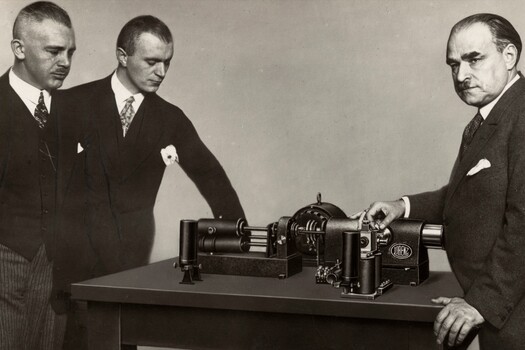
The machine is easy to picture, and picturing it turns the abstract idea into something physical. Korn wrapped a photographic transparency around a glass drum and set the drum spinning inside a cylinder pierced by a single small opening. A bright, steady lamp shone through. As the drum turned and slowly advanced, a fine point of light traveled across every part of the image in a tight helix, passing through the film and coming out the other side dimmed by whatever gray it had just crossed. A prism steered that light onto a selenium cell. Bright spot, more current. Dark spot, less current. The photograph was now a fluctuating electrical signal, and that signal could go anywhere a wire could go.
Rebuilding it took a receiver running in perfect lockstep. At the far end, a second drum turned at the same speed, carrying a sheet of photographic film in the dark. The incoming current ran through a string galvanometer, a fine wire in a magnetic field whose movement worked as a light valve, throttling the beam of a local Nernst lamp onto the film, so the receiving film was exposed brightly where the original had been bright and faintly where it had been dark. Develop that film and the photograph reappeared, line by line, a portrait rebuilt out of a stream of values that were never written down as numbers. The whole trick lived in synchronization. If the two drums drifted even slightly out of step, the face smeared into nonsense, and much of Korn's labor went into keeping them married across hundreds of miles.
Selenium, for all its magic, had a maddening flaw, and beating it is most of what took Korn years rather than months. The element reacts to light slowly. It lags behind quick changes, so a bright detail followed immediately by a dark one tends to smear together, softening exactly the fine tonal edges that make a face read as a face. Korn fought that sluggishness on both ends, refining the cell, driving the scanning point with a bright Nernst lamp, and tuning the whole apparatus so the current could keep up with the picture. His early results were muddy, and every clean transmission he coaxed out of the system was a small argument that the idea was not just possible but usable.
It was slow and it was fussy, but it worked, and Korn kept pushing the distance. Early attempts produced blurred images after twenty minutes of transmission. He got that down to roughly six minutes for a picture sent through a thousand miles' worth of line. In October 1906 came the demonstration this story opened with, the portrait of the Crown Prince pushed through some 1,800 kilometers' worth of circuit, the line between Munich and Nuremberg looped back on itself and loaded with resistance until the signal had traveled the electrical equivalent of crossing Germany. The first photograph had already made the Munich to Nuremberg run two years before; this was the transmission that made it undeniable. A photograph, a real one, had crossed a country's worth of wire as electricity and come back as itself.
A Photograph That Could Chase a Man
What turned Korn's invention from a laboratory marvel into news was the realization that a wired photograph could do a job no telegram could. In 1907 he linked cities into a working service: regular Munich to Berlin trials from that April, then commercially organized installations in newspaper offices in Berlin, Paris and, across the Channel, London by November. Newspapers were fascinated, and so were the police, because for the first time a face could travel as fast as a name.
A period account in The New York Times, from February 1907, laid out what the system could already do. Portraits of King Edward and Queen Alexandra, it reported, were photographed in Paris and received in London within two hours. The Kaiser's likeness ran between Munich and Paris. And in the detail that made editors sit up, the paper described how photographs of a wanted bank embezzler, shot from three angles, were wired from Stuttgart to London in a matter of hours so police abroad would know the man's face. The exact tellings of that manhunt vary from account to account, and it is best read as the era's favorite illustration rather than a court record, but the capability it dramatized was real. A photograph had become a thing you could send ahead of a fugitive.
Korn himself was not shy about where this led. The same account relayed his conviction that the leap from sending still pictures to sending moving ones was small, that "television," or seeing by telegraph, was only a year or two off. He was wildly optimistic on the timing, as inventors in the grip of a working prototype tend to be. Practical television was still decades away. But he had the direction exactly right, and he had already done the genuinely hard part, which was proving that an image, any image, could be dismantled into a signal and honestly rebuilt somewhere else.
From the Bildtelegraph to the Wire Services
Once the principle was undeniable, the machines multiplied and got better fast. In France, the inventor Édouard Belin took picture transmission portable, and by a road that shows how long the old ideas lived: his early apparatus, first demonstrated in 1907, read a specially prepared relief of the photograph with a stylus, Amstutz's approach refined; a portable version followed by 1913, and only around 1927 did the Belinograph adopt photoelectric scanning of the kind Korn had pioneered. Along the way it shrank into a suitcase-sized field unit compact enough to travel to the story instead of making the story travel to it, and the "Belino" became newsroom shorthand across Europe for a wired picture.
A different and stranger branch appeared in 1920. Two engineers, Harry Bartholomew and Maynard McFarlane, built a system to send pictures across the Atlantic by submarine cable, and instead of transmitting a smoothly varying current the way Korn did, they chopped each picture into a grid and coded every cell as one of a handful of gray levels, punched onto telegraph tape. Their Bartlane system, named from the two men, sent its first pictures across the Atlantic in 1921, the cable leg running from London to Halifax, Nova Scotia, and the images continuing on to New York through the network, in under three hours rather than the week a physical print needed aboard a ship. It started with five shades of gray and later pushed to fifteen. Because it turned an image into discrete coded values, historians of technology often point to Bartlane as the first digitally coded picture-transmission system, a full generation before anyone spoke of digital anything. The first digital image in the modern computer sense would wait for Russell Kirsch's scanner at the National Bureau of Standards in 1957; Bartlane was digital coding with no computer on either end.
From there the through-line runs straight into the newspaper you grew up with. Through the 1920s the American giants industrialized the idea, with AT&T and RCA sending photographs by wire and then by radio across the Atlantic. The decisive moment for photojournalism came on January 1, 1935, when the Associated Press switched on its Wirephoto network, a set of leased telephone lines wired into scanning machines in member newsrooms. The first picture it moved was perfectly ordinary news: an aerial view of the snowy spot where a small airliner had been forced down in the Adirondacks near Morehouseville, New York, three days earlier, nobody hurt, the image made on December 31, 1934. It reached dozens of papers in half a day. A photograph taken in snowy backcountry could now be on breakfast tables across the country before the story was cold. That is Korn's Bildtelegraph, grown up and put to work.
How a Photograph Travels Today
Pick up where this leaves off and the modern version looks like magic by comparison, but it is the same magic. You shoot a wedding or a protest or a ballgame on a full frame mirrorless camera like the Sony a7 V, the file lands on a CFexpress Type A card, and within minutes it can be on an editor's screen an ocean away over wifi or a cellular signal. No spinning drum, no selenium, no developing bath at the far end. And yet the bones are recognizably the same. The sensor's two-dimensional grid of pixels turns a single exposure into millions of brightness values, no crawling point of light required, the file is a long ordered stream of those values, the network carries the stream, and a screen somewhere pours it back into an image. Break the picture into pieces, move the pieces, rebuild the picture. Korn ran the same bargain in a different currency. He had no numbers at all, just one point of light creeping through the image in a tight helix and a current rising and falling in smooth analog sympathy, and his screen was a sheet of film on a drum turning in the dark. The representation has changed completely, wavering current then, coded bits now. The idea, dismantling an image into a stream that can travel and be honestly rebuilt, has not changed since Munich.
The distance from 1906 to now is not really a distance of principle. It is a distance of speed and convenience. A photographer in Korn's day watched a face crawl out of a wire over six long minutes and understood it as a miracle. A photographer today fires off a burst and grumbles when the upload takes thirty seconds. The miracle got quiet, the way miracles do once they work every time. But the next time an image lands on your phone from the other side of the planet in a heartbeat, you are watching the great-grandchild of a spinning glass drum in Munich, a strip of selenium, and a stubborn physicist who decided that gray was not a wall after all.
Lead image: Arthur Korn, at right, with an apparatus built for his picture-transmission system, Berlin, 1928. Photographer unknown, public domain. Source.
What's Your Reaction?
 Like
0
Like
0
 Dislike
0
Dislike
0
 Love
0
Love
0
 Funny
0
Funny
0
 Wow
0
Wow
0
 Sad
0
Sad
0
 Angry
0
Angry
0











Comments (0)