

The floodgates are open after another Chinese company lands a reusable rocket
Landing from space
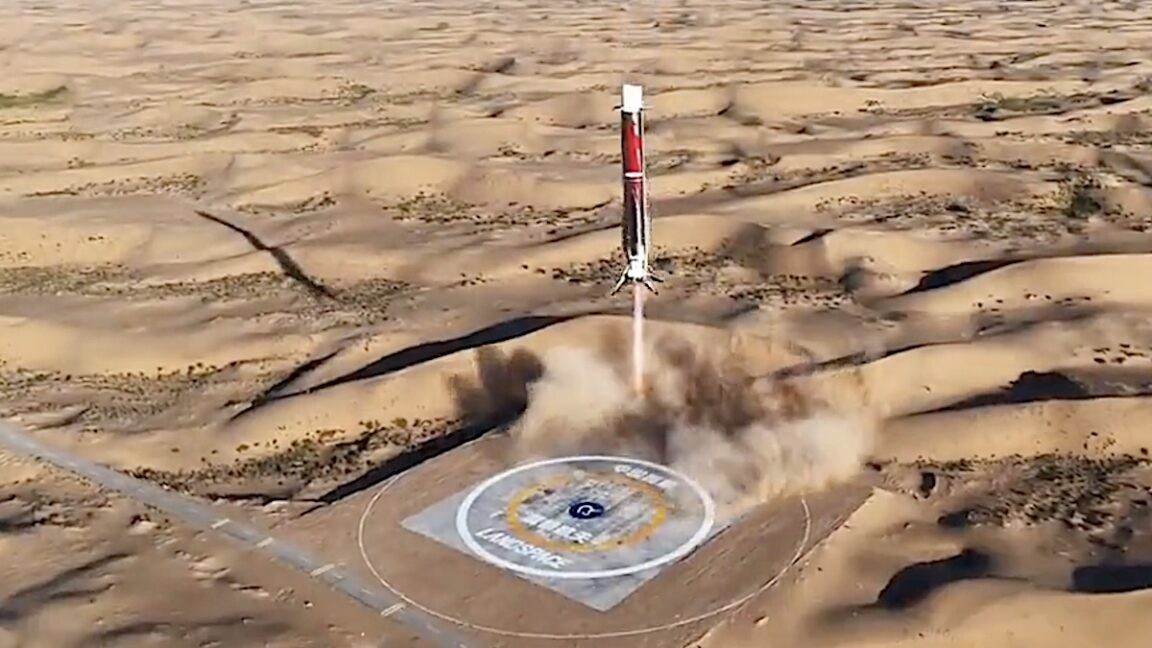
The Zhuque-3, or ZQ-3, rocket lifted off from a commercial launch zone at China’s Jiuquan Satellite Launch Center at 7:35 pm EDT (23:35 UTC) Tuesday, about an hour after sunrise Wednesday at the spaceport in the Gobi Desert. Nine methane-fueled engines powered the 216-foot-tall (66-meter) rocket on a course southeast from Jiuquan, then the rocket’s upper stage took over the task of placing a single satellite into orbit.
The rocket’s first stage, made of stainless steel, soared to the edge of space, then maneuvered toward a prepared landing zone some 240 miles (390 kilometers) downrange, settling to a propulsive touchdown on four extendable landing legs. LandSpace, founded in 2015, declared the mission a total success.
MISSION SUCCESS | ZhuQue-3 Y2 Reusable Launch Vehicle Achieved Full Success in Orbital Insertion and First-Stage Recovery
On August 19, 2026, at 07:35 (UTC+8), the ZhuQue-3 (ZQ-3) Y2 reusable launch vehicle lifted off from the Dongfeng Commercial Space Innovation Pilot Zone.… pic.twitter.com/fshijOxgtc
— LandSpace (@LandSpace_Tech) August 19, 2026
“This mission marks China’s first-ever successful recovery attempt of the first stage of an orbital-class launch vehicle using landing legs, and China’s first successful booster recovery on land,” LandSpace said in a statement. “It is a pivotal flight test for Zhuque-3 as it transitions from the technological demonstration and verification phase toward the engineering application phase of reusability.”
LandSpace’s engineers made several changes to the rocket after the crash landing of the first Zhuque-3 booster in December. The updates included using just a single engine for the final phase of landing and modifications to the rocket’s heat shield for protection from reentry conditions.
“This mission lays a solid foundation for subsequent stages, including post-recovery inspection and maintenance, reuse flights, and commercial applications,” LandSpace said.
“The first stage underwent high-altitude gliding, followed by ignition for deceleration upon re-entry, aerodynamic glide control, and finally, a landing burn to slow down,” Dai Zheng, head of the Zhuque-3 project at LandSpace, told Chinese state television. “That final braking maneuver was executed beautifully, achieving a soft landing and realizing our original design goal of a ‘one-shot reverse-parking’ maneuver while moving at high speed.
“Our team will immediately begin inspecting the recovered first-stage booster,” Dai said. “We will collect status data and perform maintenance and overhauls. Once that work is complete, we will put the booster back into service for another flight as soon as possible.”
What's Your Reaction?
 Like
0
Like
0
 Dislike
0
Dislike
0
 Love
0
Love
0
 Funny
0
Funny
0
 Wow
0
Wow
0
 Sad
0
Sad
0
 Angry
0
Angry
0









Comments (0)