

The Office star Lucy Davis, 53, looks radiant amid battle with incurable cancer as she shares sweet photos with her friend's dog
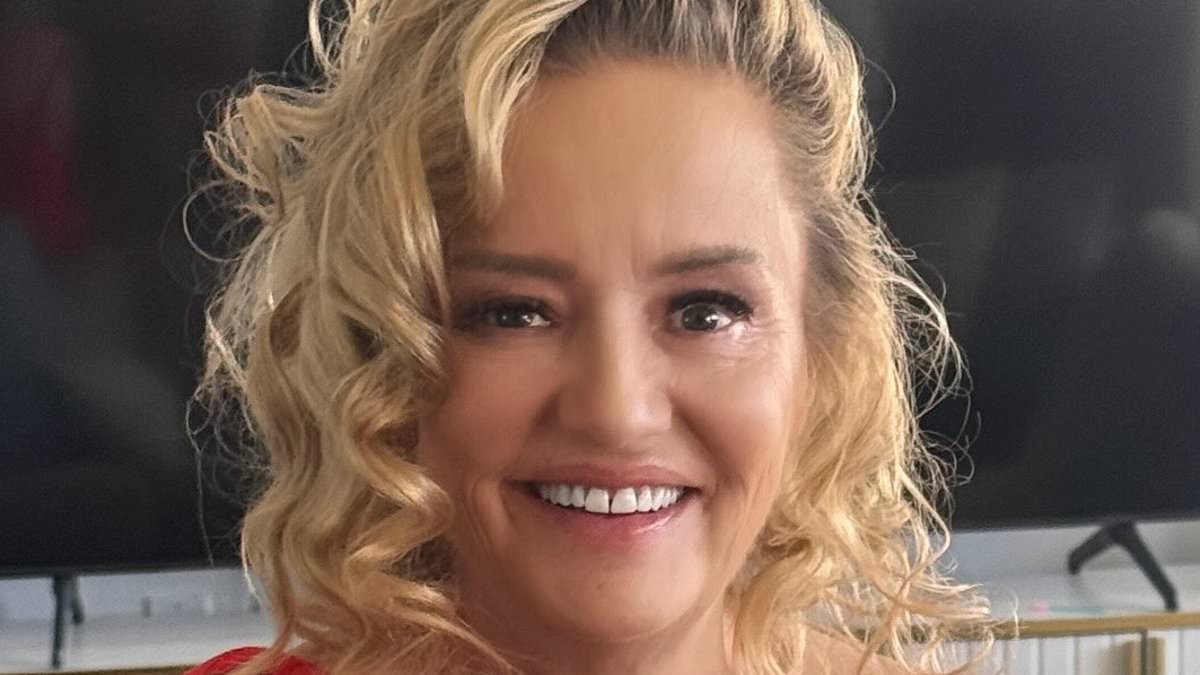
The Office star Lucy Davis looked glamorous as she shared a series of sweet photos caring for her friend's dog.
The actress, 53, announced in August she has incurable breast cancer and admitted she 'doesn't know how long she has left', but she is 'at peace with whatever comes next'.
Lucy's followers told her she looked like she was 'living her best life' as she told them she was 'in love' with looking after her friend's rescue dog, Charlie, who reminded her of her pooch Gracie who passed away two years ago.
Lucy looked radiant in the photos and wore her blonde hair in soft curls and posed in a red minidress and brown boots as she cuddled the spaniel.
She captioned the post: 'Look what I get to look after for several weeks!! Say hi to the beautiful Charlie - my friend’s rescue dog who is away for a while. It took me a while to not call him Gracie.
'He’s just the most loving, zen dog! I’m thinking of moving house and not telling my friend. So lovely to have a dog around again. He lies right up against me at night, and a couple of nights ago I did fall out of bed. But who cares!'
The Office star Lucy Davis looked glamorous as she shared a series of sweet photos caring for her friend's dog amid her battle with incurable cancer
Lucy's followers told her she looked like she was 'living your best life' as she told them she was 'in love' with looking after her friend's rescue dog, Charlie
Fans wrote in the comments: 'You look beautiful Lucy. The dog is adorable too.'
'Stunning Lucy' and 'You look amazing. Living your best life. Charlie, you have a fantastic human looking after you!'
'I absolutely support you moving and living your best life with Charlie! I bet Gracie sent him over to give you some love.'
Lucy first shared her diagnosis alongside an emotional video that showed her ringing the cancer treatment bell, and wrote in her post that she's been told it's 'too late' for her to undergo chemotherapy.
She wrote at the time: 'Hi friends. I wanted to share something with you all that I've kept to myself for a while but for various reasons would like to share now.
'A year and a half ago I was diagnosed with Stage 4 Breast Cancer, which has metastasised to my bones. Specifically to my spine, right hip, and my ribs. The cancer is incurable, and too late for chemo.'
Lucy shared that she first discovered a 'tiny, hard spot' in her breast a year ago and nearly ignored it before seeing a doctor.
She continued: 'The initial lump that I felt, wasn't a 'lump' as such; rather a kind of hard spot. Really tiny. I almost didn't bother getting it checked. So I guess I'm saying don't ignore anything - get everything checked out.
She captioned the post: 'Look what I get to look after for several weeks!! Say hi to the beautiful Charlie - my friend’s rescue dog who is away for a while'
'He’s just the most loving, zen dog! I’m thinking of moving house and not telling my friend. So lovely to have a dog around again', she added
Fans wrote in the comments: 'You look beautiful Lucy. The dog is adorable too.'
Breast cancer is one of the most common cancers in the world and affects more than two MILLION women a year
Breast cancer is one of the most common cancers in the world. Each year in the UK there are more than 55,000 new cases, and the disease claims the lives of 11,500 women. In the US, it strikes 266,000 each year and kills 40,000. But what causes it and how can it be treated?
What is breast cancer?
It comes from a cancerous cell which develops in the lining of a duct or lobule in one of the breasts.
When the breast cancer has spread into surrounding tissue it is called 'invasive'. Some people are diagnosed with 'carcinoma in situ', where no cancer cells have grown beyond the duct or lobule.
Most cases develop in those over the age of 50 but younger women are sometimes affected. Breast cancer can develop in men, though this is rare.
Staging indicates how big the cancer is and whether it has spread. Stage 1 is the earliest stage and stage 4 means the cancer has spread to another part of the body.
The cancerous cells are graded from low, which means a slow growth, to high, which is fast-growing. High-grade cancers are more likely to come back after they have first been treated.
What causes breast cancer?
A cancerous tumour starts from one abnormal cell. The exact reason why a cell becomes cancerous is unclear. It is thought that something damages or alters certain genes in the cell. This makes the cell abnormal and multiply 'out of control'.
Although breast cancer can develop for no apparent reason, there are some risk factors that can increase the chance, such as genetics.
What are the symptoms of breast cancer?
The usual first symptom is a painless lump in the breast, although most are not cancerous and are fluid-filled cysts, which are benign.
The first place that breast cancer usually spreads to is the lymph nodes in the armpit. If this occurs you will develop a swelling or lump in an armpit.
How is breast cancer diagnosed?
- Initial assessment: A doctor examines the breasts and armpits. They may do tests such as a mammogram, a special X-ray of the breast tissue which can indicate the possibility of tumours.
- Biopsy: A biopsy is when a small sample of tissue is removed from a part of the body. The sample is then examined under a microscope to look for abnormal cells. The sample can confirm or rule out cancer.
If you are confirmed to have breast cancer, further tests may be needed to assess if it has spread. For example, blood tests, an ultrasound scan of the liver or a chest X-ray.
How is breast cancer treated?
Treatment options which may be considered include surgery, chemotherapy, radiotherapy and hormone treatment. Often a combination of two or more of these treatments are used.
- Surgery: Breast-conserving surgery or the removal of the affected breast depending on the size of the tumour.
- Radiotherapy: A treatment which uses high energy beams of radiation focused on cancerous tissue. This kills cancer cells, or stops them from multiplying. It is mainly used in addition to surgery.
- Chemotherapy: A treatment of cancer by using anti-cancer drugs which kill cancer cells, or stop them from multiplying.
- Hormone treatments: Some types of breast cancer are affected by the 'female' hormone oestrogen, which can stimulate the cancer cells to divide and multiply. Treatments which reduce the level of these hormones, or prevent them from working, are commonly used in people with breast cancer.
How successful is treatment?
The outlook is best in those who are diagnosed when the cancer is still small, and has not spread. Surgical removal of a tumour in an early stage may then give a good chance of cure.
The routine mammography offered to women between the ages of 50 and 71 means more breast cancers are being diagnosed and treated at an early stage.
For more information visit breastcancernow.org or call its free helpline on 0808 800 6000
Lucy first shared her diagnosis in August alongside an emotional video that showed her ringing the cancer treatment bell
'As of now, I'm trying to live out whatever might be left of my life in as fun a way as I possibly can. I always like to find the teachable moments in anything negative that happens.
'And cancer has not disappointed in that regard; there's a lot I have learned from it, and I'm grateful for that.
'As some of you will know, the pain can really be something else. Standing and walking for too long a time can be hard, and I need to use a wheelchair sometimes (so if you see me toddling around in one, feel free to give me a push!)
'The thing that has been most vital to me is humour. I asked my friends and family to make fun of me as much as possible (which they're really good at), and most importantly of all to not treat me like a sick person.
'There's nothing that will make you feel more unwell than being treated as if you're unwell.
'I'm not scared of whatever comes next. I'm at peace with it. I'll see my Gracie [her dog, who died in 2024] sooner than expected, and for me, leaving my physical body just means going home. Any and all grieving is for my family; it's far harder for them than for me.
'I'm still going to keep up all my work for animal rights. It's so important to me. And I still would like to keep working. I'm perfectly able to do so, and acting is one of the biggest joys in my life.
'For those of you on a similar journey to mine, I do wish you well. Cancer asks a lot from us, physically and mentally. And we all get to do it however we choose. Much love to you all.'
The actress has had a number of health worries over the years and had a kidney transplant using an organ donated by her mother, Hazel, in 1997. Then, eight years later, Lucy, who is diabetic, required hospital treatment with kidney failure but went on to make a full recovery.
Lucy has also been open about living with bulimia, which was at its worst when she was going through a divorce in 2011 after a five-year marriage to The Mentalist's Owain Yeoman.
The star said that despite the cancer being declared incurable she is 'at peace with whatever comes next'.
The star is best known for her role as Dawn Tinsley in Ricky Gervais's comedy The Office, and went on to star in the DC film Wonder Woman.
What's Your Reaction?
 Like
0
 Dislike
0
 Love
0
 Funny
0
 Wow
0
 Sad
0
 Angry
0










Comments (0)