

The Problem With Paradise
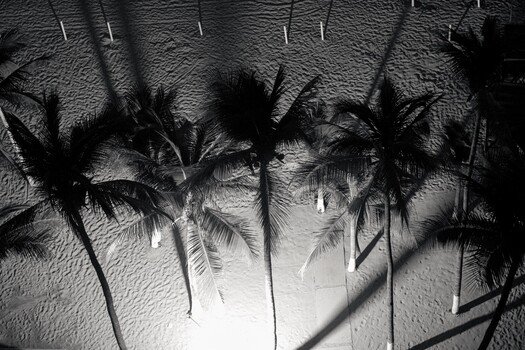
Acapulco at night feels less like a city and more like a stage set designed by a casino architect having a mild nervous breakdown. Palm trees multiply in every direction. Floodlights blast the sand with the subtlety of a prison yard. Massive hotels rise from the coastline pretending time still moves the way it did decades ago, as if glamour could survive indefinitely through architecture and denial alone.
You walk through places like this half awake, carrying cameras, caffeine, dead batteries, editorial deadlines, a small amount of existential dread, and whatever remains of your dignity after hotel security has decided you look suspicious simply for existing with photographic equipment.
I was there on assignment.
Professional work. Tight schedule. Fast pace. Meetings, logistics, images to deliver. The usual beautiful disaster that accompanies editorial photography. When you work professionally, locations often become functional long before they become emotional. You learn to move quickly, solve problems faster, and keep producing regardless of fatigue, weather, bureaucracy, or sleep deprivation.
A five-star hotel means nothing when you are busy with the assignment. Yes, it is cool to stay in a hotel room with a king-size bed all to yourself, and every kind of comfort and an ocean view, but you are not on vacation.
This photograph had absolutely nothing to do with the job, which is probably why I still think about it.
I made it from the hotel balcony after a long day of shooting. There was no elaborate concept behind it, no artistic revelation descending from the heavens, no mythology about the perfect photographic intuition. Just instinct and exhaustion collaborating for half a second. And perhaps that matters more than photographers sometimes admit.
There is an uncomfortable truth about professional photography that rarely appears in interviews or behind-the-scenes videos. Assignments pay the bills. They provide structure, purpose, and momentum. They teach discipline and force you to work under pressure. But often the photographs that remain with you are not the commissioned ones.
They are the strange little interruptions, the accidental frames made between obligations, the photographs nobody requested, the photos for me. Those images arrive quietly, almost irresponsibly, in the margins of professional life. They are often made when the mind is no longer performing for expectations, when fatigue lowers your defenses and instinct takes over. This frame belongs to that category.
Looking down at the scene, Acapulco refused to behave like a travel destination. It declined the usual contract photography tends to sign with tourism. No ocean glowing romantically under moonlight. No cocktails sweating beside infinity pools. No smiling tourists discovering themselves beneath a cinematic sunset. The photograph offered none of that.
Instead, the palms looked restless. Their shadows stretched across the sand like warnings rather than decorations. The floodlights flattened the beach into something theatrical and strangely severe. The geometry felt uneasy, artificial, slightly hostile. Paradise after closing time. Perfect.
Photography already has enough postcards. What interests me more are images that destabilize a place rather than explain it. Photographs that resist easy consumption. Frames suspended somewhere between documentary and hallucination, between observation and insomnia. Places are rarely as coherent as brochures suggest.
The liminal place is a great reference in my photography. Photographically speaking, it is a space that feels suspended between states: not fully alive, not completely abandoned, familiar yet strangely detached from normal experience. It carries the sensation of transition.
Cities contain contradictions. So do landscapes. And certainly so do photographers. Perhaps that is why I distrust photographs that arrive too neatly packaged, images designed exclusively to reassure the viewer. Beautiful photographs can be seductive, of course. They work immediately. They flatter reality. They invite approval. But sometimes beauty becomes a form of obedience.
Strangeness, on the other hand, carries risk. It leaves room for uncertainty. Black and white helped me find that uncertainty here.
Once the color disappeared, Acapulco stopped performing. The tropical warmth evaporated. The seductive palette of tourism lost its authority. What remained was structure: light, shadow, geometry, tension. The beach became colder, stranger, more psychologically charged. More honest, perhaps.
I often think of photographs like certain dark spirits, something closer to black label whisky than tropical cocktails. Not necessarily comforting. Not designed for immediate pleasure. Slightly abrasive. Better approached slowly. This image feels like that to me.
And honestly, I trust strange photographs more than beautiful ones. Beautiful images often tell you exactly what to feel. They guide your reaction. They reassure you that the world is understandable, attractive, and emotionally resolved.
Strange photographs do something else entirely. They leave you alone. No instructions. No sentimental subtitles. Just space, tension, and your own thoughts staring back at you. And that, to me, feels personal.
What's Your Reaction?
 Like
0
Like
0
 Dislike
0
Dislike
0
 Love
0
Love
0
 Funny
0
Funny
0
 Wow
0
Wow
0
 Sad
0
Sad
0
 Angry
0
Angry
0







Comments (0)