

The Push-Pull Zoom Was Faster Than Any Modern Zoom Ring and Dust Got the Blame
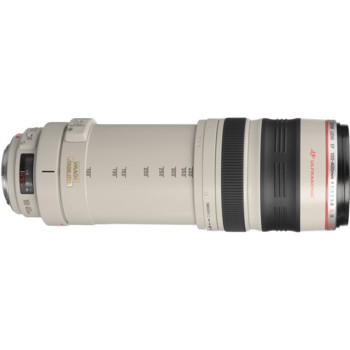
When Canon announced the replacement for the EF 100-400mm f/4.5-5.6L IS USM in November 2014, the change photographers argued about was the disappearance of the sliding zoom collar rather than the optics or the stabilizer. The reason repeated everywhere at launch was that a rotating ring stops dust from being pulled into the barrel. That announcement retired what a lot of photographers still consider the fastest zoom control ever fitted to a camera lens.
What a One-Touch Zoom Actually Does
Two different things get called push-pull. The narrow sense is a one-touch zoom, which puts two jobs on one collar: slide it along the barrel and the focal length changes, rotate the same collar and the lens focuses. The broader sense, which Canon's own specifications call a linear extension or a linear zoom system, means only that focal length changes by sliding something along the axis of the lens. A lens like that can have an ordinary focus ring elsewhere on the barrel, and most of the autofocus-era ones did. Whether pushing away from the body gives you the long end or the wide end depends on the lens, so muscle memory did not always transfer between brands.
The alternative, which the industry now calls a two-ring or two-touch design, splits those jobs onto separate rings at separate positions on the barrel. You move your hand to change what you are doing.
That hand movement is the whole speed argument. With a one-touch collar, your left hand grips the lens once and never lets go. You can pull to 200mm and rotate into focus in one continuous motion, without the pause where your fingers walk forward or back to find the other ring. For anyone tracking a receiver breaking downfield or a bird changing direction, the regrip is the expensive part, and the sliding collar deleted it.
The Lenses That Made the Case
Nikon brought out the Zoom-Nikkor Auto 43-86mm f/3.5 in 1963 with a single collar doing both jobs, nine elements in seven groups, a body about three inches long and a weight of roughly 14 ounces. The exact debut is not settled, as Nikon's own historians say the month could not be pinned down from the period magazines, and an Asahi Camera piece as late as April 1963 still described the Nikon F version as coming in the near future. Nikon's own house lens history treats it as the arrival of a standard zoom small enough to actually carry, which is a narrower claim than being first. The Voigtländer Zoomar 36-82mm f/2.8, designed by Frank Back and shown publicly in 1959, is generally credited as the first production zoom for 35mm still cameras.
Vivitar's Series 1 70-210mm f/3.5 Macro Focusing Zoom, built by Kino Precision, arrived a decade later. Period advertising put it on sale from mid-1973, though plenty of modern sources date it to 1974, and the record is genuinely muddled by a long staggered rollout across mounts. It weighed 940 g in an all-metal barrel and focused close enough for roughly 1:2.2 reproduction. Zooming meant pulling a control sleeve back and forth.
Canon's manual focus FD line leaned on the same idea, though not consistently. The FD 80-200mm f/4 L of November 1985 used a one-touch collar, and it is still one of the better-built telephoto zooms of the film era at 675 g with 14 elements in 12 groups. The earlier FD 80-200mm f/4 S.S.C. of October 1976 went the other way, splitting zoom and focus onto two rings for photographers who found a single ring too imprecise.
Nikon's professional telephoto line stayed committed longest. The AI-S Zoom-Nikkor ED 80-200mm f/2.8 of 1982, the AF Zoom-Nikkor 80-200mm f/2.8 ED of 1988, and the AF Zoom-Nikkor 80-200mm f/2.8D ED of 1992 were all push-pull. The 43-86mm was not an outlier in the catalog either; the Zoom-Nikkor 50-135mm f/3.5 AI-S of 1982 used a single nonslip collar too, and lasted only about two years in production.
The 1988 autofocus 80-200mm f/2.8 was Nikon's top photojournalism lens when it launched, and it went into service alongside the Nikon F4, which was announced that September and shipped in December. That pairing put a sliding collar in the hands of many of the wire photographers covering the late 1980s and early 1990s, which is why so much of the era's news and sports coverage came off a one-touch barrel.
Canon's autofocus system launched with sliding zooms at the top, though in the broad sense rather than the Nikon one. The EF 100-300mm f/5.6 of March 1987 and the EF 100-300mm f/5.6L of June 1987, the latter among the first L-series EF lenses, both changed focal length by sliding the barrel, but focus sat on its own narrow ring that engaged only in manual mode. Autofocus had already taken the collar's second job. The EF 100-300mm f/4.5-5.6 USM that arrived in June 1990 replaced the sliding collar with a rotating ring, and the EF 70-200mm f/2.8L USM of 1995 went further by zooming internally, so the barrel never changed length at all.
Nikon held on until 1997, when the AF Zoom-Nikkor 80-200mm f/2.8D ED (N) moved to two rings and finally added a tripod collar. Nikon repair specialist Richard Haw attributes the redesign directly to photographers asking for both. The AF-S 80-200mm f/2.8D IF-ED followed in December 1998, and the AF-S VR 70-200mm f/2.8G IF-ED took over the slot in 2003.
Canon kept building sliding zooms regardless. The EF 35-350mm f/3.5-5.6L USM of January 1993 paired what Canon called a linear zoom system with a wide manual focus ring, the EF 100-400mm f/4.5-5.6L IS USM of November 1998 used a linear extension zoom with rear focusing, and the EF 28-300mm f/3.5-5.6L IS USM of June 2004 shipped with a barrel Canon specifies as push-pull type and an adjustable friction damper, six years after the 100-400mm. The 100-400mm is the one photographers remember, and it survived 16 years. It grew from about 189mm retracted to roughly 260mm at 400mm, with a friction ring behind the focus ring to set how stiff the slide felt. I really loved that lens and was so disappointed when it's successor changed the design.
The Barrel Is a Pump, but the Seal Is the Real Problem
A lens that extends and retracts changes its own internal volume every time you zoom. Air has to leave when the barrel collapses and enter when it extends, and unfiltered air carries dust and moisture with it.
Manufacturers have engineered around this explicitly rather than hoping the tolerances are tight enough. A Canon patent titled "Lens apparatus having vapor-resistant ventilation," filed at the end of December 2002 and granted in May 2004, describes vents cut into the lens-holding frame specifically to keep internal pressure equal to external pressure as the spacing between element groups changes during zooming. The vents are covered with a water-repellent microporous membrane, the patent naming Gore-Tex as an example, so air can pass while liquid water cannot. The document also warns about what happens when that membrane gets covered in water droplets, at which point insufficient airflow means moisture "may be freed to enter the interior by a vacuum pumping action."
The evidence that push-pull lenses suffer worse than everything else is thinner than the story suggests. Lensrentals has torn down more lenses than almost anyone, and Roger Cicala's findings on internal dust were that every lens has some, that lenses are not sealed and air moves in and out of all of them, and that the dustiest examples in his inventory were actually certain primes and short-range zooms rather than long extending telephotos. He also found that internal dust is essentially invisible in photographs.
The stronger engineering case against the sliding collar is about sealing, not particle counts. On a rotating-ring telephoto, the surface you touch stays in one place. The seal is a gasket sitting in a groove, and the ring turns against it in a single degree of freedom, at a fixed axial position, forever. On a traditional push-pull like the 100-400mm, the grip surface is part of the translating barrel, so the seal has to hold across the whole length of travel at the exact interface the user's wet, gritty hand is holding. On a one-touch lens it is worse again, because that same surface rotates to focus, and the seal has to stay tight through rotation at every point in the travel. The inner barrel of a modern telephoto still extends, so the volume still changes, but the control interface no longer moves with it.
Canon's answer on the Mark II was consistent with that reading. It kept an extending barrel and paired a rotating ring with a magnesium housing, L-series weather resistance and fluorine coating on the front and rear elements. Canon's own product history is careful here, explaining the switch to a rotational system as a way to hold the camera in balance while zooming rather than as a dust fix. The lens still breathes. The place where a hand meets the barrel simply stopped being a moving joint.
Autofocus Took Away Half of the Collar's Job
The one-touch design was invented for manual focus cameras, and its elegance depended on focus being something your hand did constantly. Once autofocus arrived, and then internal focusing groups and ring-type ultrasonic motors, rotation became a fallback control rather than the primary one. The combined collar was solving a problem that the camera had taken over.
The early screw-drive autofocus lenses made this worse before they made it better. On a body-driven design, the motor in the camera turns the focus mechanism, so the ring your hand is already holding is the one the camera is trying to move. Splitting the controls onto two rings gave manufacturers somewhere to put a focus ring that could be decoupled, clutched or simply ignored while your grip hand stayed on a zoom ring that nothing else was driving. Internal focusing and ring-type ultrasonic motors then made full-time manual override normal, and the one-touch collar's central promise, that focus and zoom live under the same fingers, stopped being worth its costs.
Gravity took care of the rest. Zoom creep, the tendency of a lens to change focal length when it is pointed steeply up or down, is a nuisance on a two-ring lens and a structural flaw on a push-pull one, because the same lubricated slide that makes the design fast also lets the barrel run under its own weight. Nikon's push-pull 80-200mm f/2.8 was known for creeping under its own weight when the camera was aimed steeply down, and creep is one of the complaints the two-ring redesign was built to answer. Canon's friction ring on the 100-400mm was an attempt at a fix that reviewers found finicky to set, too stiff to zoom quickly at one end and prone to creep at the other, and easy to nudge out of position while turning the focus ring next to it.
An extending barrel also shifts the center of mass forward as you zoom, which you feel on a monopod or a gimbal head. A push-pull with no tripod foot compounds that, since the mount is carrying a load that keeps moving away from it. Nikon adding a tripod collar in 1997 at the same moment it added the second ring was not a coincidence.
What the Two-Ring Design Buys You
A rotating ring gives you repeatable focal length. Marked positions on a ring mean 200mm is 200mm, every time, by feel, without looking. A sliding collar has an index mark too, but nothing about the motion helps you land on it, and nothing stops your grip pressure from nudging it off.
Video is where the ring pulls ahead. A ring can be geared and driven by a follow focus or a motor, at a controlled rate, repeatably. Nothing standard clamps onto a sliding barrel, so a straight zoom stays a hand operation, and a hand pushing a barrel produces a zoom with visible acceleration and hesitation in it. If you shoot both stills and motion on the same body, which most people now do, the two-ring lens is the one that fits the rest of the rig. Anyone building out that side of their work will find a photographer's guide to filmmaking a faster route in than trial and error on a paid shoot.
Manufacturers also solved the speed complaint partway. Zoom torque controls are now common, letting you set a ring loose enough to sweep the whole range in one motion or tight enough to hold position. Canon put a torque adjustment ring on the RF 100-500mm f/4.5-7.1L IS USM, alongside weather-sealing and fluorine coatings, which is exactly the combination the old design could not deliver.
The Slide Is Not Quite Dead
Sigma has kept the straight-zoom action alive by refusing to choose. The 150-600mm f/5-6.3 DG DN OS Sports, announced in August 2021 at $1,499, and the 60-600mm f/4.5-6.3 DG DN OS Sports, announced on January 12, 2023 at $1,999, both carry what Sigma calls a Dual Action Zoom, which the company describes as supporting "both straight zoom and ring zoom, allowing you to change the angle of view in a quick and intuitive way." Grab the hood and shove it, or turn the ring, whichever the moment calls for. What Sigma has not brought back is the combined collar. Focus stays on its own ring, where autofocus put it.
Sigma also fixed the two failure modes that sank the original design rather than pretending they did not exist. A zoom torque switch on the 150-600mm, with lock, tight and smooth settings, addresses creep directly, while the 60-600mm answers the same problem with a conventional zoom lock. Both lenses carry a dust and splash resistant structure with a water and oil repellent front coating, sealed at the mount, the focus and zoom rings and the other controls. That list is the trick: the straight-zoom motion happens out at the hood, so the sealed control surfaces stay put. That is the trombone with gaskets on it.
If you have never used one, the speed is not a nostalgia claim you have to take on faith. Borrow a Nikon 80-200mm f/2.8 push-pull for an afternoon of anything that moves unpredictably, and count how many times your left hand leaves the barrel. On a two-ring lens, that number will be in the dozens. On the sliding collar, it is zero.
What's Your Reaction?
 Like
0
Like
0
 Dislike
0
Dislike
0
 Love
0
Love
0
 Funny
0
Funny
0
 Wow
0
Wow
0
 Sad
0
Sad
0
 Angry
0
Angry
0














Comments (0)