

The Sony a7R VI Has the Best Dynamic Range of Any Full-Frame Camera
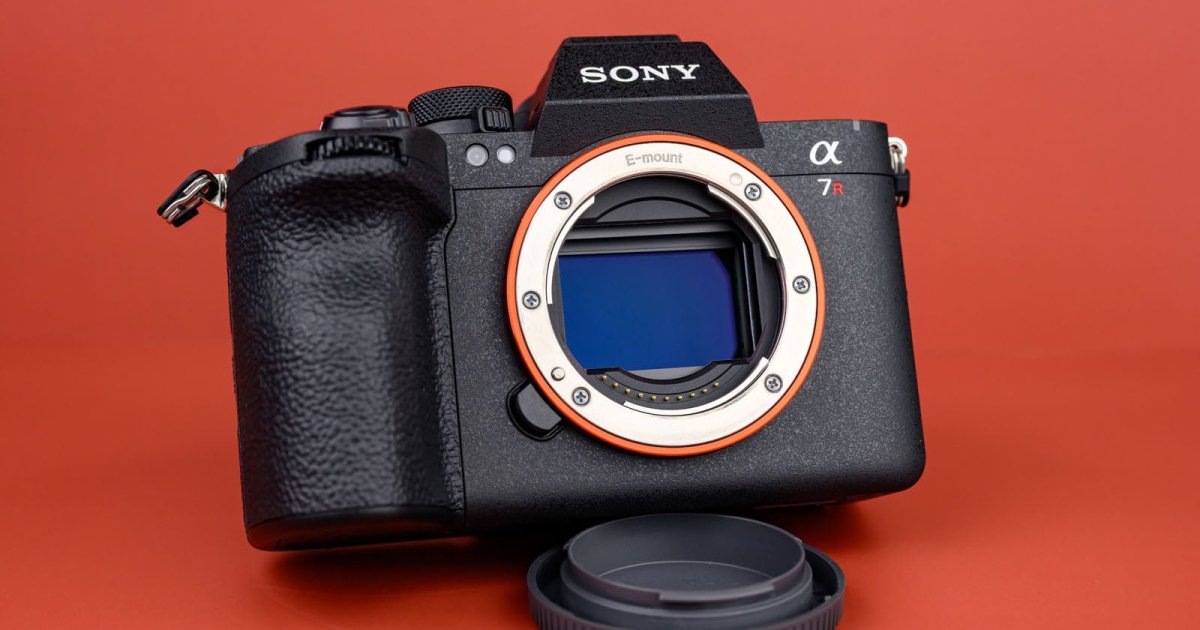
There’s a new dynamic range champ, the Sony a7R VI.
Bill Claff of Photons to Photos has published his highly anticipated Sony a7R VI dynamic range results for both its mechanical and electronic shutter, and the numbers are extremely impressive.
When using its mechanical shutter, the Sony a7R VI tops out at a class-leading 12.55 PDR on Claff’s charts. This base ISO (100) result is essentially matched by the a7R VI’s performance at its extended ISO 50 setting, although the simulated ISO 64 and ISO 80 numbers are demonstrably inferior to both.
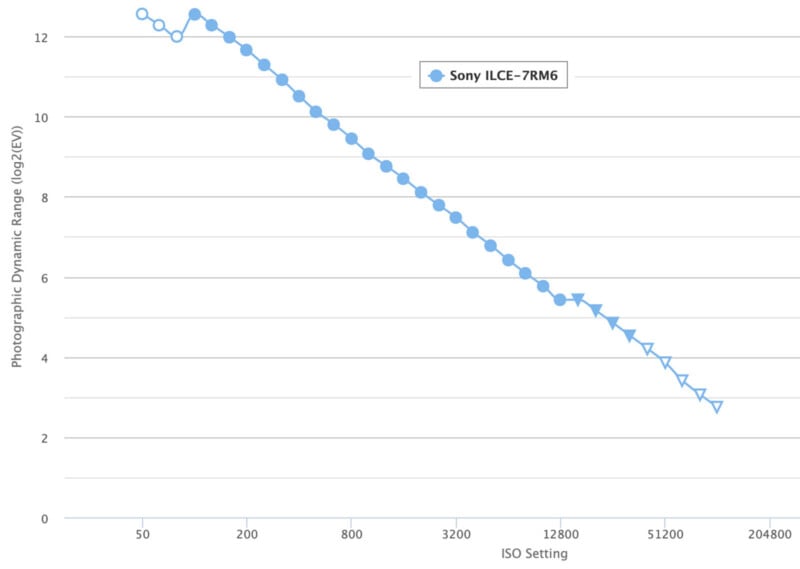 Sony a7R VI dynamic range | Image credit: Bill Claff (Photons to Photos)
A 12.55 photographic dynamic range (PDR) score is not just better than the superb a7R V by 0.86, nearly a full stop, but better than every other full-frame camera on Photons to Photos, at least when used normally. The Sony a7R III’s pixel-shift multi-shot mode (PSMS) still tops the charts at 12.79, but this mode is very limited in its practical applications, requires a tripod and external software, and only works with stationary subjects.
These results align with what PetaPixel found during its Sony a7R VI Review, as we observed about a little less than a stop better dynamic range.
“The Sony a7R V, amazing dynamic range. No complaints,” Chris Niccolls said. “Love that sensor, love the ability to be able to push shadows. But we are getting a dynamic range improvement over the older a7R V.”
While it is normal to expect a high-end camera like the a7R VI to outperform its predecessor, that is not always the case, especially when a new model makes the jump to a fully stacked image sensor. Historically, this sensor architecture, while significantly more performant and faster overall, offers similar or even worse dynamic range than a more traditional backside-illuminated CMOS like the one in the a7R V.
So the a7R VI has more megapixels (66.8 versus 61), faster sensor readout, and better burst-shooting performance, while also delivering a significant boost in dynamic range compared to the a7R V. So what’s the catch?
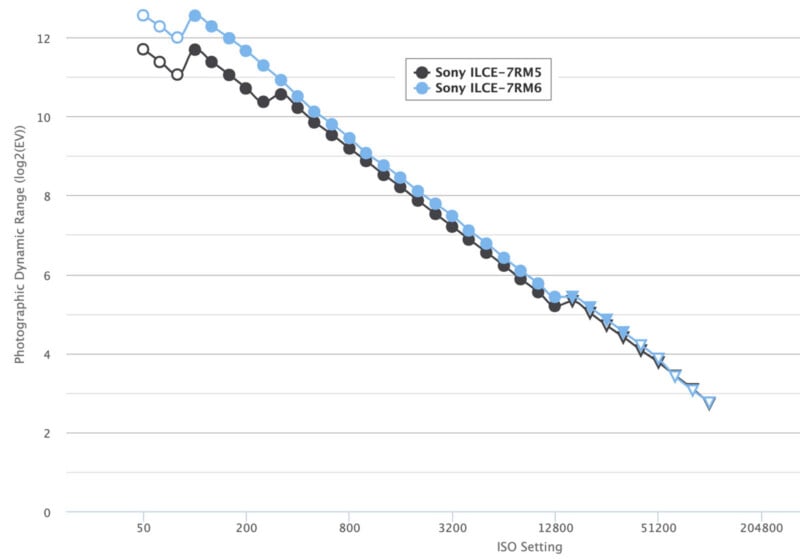 Sony a7R VI (blue) versus Sony a7R V (black) dynamic range | Image credit: Bill Claff (Photons to Photos)
Well, there isn’t really one. The a7R VI’s dynamic range is superb at base and low ISO settings when using the mechanical shutter, and remains very good as ISO increases. However, it loses its sizable dynamic-range advantage over the a7R V as ISO rises to 400 and beyond. It is worth noting as well that the a7R VI, with its mechanical shutter, can shoot 14-bit lossless RAW files at 10 frames per second, while the a7R V dropped the bit depth to 12 at 10 fps.
 Sony a7R VI sample, ISO 100
The a7R VI is most likely utilizing a form of Dual Gain Output (DGO) with its mechanical shutter, meaning it is combining two readouts of a single exposure at different ISO settings. Unfortunately, DGO and all its benefits are not available with the electronic shutter, so what happens with the a7R VI’s dynamic range performance in this case?
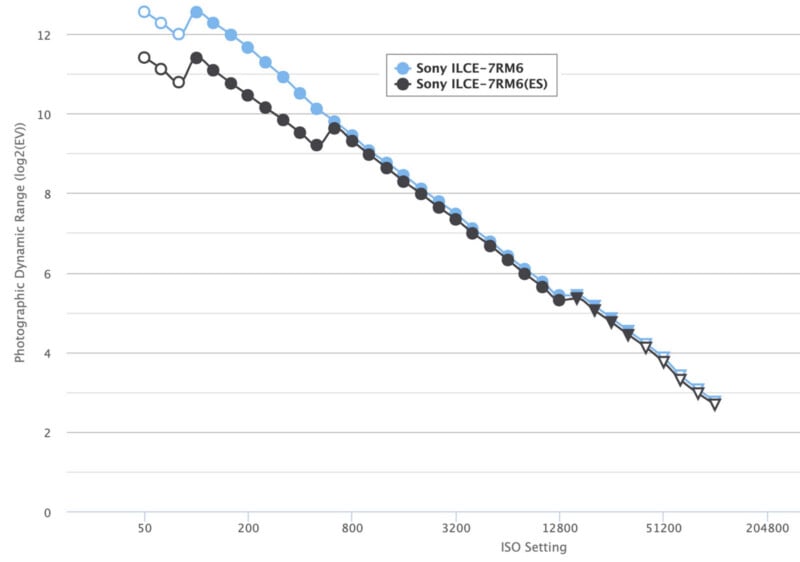 Sony a7R VI mechanical shutter (blue) versus electronic shutter (black) dynamic range | Image credit: Bill Claff (Photons to Photos)
As expected, the camera takes a notable hit to dynamic range with its electronic shutter. At base ISO, the a7R VI loses just over a stop of dynamic range when using its electronic shutter. However, that still leaves it at 11.4 PDR, very similar to the Canon EOS R5 II’s peak 11.45 PDR with its mechanical shutter.
 The Sony a7R VI’s dynamic range is still plenty good with the electronic shutter. | ISO 1250
By ISO 640, the mechanical and electronic shutters deliver nearly identical photographic dynamic range on the a7R VI, which possibly suggests how its assumed DGO technology is working. As a point of comparison, the a7 V’s shutter types, the first Sony camera to implement this type of technology, overlap starting at around ISO 1000.
As PetaPixel said in its a7R VI Review, when photographers require the faster shooting speeds enabled by the electronic shutter, they should use it. The dynamic range penalty exists, but is not that severe, and the dynamic range is still excellent either way. In situations where the ISO is at 640 or higher, which is often the case in action photography, there is no dynamic range penalty to using the electronic shutter.
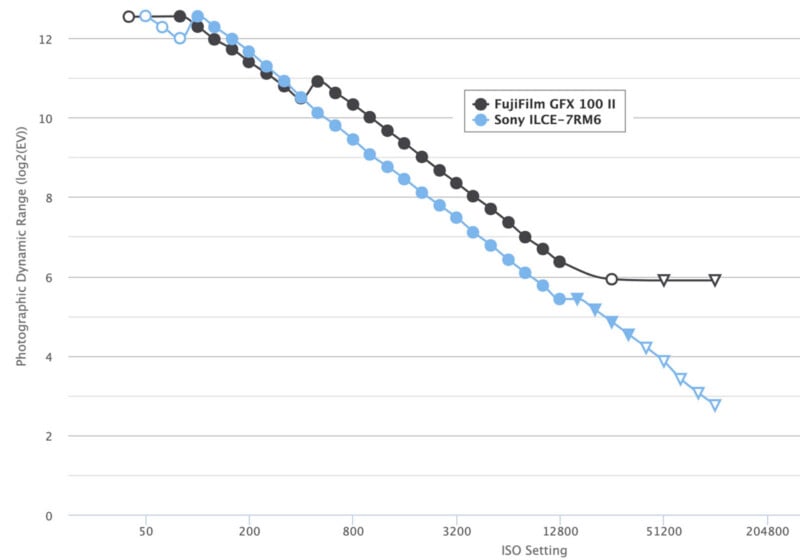 Sony a7R VI (blue) versus Fujifilm GFX100 II (black) dynamic range | Image credit: Bill Claff (Photons to Photos)
The primary takeaways here are as follows. The Sony a7R VI offers the best peak photographic dynamic range of any full-frame camera ever made. At base ISO, its performance is exceptional and nearly identical to that of the 100-megapixel medium-format Fujifilm GFX100 II. Photographers can hem and haw over the “medium format look,” other image quality parameters, and the advantages of 100 megapixels versus nearly 67 megapixels, but from a purely dynamic range perspective, the a7R VI is in the conversation for the best available option. And it does so for $4,500, with excellent autofocus, fast shooting, and impressive hybrid capabilities.
The Sony a7R VI also delivers yet another example of the power of DGO. Image sensor expert Adam Horshack previously told PetaPixel he expects many future cameras to employ this type of technology, and it’s easy to see why after the a7 V and a7R VI delivered such exceptional performance. It’s a serious leap forward in image quality, arguably the biggest seen in a very long time.
For those who want to get their hands on the full-frame dynamic range leader, the Sony a7R VI is now shipping.
Image credits: Charts courtesy of William J. Claff, Photons to Photos. Product photos by Erin Thomson for PetaPixel.
What's Your Reaction?
 Like
0
Like
0
 Dislike
0
Dislike
0
 Love
0
Love
0
 Funny
0
Funny
0
 Wow
0
Wow
0
 Sad
0
Sad
0
 Angry
0
Angry
0












Comments (0)