

‘The Uprising’ Review: Paul Greengrass Turns the Peasants’ Revolt of 1381 Into an Unapologetic Work of 21st Century Populism
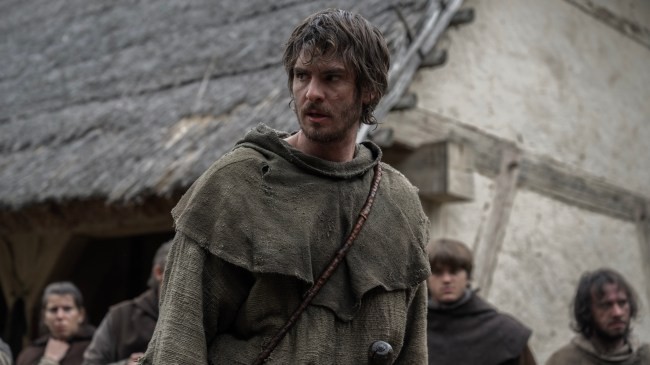
“The Uprising” would have been a challenging film to review if the Focus Features marketing team hadn’t done critics the enormous service of turning its big twist into a tagline. When its first trailer dropped, Paul Greengrass‘ film about the Peasants Revolt of 1381 had all the makings of a standard historical epic. Greengrass’ knack for turning history into set pieces has been well-documented, and it wasn’t hard to see why you’d choose this moment to make a film about a society whose brewing resentment over income inequality in the aftermath of a plague led to violence. With so much real history to work with, you’d never guess that fictional literary characters would enter the fray.


For the first two hours, straightforward history is what you get. The barren English countryside has been ravaged by a plague that killed half the population. A costly war with France has led to massive taxation of ordinary citizens, who spend their lives working land that they’ll never have a chance to own and now can barely hold onto the fruits of their labor. The overwhelming sense of trauma for the loved ones they lost in the Black Death — and even more than that, the lack of closure stemming from the Crown’s refusal to properly acknowledge their losses — created the conditions for a rebellion to arise. All it needed was the spark to light the tinder… and a crushing tax levied by a prepubescent king (Woody Norman) will certainly do that.
The rebellion was famously orchestrated by Wat Tyler (Cosmo Jarvis), but in this film the leader plays second fiddle to an anonymous farmer known only as Ploughman (Andrew Garfield). The character is a man of few words, which is understandable after an opening shot of him weeping over a large gravestone with two smaller ones beside it tells us how much he’s lost. Once the two men start working together, the combination of Ploughman’s crushing grief and Tyler’s populist rage illustrates the two factors that shaped the revolt.
The story will be well known to many Anglophiles and history geeks: peasants from neighboring villages all united to approach the king with a list of demands ranging from the utterly reasonable (sharing some of the wealth that their war efforts brought the kingdom and getting a fair shot to own some of the land they work on) to some clear overreaches (an itemized list of people that they want to behead without consequences). The idea that a mob mentality can turn even the most noble goals into bloodthirsty violence is one of the less savory constants of the human condition, and the film’s strongest moments come when it pauses its “rah-rah eat the rich” rhetoric long enough to frictions that emerge when you try to unite such a large group around any singular cause. (Though, if you’re specifically seeing the film because of its “rah-rah eat the rich” rhetoric, rest assured you’ll never have to go without for more than five minutes or so.)
Which brings us to Robin Hood.
The vast majority of “The Uprising” is a competent, straightforward recreation of a landmark historical event. A talented team of below-the-line artists recreate the drab poverty of feudal England with impressive detail, and there shouldn’t be any complaints about Greengrass’ staging of the battle sequences. The parallels to today’s world are clearly on display, but the script stops just short of hitting audiences over the head too hard.
The only problem, of course, is that the Peasants’ Revolt did not succeed. King Richard II famously feigned interest in meeting the rebels’ demands, only to squash the effort in a brutal fashion. It doesn’t make for much of a Hollywood ending, especially in a movie that clearly wants to position itself as a crowdpleaser that aligns with the economic anxieties that many people face today. So how do you salvage a happy (or at least marginally hopeful) ending without changing the actual historical events? There are worse ideas than turning your film into an origin story for one of literature’s great populist superheroes.
Yes, Ploughman eventually turns into Robin Hood. He never explicitly uses those words (he’s never been much of a name guy), but a final sequence in which he covers his face with green fabric and leads a band of forest-dwellers to rob the king with bows and arrows conveys the message. It’s a darker version of the character than we’re used to seeing — I wouldn’t characterize any of those men in Sherwood Forest as particularly merry — and the portrayal suggests that this Robin Hood’s origin story was driven just as much by desperation as principles.
It’s unclear what the larger goal was. It’s hard to imagine “The Uprising” was designed to launch a franchise, but it really plays like the kind of scene you tack on when you think there’s a world where you can make a full Robin Hood movie with Andrew Garfield. In any case, the epilogue sticks the landing and allows audiences to leave the theater feeling riled up rather than hopeless. It completes a film that’s likely to satisfy anyone sympathetic to its message, even if it has to blend history and fiction to get there.
Grade: B
A Focus Features release, “The Uprising” opens in theaters on Friday, September 10.
What's Your Reaction?
 Like
0
Like
0
 Dislike
0
Dislike
0
 Love
0
Love
0
 Funny
0
Funny
0
 Wow
0
Wow
0
 Sad
0
Sad
0
 Angry
0
Angry
0








Comments (0)