

This portable keyboard is the ultimate productivity tool - especially for Mac and PC users

pros and cons
Pros
- The build feels premium.
- It has a browser-based control panel.
- Macro and hotkey customization is extensive.
- The tactile feedback is satisfying.
Cons
- It feels slightly cramped.
- Certain symbols and keys require Fn commands.
- The touch panel is hit-or-miss.
Follow ZDNET: Add us as a preferred source on Google.
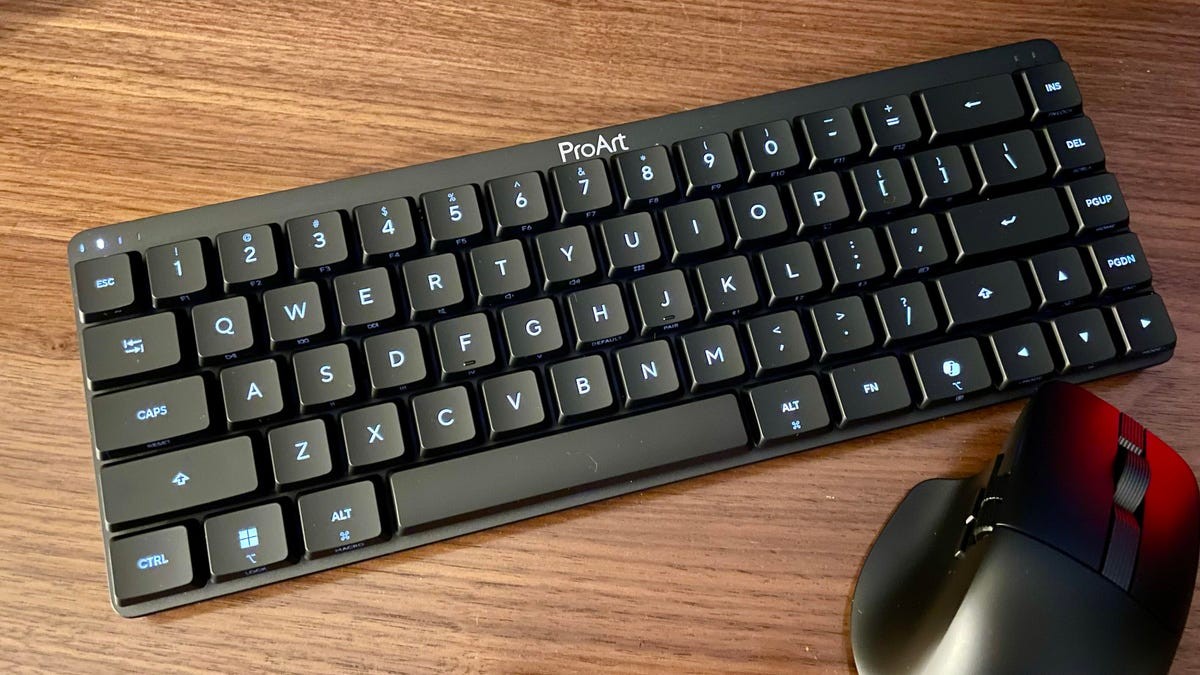
Asus' ProArt Keyboard KD300 is a compact, premium 65% keyboard designed for creators and professionals, with a customizable touch panel and satisfying, tactile keys. One of its standout features is its ability to swap between PC and Mac connectivity via a physical switch, which is notable for anyone who uses both platforms regularly.
It supports connections for up to five devices simultaneously via 2.4 GHz wireless, Bluetooth, a wired connection, or the included USB-A dongle, which slots neatly into the back of the keyboard.
Also: I was not expecting a Razer keyboard to enhance my office productivity - here's how it did
It's certainly one of the more premium compact keyboards I've tested, ideal for small desktops and anyone who needs to stay connected to multiple devices at once. But there are some trade-offs to its compact design, namely the lack of a number pad and a layout some might find a little cramped. Additionally, I've yet to fully embrace the sliding control panel, but that's more of a personal preference.
Physical build and usability
The keyboard itself measures exactly 12 inches long and a little over 4 inches deep for a particularly small desktop footprint. Asus cites this as ideal for creators who need room for other devices such as cameras or tablets, and the all-black form factor only contributes to this minimalist profile.
The build is sturdy and solid, with no flex or wobble, and the rubberized stoppers on both the kickstands and the front of the keyboard keep it stationary on the desk, even while hammering away.
I will say that the 65% form factor, along with the keyboard's size, does take a little getting used to, and at times I found it to be slightly cramped, but I am also a regular user of a full-sized mechanical keyboard. For me, this resulted in a fair amount of fat-fingering keys, as well as often hitting left Alt and moving the cursor while typing.
It has two positions: completely flat (with the board's built-in 4.5-degree angle) or at an 8° tilt with the kickstands out. The kickstands feel sturdy and solid, not at all cheap or like they could snap off.
The keys' low-profile switches feature 1 mm actuation and responsive feedback, with a very uniform feel and satisfying usability that's comparable to other premium keyboards. Asus says each key features integrated silicone dampening to mitigate sound. It's certainly on the quiet side, with an appropriate "clack," but not altogether silent.
Shortcuts and customization
If you're a creator and you want your own shortcuts, the ProArt KD300 gives you lots of options in the accompanying Gear Link control panel. Gear Link is a web-based application that automatically attempts to connect to the keyboard upon loading the site -- no downloads required -- which is about as frictionless as you can get. I'm glad to see more brands embracing browser-based control panels instead of proprietary apps, especially when those panels are well optimized.
The web-based Gear Link UI.
The amount of customization here is appropriate for creators and professionals looking to create macros or app-specific hotkeys without being too complex. You've got all the RGB lighting effects you'd expect, including individual key-by-key settings.
The touch panel is one of the first things you'll want to customize, however. By default, sliding left or right across its surface will raise or lower the volume, but it can also be assigned to scroll up and down, a myriad of multimedia commands, or more specific commands.
Also: I tried the best-looking laptop of 2026, and its battery life was the real surprise
I found reaching to the top left corner of a keyboard for media controls takes some getting used to. The panel is responsive, but it's not exceedingly precise, as the nodes respond best to movement over them, not just touch.
Additionally, reaching up there to scroll up and down on a page, for example, doesn't seem very intuitive to me personally, but I can see the applications for users who don't want to take their hands off the keyboard while editing video or images in Adobe Photoshop or Premiere, for example.
Connectivity and battery
Swapping the keyboard between devices is done by tapping the button on the far left corner of the board, next to the touch panel. The white bar LEDs each correspond to a different connection, allowing you to tell at a glance which device it's currently connected to (as long as you can remember which light corresponds to which device).
As mentioned, the physical PC/Mac switch makes it a solid choice for anyone who uses both platforms. I tested this out by connecting the keyboard to my ThinkPad and MacBook Air M5, and it works like a charm.
Also: 7 WFH gadgets that seriously improved my workflow (and they're on sale)
Regarding the battery, Asus cites up to 16 months on one charge, which seems like an absurdly long amount of time, but that metric certainly assumes no RGB lighting effects. With normal lighting settings and daily use, I would expect a quarter of that number on one charge.
ZDNET's buying advice
The Asus ProArt KD300 is a premium keyboard for creators and professionals seeking a minimal footprint. At 12 inches long, it takes up very little space on a desktop, and its black Aerolite form factor is sleek and minimalist. There's just enough customization with the web-based Gear Link control panel, and the keyboard's build is worth the $165 price.
I'd recommend it in particular to users who want one keyboard that can swap between a PC and Mac with the press of a button, as its multipoint connectivity is one of its strongest features.
What's Your Reaction?
 Like
0
Like
0
 Dislike
0
Dislike
0
 Love
0
Love
0
 Funny
0
Funny
0
 Wow
0
Wow
0
 Sad
0
Sad
0
 Angry
0
Angry
0










Comments (0)