

‘Union Town’ Review: Barbara Kopple Returns to Her Labor Roots by Unevenly Covering the Plight of New York Delivery Workers
In 1973, Barbara Kopple and a small team traveled to Harlan County, Kentucky to chronicle the Brookside miners’ strike against the Duke Power Company. She integrated herself into the community for over three years and witnessed peaceful demonstrations, violent retribution, and a hard-won solidarity amongst minders that stemmed from decades of poor health and a low standard of living. Her footage eventually comprised “Harlan County USA,” which won the Best Documentary Oscar in 1976.
Twenty years later, Kopple embedded herself in Austin, Minnesota and covered the strike against the Hormel meatpacking plant enacted by 1,500 unionized workers, who had recently shouldered a significant wage decrease and benefit cut. Unlike the Brookside miners, whose strike was a relative success, the Hormel workers, who pursued their fight against management without the support of their parent union, were unsuccessful. Their failure was perceived as part of a pattern of significant blows to union power during the Reagan era. Kopple’s 1990 film about the Hormel strike, “American Dream,” also won the Oscar for Best Documentary.


With her latest film, “Union Town,” Kopple once again turns her eye to the cause of American organized labor, at a time when class stratification has hardened, and billionaires and the corporate class have accumulated unprecedented social and political power. Workers have struggled to make significant gains post-Reagan, but class consciousness has increased amongst their ranks. In short, it’s a perfect time for Kopple to return to her roots.
Sadly, “Union Town” doesn’t live up to the heights of the previous two films in her informal strike trilogy. While Kopple’s righteous politics, her sympathetic view of both the palpable and invisible plight of the oppressed, and her unwavering appreciation of the overlooked women on the frontlines remains intact, the diffuse nature of the film’s setting (New York City) and its attendant labor struggles makes the film feel dramatically uncentered. Despite Kopple’s access, the on-the-ground intimacy of the previous two features have been replaced by a slickly filmed bird’s eye survey.
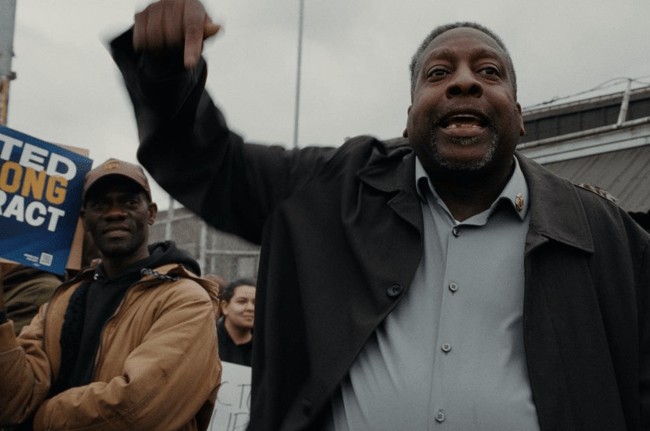
Granted, the workers at the heart of “Union Town” aren’t limited to a singular coal mine or factory. Kopple turns her eyes to delivery workers whose job takes them all over the city, whether they’re in a truck on a bike. The film begins in 2023 when the International Brotherhood of Teamsters threatened a nationwide strike against UPS if the company didn’t increase wages for full-time employees, add air conditioning to new trucks, and raise the minimum pay for part-time workers. Kopple follows Teamster Local 804, which represents unionized UPS workers in the New York area, and the efforts of shop steward and full-time organizer Antonio Rosario to rally workers. UPS narrowly avoided a strike by providing the Teamsters with their best contract in decades, partly due to the media rabble-rousing by IBT president Sean O’Brien.
“Union Town” then shifts its energy towards an Amazon warehouse in Maspeth, Queens where workers are trying to organize the shop. After one of the drivers is fired for his union activity, the warehouse slowly coheres around voting to become part of the Teamsters Union. Alongside Rosario and the Local 804, Amazon employees plan a shutdown a week before Christmas to fight for better pay and baseline safety standards.
Kopple partly picks up where Brett Story and Stephen Maing’s “Union” left off with regards to the Amazon union fight, highlighting both the workers’ campaign for their dignity and management’s callous hostility towards them. “Union Town” neatly connects the UPS and Amazon fights as two sides of the same coin by illustrating how the same cost-cutting strategies are deployed by both companies against their workers, including punishing schedules and financial incentives to sacrifice one’s health. “We like labor work,” one employee says. “We just want it to be fair.”
“Union Town” fares much better when it turns its focus towards the micro stories within its large narrative. A UPS driver who’s forced to sleep in his car so he can make an eight-hour-per-day wage still finds time to sit a garden to briefly center himself. An Amazon subcontracted delivery driver marvels at the company’s surveillance of his work combined with their hands-off attitude towards any liability. (Recently proposed legislation has been introduced in New York City council to force companies like Amazon to directly employ delivery drivers instead of relying upon subcontractors.)
The best subplot involves a new, young part-time UPS worker who challenges the Teamster party line involving the UPS contract. She encourages her fellow workers to vote “No” so they can agitate for a $25 minimum pay for part-time workers and faces fairly aggressive opposition from the union brass. The antagonism she faces from the union establishment in informal settings as well as official meetings demonstrates the limitations of intra-organization dissent and the ingrained bias against younger employees.
Alongside the Teamsters struggles, “Union Town” also enters the realm of app-based delivery bikers who face myriad obstacles in their employ, particularly deactivations by companies like DoorDash that effectively function as soft firings. Kopple follows the Workers Justice Project and Los Deliveristas Unidos as they battle against corporate wage theft and for the physical safety of their bikers, some of whom have suffered grievous injuries and even death simply by going to work amidst reckless drivers and dangerous weather.
While the workplace struggles of UPS drivers, Amazon warehouse workers, and app-based bikers are obviously connected, “Union Town” struggles to integrate the latter into the film’s framework, contributing to a generally uneven tone. Partially because of the geographical distance between them and the Teamster fight, the WJP and Deliverista organizer story dramatically feels like it’s in a separate film altogether. Similarly, the hazards New York City bikers face exist in a slightly different category than those of unionized truck drivers and warehouse employees. (Simply put, the chaos of traffic and weather sans the meager protection of four doors exponentially impacts worker welfare.) By intercutting between their struggle and the Teamster/Amazon debacle, which feels moderately more localized by comparison, the app-based bikers receive somewhat of a short shrift in the overall picture.
Kopple also understandably expands the scope of her film to incorporate recent tumultuous political history. Due to the film’s sprawling remit and compressed structure, “Union Town” treats the 2024 presidential election and the subsequent nationwide threat of ICE raids like boxes to be checked, which has some noticeable drawbacks. Kopple acknowledges, and then quickly moves on from, the irony of the Teamsters’ overwhelming support for Trump, and then doesn’t address O’Brien’s unprecedented decision to speak at the Republican National Convention. The diminished safety of immigrant delivery drivers, who already exist in precarious societal positions, is also briefly touched upon before “Union Town” returns to its main narrative. Though there are worse artistic crimes than biting off more than one can chew, “Union Town” ultimately suffers from scattered focus, which, despite Kopple’s clear investment in the material, lends it a vaguely impersonal feel.
The film’s modest detachment possibly stems from its unique setting: fairly or not, New York City tends to be treated by the media like a microcosm of American business elites, which makes it difficult for “Union Town” to ground its subject in regional specificity. But it also might be a result of the modern attention economy where it’s tough to make one’s voice heard, and companies are largely indifferent to negative optics. Years after the events of “Harlan County USA,” one of the striking miners said that Kopple’s presence not only limited the level of violence management waged against labor but also effectively pressured it to come to the bargaining table. As much as Kopple celebrates her subjects’ hard-won victories in “Union Town,” it’s unlikely that her film will rattle the C-suites of UPS, Amazon, or any of the online food ordering companies, if they even notice. The fight she documents is pivotal and momentous, but it might be too big for one documentary to tackle.
Grade: B-
“Union Town” premiered at the 2026 Venice International Film Festival. It is currently seeking U.S. distribution.
What's Your Reaction?
 Like
0
Like
0
 Dislike
0
Dislike
0
 Love
0
Love
0
 Funny
0
Funny
0
 Wow
0
Wow
0
 Sad
0
Sad
0
 Angry
0
Angry
0










Comments (0)