

US moves to cut China’s remote access to AI chips
Trump bets China won’t mind US blocking remote access to AI chips.
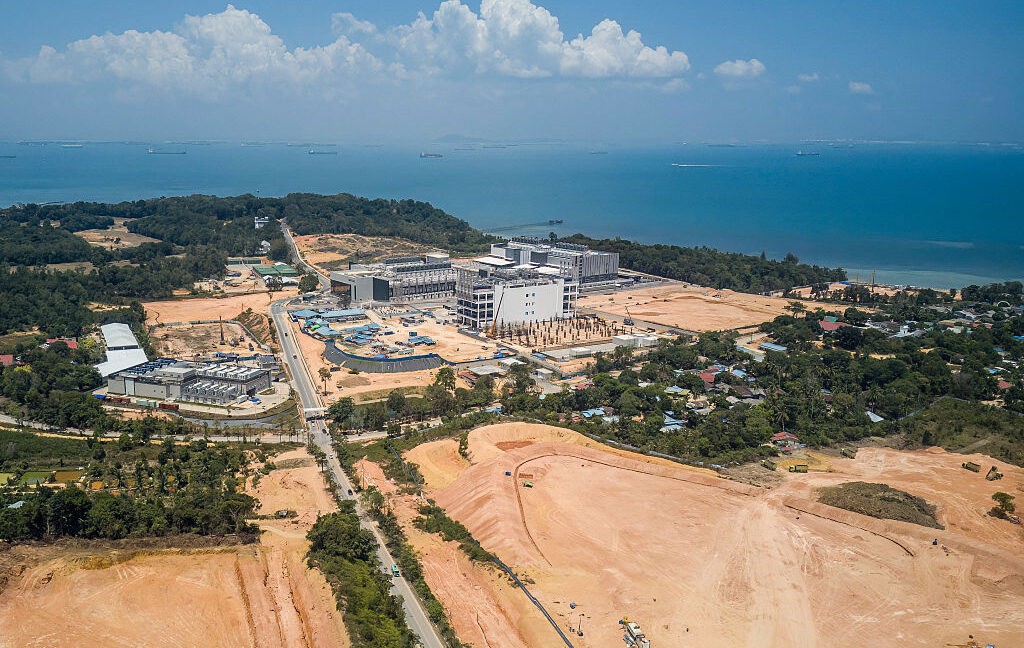
This aerial picture shows the Nongsa Digital Park (NDP) area, a hub for AI data center development, in Indonesia. Credit: ANDARU / Contributor | AFP
On the heels of the Nvidia scandal, the Trump administration is preparing to crack down on foreign data centers that are fueling China’s advancements in artificial intelligence by allowing remote access to otherwise restricted high-end chips necessary for AI training.
In a summary of the rule change, the Commerce Department said it was closing a loophole that previously allowed foreign rivals like China, Russia, and Iran to bypass export curbs on certain advanced computer chips by instead renting access to those chips from data centers in Indonesia, Malaysia, Singapore, Thailand, and Brazil.
US rivals could possibly use that access to train and run advanced AI models “capable of supporting military- and intelligence-related activities that could threaten US national security or foreign policy interests,” the Commerce Department said. Among threats, the US fears rivals could use advanced AI to develop “more effective weapons of mass destruction and advanced conventional weapons, coordinated cyber-espionage and targeted cyber-disruption, algorithmic theft, and weaponized disinformation.”
Now, the rules have been tightened up so much that the South China Morning Post reported that, “as a result, any advanced chips made for a Chinese firm are assumed to be restricted, and factories must ask the US government for a license before shipping them.”
The rule change takes effect 90 days after it’s posted to the Federal Register. Moving forward, companies headquartered in any of those countries deemed to “present a higher-than-normal risk of diversion” to China, Russia, and Iran must apply for a license with strict know-your-customer controls when transferring high volumes of advanced chips. If a license is granted, companies will have to “perform robust due diligence,” submitting monthly reports on transactions that thoroughly detail all parties involved, as well as their parent companies, and the final destination for chips sold.
In a press release Sunday, the Commerce Department described the rule change as “designed to ensure that existing restrictions on access to sensitive American technology cannot be circumvented through remote computing arrangements involving data centers in third countries.” An exception was carved out for companies providing computing power “exclusively used for commercial recommender systems.” The Department said it was acting to “prevent certain foreign actors from leveraging advanced computing power based on US technology to threaten US national security and foreign policy interests.”
Without the intervention, officials fear that China could develop a military or economic edge, The New York Times reported.
Trump officials clash on new rule
Nvidia CEO Jensen Huang resigned after admitting to an affair with a woman, Alice Huang, suspected of serving as a Chinese spy. Congress is probing if Alice Huang used her personal relationship with Jensen Huang to help her former company, Megaspeed, become one of Nvidia’s biggest customers, then used that position to smuggle Nvidia’s restricted AI chips into China. China has denied that Alice Huang was a spy, and Megaspeed has denied that smuggling occurred, while launching its own internal probe.
Megaspeed is a Singaporean data center firm whose primary business is cloud computing and AI infrastructure. Prior to the rule change, selling remote access to AI servers to customers in China was perfectly legal, NYT noted. But now, the Commerce Department has given firms like Megaspeed 90 days to either obtain licenses or face future export restrictions.
Whether or not to add more chip curbs has been a polarizing debate in the Trump administration. Treasury Secretary Scott Bessent reportedly butted heads with Commerce Secretary Howard Lutnick. When the Megaspeed news broke, Bessent pushed for curbs, but Lutnick reportedly appeared “too cozy” with Nvidia to move. Instead, Lutnick initially favored looser controls that Nvidia claimed would ensure global dominance of US technology. (A Commerce Department spokesperson told NYT that Bessent has never confronted Lutnick over his handling of Megaspeed.)
Any companies found violating the rules could face a “range of consequences,” the Commerce Department said after reportedly bending to Bessent’s pressure campaign. Those include possibly facing new import restrictions, stricter license requirements, downgrading their status in the US export control regime, or other changes to their company’s or their base country’s entity-list designations.
New rule may not be aggressively enforced
Although the summary of the rule change said that “Commerce will be actively monitoring for countries that tolerate evasion” of the anti-diversion policy, it’s unclear how aggressively the Commerce Department might enforce the rule, NYT noted.
Bessent has publicly criticized Lutnick for failing to sanction Megaspeed, and NYT reported that ultimately, enforcement of the stricter rules—which Bessent helped draft—“would be up to the Commerce Department.”
“The real story here should be: Did Nvidia know their client, and was there a robust effort at Nvidia to make sure that there was no leakage and that they were selling to what were obviously pass-through shell companies?” Bessent said on a CNBC appearance. “I think it’s important that anyone at the company there be held accountable for that.”
There’s even a push to oust Lutnick over his position on chips, but The Guardian reported that Donald Trump confirmed he has no plans to replace the AI industry-friendly commerce secretary. On Monday, Trump told reporters that Lutnick was right to delay blacklisting Megaspeed, because “if you didn’t delay it… you could have a blow-up with China.”
At the press gaggle, Trump aligned with China in saying that there’s no evidence yet that Alice Huang was a spy. He also joined a band of prominent tech leaders calling for Jensen Huang’s return to Nvidia, saying that it wasn’t a “bad idea.”
“Nobody’s proven that she’s a spy,” Trump said. “She may not be a spy.”
However, US investigators have alleged that they found “Alice Huang used industry contacts and a series of shell companies to access 240,000 chips banned for export into China,” CBS News reported.
Trump thinks China won’t react to rule change
China is unlikely to welcome the new rules, as it has consistently accused the US of fabricating the spying claims to justify imposing additional chip restrictions.
However, a senior Trump official, granted anonymity to discuss sensitive policy matters, told the NYT that Trump “did not expect countermeasures from China in response.”
Trump will be in China for an economic summit this week, including a meeting with Chinese President Xi Jinping. The new curbs could potentially disrupt those talks, according to Hong Yuan, a researcher and secretary-general of the Center for American Military Studies at the Chinese Academy of Social Sciences. Hong told the People’s Daily that China will likely view the rule change as politically motivated.
“Before any judicial causality was established, Washington handed down a political conviction, substituting suspicion for proof, espionage for personal contact, and an industrial embargo for private conduct,” Hong said. “The issue is not the cause of tighter controls, but a political catalyst.”
The new policy could hurt the US, experts told the Chinese outlets. Analysts told the South China Morning Post that the policy could “accelerate Chinese companies’ shift to domestic AI chips.” Other experts told the People’s Daily—which is the official newspaper of the Chinese Communist Party—that “the cost of switching back to US platforms will rise” over time. If that happened, it could potentially lock in Chinese technology over America’s in “the world’s largest single consumer market for chips,” experts said.
Sun Chenghao, senior fellow at the Center for International Security and Strategy at Tsinghua University in Beijing, told the People’s Daily that “what US companies stand to lose could be customers and technological influence for years to come.”

Ashley is a senior policy reporter for Ars Technica, dedicated to tracking social impacts of emerging policies and new technologies. She is a Chicago-based journalist with 20 years of experience.
What's Your Reaction?
 Like
0
 Dislike
0
 Love
0
 Funny
0
 Wow
0
 Sad
0
 Angry
0







Comments (0)