

Vincent Price Is the Weirdest Serial Killer Ever in this '70s Cult Classic

Published Oct 25, 2026, 6:00 AM EDT
Tremble before The Abominable Dr. Phibes
 Image: Everett Collection
A hooded figure emerges slowly from the floor of a cavernous art-deco space — supposedly the hallway of his house, although it looks like a theater stage. He dramatically plays an organ mounted on a hydraulic platform. The organ is flanked by a sinister clockwork jazz band with papier-mâché heads. The hooded figure sets the band in motion and a beautiful young woman appears in a fantastical white gown. The pair dance together in courtly fashion. Then they go and murder a guy by lowering a cage full of ravenous bats into his bedroom through a skylight. The bats eat the man alive. The woman and the hooded man return home and he plays his organ again, sinking slowly into the floor.
We are 10 minutes into The Abominable Dr. Phibes, and nobody has spoken a word. Robert Fuest’s 1971 horror film is a surreal, kitsch, and intentionally funny murder-museum of a movie. But it's also dreamlike and deeply strange in a way that lingers after you've watched it.
The hooded figure will turn out to be Vincent Price, the stately star of horror cinema's most lurid and campy era. Unlike his friends and peers Peter Cushing and Christopher Lee, Price never appeared in a production by Hammer, the legendary British horror studio; his career followed a parallel American track in Roger Corman's Edgar Allen Poe adaptations. But by the late '60s, Price was appearing in British productions that were pushing Hammer's technicolor horror style in weird new directions, like the brutally grim Witchfinder General.
 Image: Everett Collection
The Abominable Dr. Phibes belongs at the other end of the scale. It's a fantasia and a black comedy, although Price plays it dead straight, with mournful solemnity. He is Dr. Anton Phibes, a concert musician and theologian who, in 1920s London, resolves to murder every member of the medical team whose botched surgical procedure killed his beloved wife.
Phibes himself was disfigured in a terrible car accident, and wears an immovable prosthetic of his own head; simple makeup and Price's committed performance turn his familiar face into a ghastly death mask. He rarely speaks, and when he does, it's through a tube that he runs between his neck and a gramophone contraption. Price never opens his mouth, but flexes his jaw while his inimitable voice emerges from the machine, scratchy and distant, as if from another time. It's absurd and haunting at the same time.
There is no explaining this character. Why does he have a clockwork jazz band and an organ elevator? Who is the woman, Vulnavia, who bears a resemblance to his dead wife but with whom he never speaks, and whose relationship to Phibes seems to be that of a deadly magician's assistant? Why does he decide to model his murders after the 10 Plagues of Egypt leveled on the Pharaoh by God for keeping the Israelites in bondage? Why, after each killing, does he melt a wax effigy of the victim's head with a blowtorch?
 Image: Everett Collection
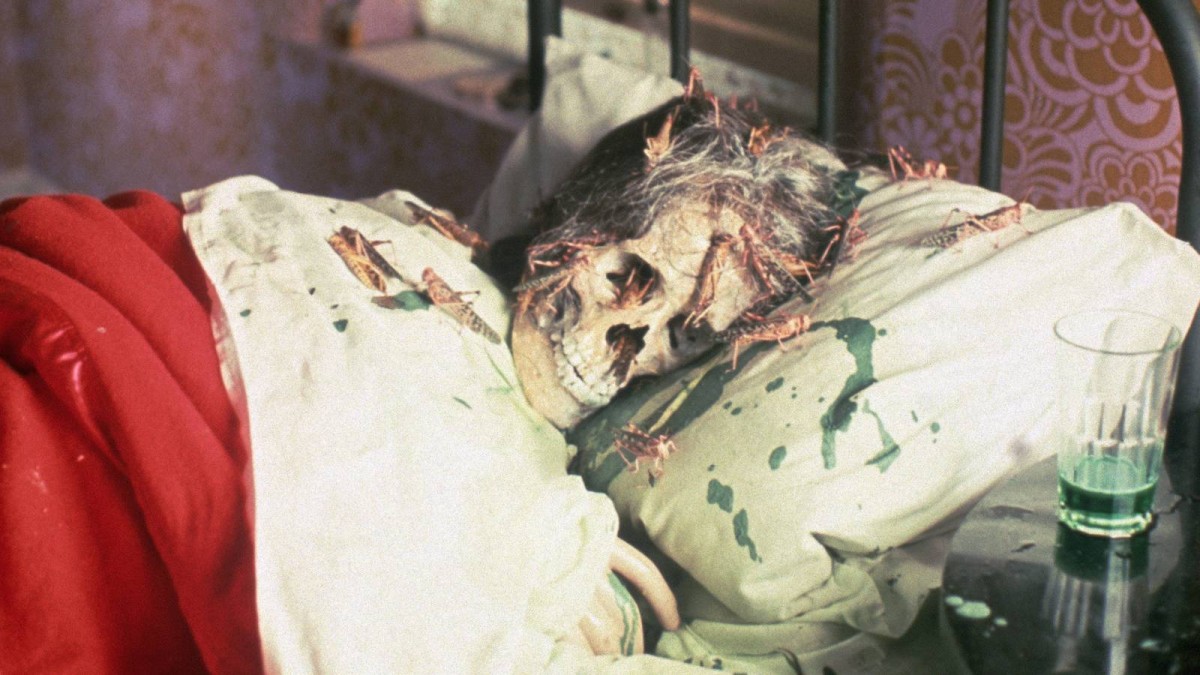
The Abominable Dr. Phibes answers none of these questions, and it's all the better for it. The movie plays out as a series of elaborate traps, like a Vaudevillian version of Seven or Saw. Phibes boils cabbages down into a green gloop that he pours through a hole in the ceiling onto one victim's head so that it will be devoured by locusts. (Things are always being lowered through ceilings and floors in this movie.) He somehow gets from Hebrew scripture to impaling one guy with a brass unicorn fired out of a catapult.
All this silliness is relayed by director Robert Fuest with visual panache but a strangely flat, deadpan tone that doesn't distinguish between Phibes' macabre murders, his bizarre rituals, or the bumbling attempts of an uninspired police detective (Peter Jeffrey as Inspector Harry Trout) to catch him. Citizen Kane's Joseph Cotten appears as one of the surgeons, and he and Jeffrey are the nominal heroes of the movie. But as with most of the Hammer-era stuff, Price's monster is the true protagonist.
Dr. Phibes is utterly bizarre, hilariously cruel, and desperately sad. When, at the end, you find out what's in the basement his organ elevator leads to, The Abominable Dr. Phibes' strange waxwork parade acquires a poignant pathos — a sad, trapped feeling that, you realize, has been in Price's eyes from the very start.
What's Your Reaction?
 Like
0
 Dislike
0
 Love
0
 Funny
0
 Wow
0
 Sad
0
 Angry
0









Comments (0)